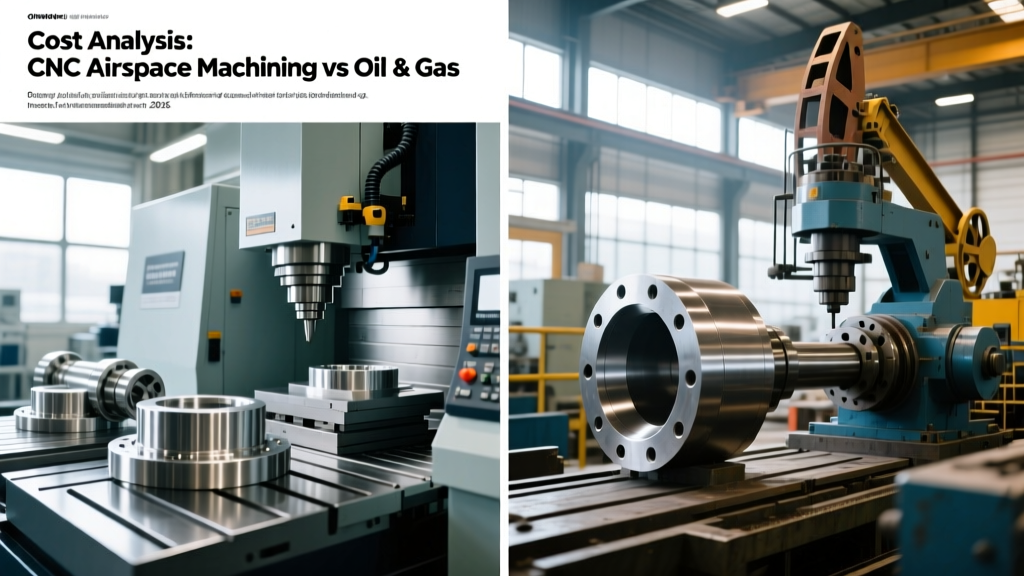
Cost Analysis: CNC Aerospace Machining vs Oil & Gas
Compare CNC aerospace machining costs with oil & gas component production. Optimize your 2026 budget for Inconel valves, manifolds, and API 6A parts.
Procurement teams sourcing high-pressure oil and gas (O&G) components often receive quotes from machine shops heavily entrenched in CNC aerospace machining. While these shops possess elite 5-axis capabilities, rigorous quality management systems, and advanced metrology labs, applying aerospace cost structures to O&G valves, manifolds, and Christmas tree components can inflate budgets by 30% to 50%. The fundamental divergence lies in material behavior, tolerance requirements, and inspection protocols. This cost analysis dissects the financial differences between aerospace and O&G production machining, providing a concrete framework to optimize your 2026 component budget.
Material Cost & Tool Wear: O&G Superalloys vs. Aerospace Alloys
The baseline material costs and machining characteristics dictate the hourly output and tooling budget. Aerospace shops frequently work with Titanium (Ti-6Al-4V) and high-strength aluminum (7075-T6). O&G components, governed by AMPP (formerly NACE) MR0175 standards for sour gas environments, rely heavily on Nickel-based superalloys and Duplex stainless steels.
| Material | Primary Industry | Raw Cost (per lb) | Machinability | Tool Wear Factor |
|---|---|---|---|---|
| Inconel 718 | Oil & Gas (Valves) | $45 - $60 | ~15% | Severe (Work-hardening) |
| Super Duplex 2507 | Oil & Gas (Manifolds) | $25 - $35 | ~25% | High (Abrasive carbides) |
| Ti-6Al-4V | Aerospace (Structural) | $35 - $50 | ~25% | Moderate (Heat retention) |
| Al 7075-T6 | Aerospace (Airframes) | $4 - $6 | ~120% | Minimal |
Machining Inconel 718 for an O&G wellhead component eats carbide inserts at up to three times the rate of aerospace titanium. Inconel rapidly work-hardens and requires high-pressure coolant (HPC) at 1,000+ PSI to break chips and prevent built-up edge (BUE). If an aerospace shop quotes an O&G Inconel manifold using their standard titanium tooling wear algorithms and relies on standard flood coolant, tool life drops by 70%. This inevitably leads to mid-run upcharges or blown tooling budgets. When reviewing quotes, ensure the shop has explicitly allocated budget for specialized PVD-coated carbide or ceramic inserts, such as the Sandvik Coromant CoroMill 390 series designed specifically for superalloys.
The Tolerance Trap: API 6A vs. AS9100 Inspection Costs
WARNING: Over-Inspection Budget DrainApplying AS9100 Rev D First Article Inspection (FAI) protocols to an API 6A O&G part is a primary source of wasted capital. Aerospace FAI per AS9102 requires balloon-marking every dimension on the drawing and recording it on a comprehensive 3-page form. For a complex O&G valve body with 150+ dimensions, this adds 6 to 8 hours of CMM (Coordinate Measuring Machine) programming and inspection time, costing an extra $900 to $1,200 per batch. API 6A standards primarily require strict verification only on critical sealing features, such as ring groove depths and angles.
Many machine shops default to their highest quality standard across all jobs to simplify their Quality Management System (QMS). If you do not explicitly define the inspection criteria in your Request for Quote (RFQ), an aerospace-focused shop will charge you for aerospace-level metrology on non-critical O&G features. Specify that non-mating flange faces and standard bolt hole patterns be held to standard machining tolerances (e.g., +/- 0.005 inches) and verified via standard shop-floor gauging, reserving the Zeiss CONTURA CMM strictly for the API ring grooves and internal sealing bores.
Machine Hour Rates: Mill-Turn Centers vs. Standard VMCs
Complex aerospace airfoils and turbine blisks often mandate simultaneous 5-axis machining or advanced mill-turn centers. Consequently, shops specializing in CNC aerospace machining heavily utilize flagship machines like the DMG MORI NTX 2000 mill-turn center, which commands a shop rate of $180 to $220 per hour in 2026. Conversely, many O&G components, such as standard flanges, cross-overs, and simple valve bodies, can be fully machined on a 4-axis Vertical Machining Center (VMC) like the Haas VF-4SS, which operates at $85 to $105 per hour.
Step-by-Step RFQ Optimization Framework
To prevent paying a 120% premium on machine hours unnecessarily, structure your O&G procurement strategy using the following framework:
- Audit the Geometry: Identify if the O&G component truly requires 5-axis contouring or if a 4-axis VMC with a rotary table and custom fixturing can access all necessary features.
- Specify the Machine Class: In your RFQ, explicitly request pricing based on a 4-axis VMC or 3-axis turning center with live tooling, rather than leaving the machine selection to the shop's default aerospace workflow.
- Separate Setup from Run Time: Aerospace shops often amortize high setup costs over low-volume production. For O&G production runs (50+ units), demand a bifurcated quote showing setup costs versus per-part run time to identify where machine rate inefficiencies are hiding.
- Define the QMS Scope: Explicitly reference American Petroleum Institute (API) standards in the quality section of your PO, overriding default AS9100 aerospace inspection requirements.
Sourcing Strategy: When to Hire an Aerospace Shop for O&G Parts
Despite the cost risks, there are specific scenarios where leveraging a shop with deep CNC aerospace machining expertise is financially advantageous for O&G procurement.
- Subsea Control Modules: These components feature deep, intersecting hydraulic bore networks with extreme surface finish requirements (Ra 16 or better) to prevent seal extrusion. Aerospace shops excel at deep-hole drilling and precision honing techniques originally developed for landing gear struts.
- Multiphase Flow Meter Bodies: When dealing with complex internal venturi profiles machined from solid Super Duplex 2507 forgings, the 5-axis simultaneous milling expertise found in aerospace shops reduces setup times and eliminates chatter marks that plague standard job shops.
- Prototyping New Downhole Tools: For R&D phases where design iteration is rapid, the agile CAM programming and advanced toolpath verification software (like VERICUT) standard in aerospace shops prevent catastrophic crashes in expensive O&G forgings.
By understanding the inherent cost drivers of CNC aerospace machining—specifically the tooling algorithms, metrology overhead, and machine hour rates—O&G procurement teams can surgically edit RFQs to extract elite manufacturing quality without subsidizing unnecessary aerospace protocols.
Ultimately, budget planning for O&G components requires a firm grasp of where precision adds value and where it merely adds cost. Aligning your inspection requirements with API 6A, mandating appropriate machine classes, and verifying superalloy tooling strategies will ensure your 2026 manufacturing budget is spent on functional reliability, not overhead.