PTFE CNC Machining for Auto Aftermarket: Compliance & Safety
Explore safety standards and compliance requirements for PTFE CNC machining in automotive aftermarket parts, including DOT, SAE, and ISO certifications.
Producing high-performance components for the automotive aftermarket requires navigating a complex intersection of material science, precision manufacturing, and stringent regulatory compliance. Polytetrafluoroethylene (PTFE) is heavily specified for aftermarket applications demanding extreme chemical resistance, low friction, and high-temperature stability—such as turbocharger wastegate bushings, fuel injector seals, and brake piston guides. However, PTFE CNC machining introduces unique thermal and mechanical challenges. Failure to control these variables not only compromises part integrity but also violates critical operator safety standards and automotive regulatory frameworks.
Material Selection & Automotive Grade Compliance
Virgin PTFE is rarely suitable for high-load automotive aftermarket applications due to its inherent susceptibility to cold flow (creep) under sustained mechanical stress. To meet Society of Automotive Engineers (SAE) load-cycle testing requirements, machine shops must utilize filled PTFE compounds. Selecting the correct filler is the first step in ensuring the finished part complies with OEM and aftermarket safety standards.
| PTFE Grade | Composition | Primary Automotive Application | Compliance & Performance Benefit |
|---|---|---|---|
| Virgin PTFE | 100% Unfilled | Fuel system O-rings, low-load chemical seals | Maximum chemical inertness; meets SAE J2236 fuel compatibility. |
| Glass-Filled PTFE | 15% - 25% Fiberglass | Suspension bushings, clutch release bearings | Reduces creep by up to 10%; increases compressive strength for load-bearing compliance. |
| Carbon-Filled PTFE | 10% - 25% Carbon Fiber | Wastegate bushings, static-dissipative fuel components | Provides electrical conductivity to prevent static sparking in fuel systems; superior wear resistance. |
| Bronze-Filled PTFE | 25% - 60% Bronze | Brake caliper piston guides, heavy-duty steering seals | High thermal conductivity and extreme load capacity; meets DOT heavy-vehicle durability specs. |
Operator Safety: Mitigating Polymer Fume Fever
The most critical safety hazard in PTFE CNC machining is thermal degradation. While PTFE is highly stable at ambient temperatures, excessive heat generated during cutting operations can cause the polymer to break down. When PTFE exceeds 260°C (500°F), it begins to release toxic fluorocarbon gases, including carbonyl fluoride and hydrogen fluoride. Inhalation of these fumes causes polymer fume fever, a condition characterized by severe flu-like symptoms, respiratory distress, and pulmonary edema.
⚠️ OSHA COMPLIANCE WARNING:The Occupational Safety and Health Administration (OSHA) and the National Institute for Occupational Safety and Health (NIOSH) mandate strict Permissible Exposure Limits (PEL) for PTFE decomposition products. According to the NIOSH Pocket Guide for Polytetrafluoroethylene, shops must implement localized exhaust ventilation (LEV) directly at the CNC cutting zone. Standard shop-wide HVAC systems are insufficient for capturing sub-micron fluoropolymer particulates and gases.
To maintain compliance and protect operators, machine shops must enforce the following protocols:
- Thermal Monitoring: Use infrared thermography to monitor the cutting zone. If surface temperatures approach 200°C (392°F), feeds and speeds must be adjusted immediately.
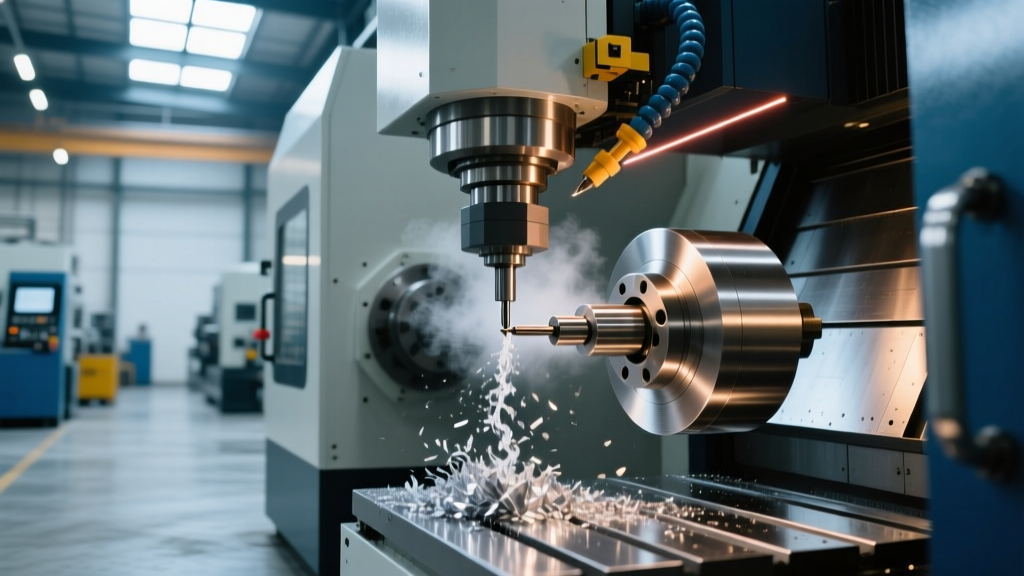
- Flood Coolant Mandate: Dry machining PTFE is strictly prohibited in production environments. A high-volume flood coolant system is required to suppress dust and evacuate heat.
- Enclosure Interlocks: CNC lathes and mills processing PTFE must feature sealed enclosures with negative pressure ventilation tied to HEPA and activated carbon filtration units.
Regulatory Frameworks for Aftermarket Auto Parts
Automotive aftermarket parts manufacturers cannot rely solely on dimensional accuracy; they must prove material and performance compliance to regulatory bodies. When contracting PTFE CNC machining services, buyers must verify the machine shop's familiarity with the following standards:
1. DOT FMVSS 106 (Brake Hoses and Seals)
For PTFE-lined stainless steel braided brake hoses and associated caliper seals, the Department of Transportation (DOT) mandates compliance with Federal Motor Vehicle Safety Standard (FMVSS) 106. This standard dictates rigorous burst pressure, tensile strength, and low-temperature flexibility tests. CNC machined PTFE end-fittings and internal seals must maintain dimensional stability under extreme hydraulic pressure spikes without extruding into the fitting gaps. Full regulatory text and testing parameters are available via the NHTSA eCFR database for FMVSS 106.
2. SAE Fluid Compatibility Standards
Aftermarket fuel and oil system components machined from PTFE must pass SAE fluid compatibility testing. While PTFE is virtually inert, the CNC machining process can leave microscopic tool marks or embedded metallic swarf (if carbide tools degrade). These anomalies can become failure points when exposed to modern aggressive fuel blends (e.g., E85 or high-sulfur diesel). Shops must utilize strict ultrasonic cleaning and passivation protocols post-machining to meet SAE J2236 and SAE J200 specifications.
3. IATF 16949 Quality Management
Any machine shop producing safety-critical PTFE components for the automotive supply chain should hold IATF 16949 certification. This global standard ensures that the shop employs Advanced Product Quality Planning (APQP) and Production Part Approval Process (PPAP) methodologies. As outlined by IATF Global Oversight, this certification guarantees that the shop tracks tool wear, material batch traceability, and statistical process control (SPC) specifically tailored to the high-expansion coefficients of fluoropolymers.
Precision Machining Parameters to Prevent Thermal Degradation
PTFE possesses a high coefficient of thermal expansion (approximately 10 times that of steel) and poor thermal conductivity. If heat is allowed to build up during CNC turning or milling, the part will expand, be machined to size, and then shrink below tolerance once it cools to room temperature. Furthermore, thermal stress compromises the polymer's molecular structure, leading to premature failure in automotive applications.
The following baseline parameters should be utilized for 5-axis CNC milling and CNC turning of filled and unfilled PTFE:
| Operation | Tooling Material & Geometry | Surface Speed (SFM) | Feed Rate (IPR / IPT) | Depth of Cut (DOC) |
|---|---|---|---|---|
| Turning (Roughing) | Carbide, 15° Pos. Rake, 10° Clearance | 300 - 500 | 0.008 - 0.015 | 0.050" - 0.100" |
| Turning (Finishing) | Carbide/Diamond, 20° Pos. Rake, High Polish | 500 - 800 | 0.002 - 0.005 | 0.005" - 0.015" |
| Milling | HSS or Carbide, 2-Flute, High Helix | 400 - 600 | 0.005 - 0.010 | Max 1/2 Tool Diameter |
| Drilling | Split-point, 118° included angle, High Polish | 200 - 300 | 0.003 - 0.008 | Peck cycle mandatory (chip clearing) |
The Critical Role of Pre-Machining Annealing
Extruded or molded PTFE stock contains significant internal residual stresses from the manufacturing process. If CNC machined in its as-received state, the removal of material will cause the part to warp or twist, rendering it non-compliant with tight automotive geometric dimensioning and tolerancing (GD&T) requirements.
Mandatory Annealing Protocol: Before any CNC cutting begins, PTFE stock must be annealed. The material is heated to 288°C (550°F) in an inert atmosphere or specialized oven, held for 2 hours per inch of thickness, and then slow-cooled at a rate not exceeding 5°C per hour. This relieves internal stresses and stabilizes the crystalline structure, ensuring that the final CNC machined automotive part maintains its dimensional integrity under the hood of a vehicle.
Quality Assurance & Traceability Protocols
In the automotive aftermarket, liability is a primary concern. A failed PTFE turbo bushing can lead to catastrophic engine over-speed, while a degraded brake seal results in total braking failure. Therefore, compliance extends beyond the physical properties of the part to the documentation surrounding it.
'A compliant PTFE automotive component is only as trustworthy as its traceability matrix. Machine shops must provide full material certification (C of C), resin batch numbers, and proof of annealing for every production run. Without this data trail, the part cannot be legally integrated into DOT-regulated aftermarket assemblies.'
— Automotive Quality Assurance Directive, IATF 16949 Guidelines
Shops performing PTFE CNC machining for the automotive sector must implement Coordinate Measuring Machine (CMM) inspections utilizing non-contact laser scanning or specialized low-force touch probes. Standard touch probes can indent soft virgin PTFE, resulting in false dimensional readings. By combining non-contact metrology with rigorous thermal management and strict adherence to SAE and DOT frameworks, machine shops can deliver aftermarket components that satisfy both regulatory auditors and end-user safety demands.