Prototype CNC Machining Savannah Auto Aftermarket Safety
Discover premier prototype manufacturing Savannah services for auto aftermarket safety. Learn CNC machining standards and get your custom parts quote today!
For automotive aftermarket engineers and custom vehicle designers seeking prototype manufacturing Savannah facilities, specialized Computer Numerical Control (CNC) machining provides the precision required for safety-critical components. Savannah has emerged as a premier hub for rapid prototyping, leveraging advanced manufacturing infrastructure to deliver custom auto parts in 7 to 14 days. This guide details how local CNC services ensure aftermarket components meet rigorous crash-safety standards.
Key Takeaways
- Savannah offers rapid CNC prototyping with 7 to 14 day lead times for auto aftermarket parts.
- 5-axis CNC machines achieve ±0.005 millimeter tolerances for safety-critical suspension components.
- Prototypes must comply with Federal Motor Vehicle Safety Standards (FMVSS) before mass production.
Savannah as an Automotive Prototyping Hub
The coastal logistics advantage makes custom auto parts prototyping Savannah facilities highly competitive for national supply chains. The Georgia Ports Authority handles over 5.9 million Twenty-foot Equivalent Units (TEUs) annually, ensuring raw material billets and finished prototypes move efficiently. This infrastructure supports rapid prototyping services Savannah port districts rely on for just-in-time manufacturing.
Local machine shops specialize in CNC machining for aftermarket vehicles Georgia designers require for off-road, performance, and commercial fleets. Engineers benefit from regional expertise in high-stress component fabrication. The proximity to major southeastern automotive testing tracks further accelerates the design validation cycle.
CNC Machining and Aftermarket Safety Standards
Aftermarket components must perform flawlessly under extreme dynamic loads. According to the National Highway Traffic Safety Administration (NHTSA), any modification to a vehicle's structural or safety systems must not degrade original crashworthiness. Prototyping facilities in Savannah utilize strict quality management systems to ensure dimensional accuracy matches original equipment manufacturer specifications.
Understanding Federal Motor Vehicle Safety Standards
Federal Motor Vehicle Safety Standards (FMVSS) are regulations established by the National Highway Traffic Safety Administration that set minimum performance requirements for motor vehicle equipment. These standards ensure that automotive components, including aftermarket parts, provide adequate protection to occupants during collisions and normal vehicle operation.
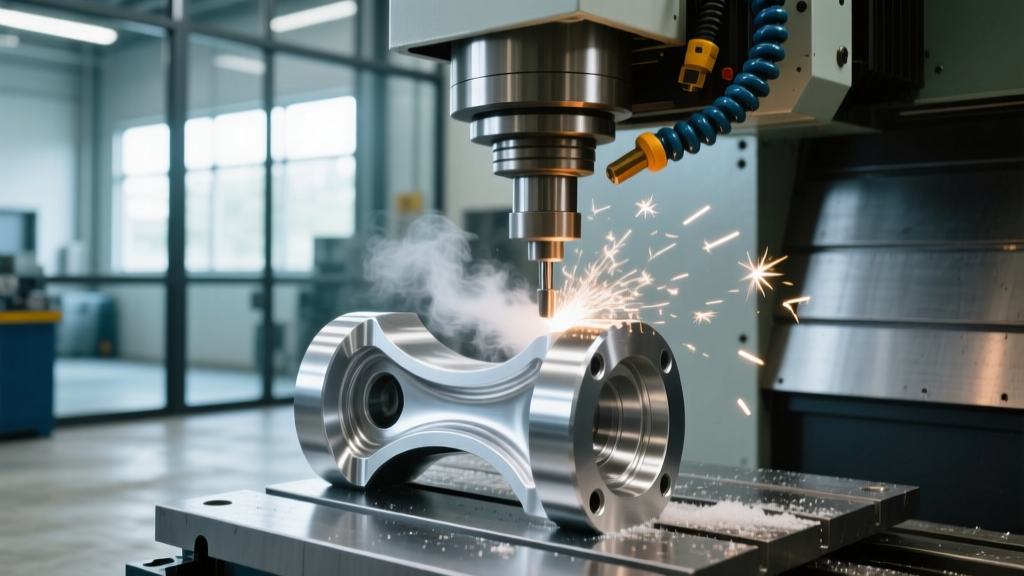
To meet these standards, Savannah machine shops deploy 5-axis CNC machining for complex geometries. 5-Axis Computer Numerical Control (CNC) Machining is a subtractive manufacturing process where the cutting tool moves across five different axes simultaneously. This advanced capability allows manufacturers to mill complex, contoured automotive geometries in a single setup, drastically reducing lead times and improving dimensional accuracy.
Material Selection for Crash-Tested Components
Selecting the correct alloy is critical for passing 500-pound crash test sled simulations. Material choice dictates both the manufacturability of the prototype and its real-world energy absorption characteristics. Below is a decision framework for selecting automotive prototype materials.
| Material | Tensile Strength | Approximate Cost | Best Application |
|---|---|---|---|
| 6061-T6 Aluminum | 310 Megapascals | $45 per kilogram | Intake manifolds, lightweight brackets |
| 4130 Chromoly Steel | 560 Megapascals | $28 per kilogram | Roll cages, suspension control arms |
| Titanium Grade 5 | 950 Megapascals | $120 per kilogram | High-stress steering knuckles, valve springs |
Validating Material Integrity
CNC machined prototypes undergo non-destructive testing to verify internal grain structure. Ultrasonic testing ensures no micro-fractures exist within the milled billet. This evidence-based validation guarantees the prototype will behave predictably during physical impact testing.
The Prototyping Process: From CAD to Crash-Test Ready
Transforming a digital model into a physical, safety-compliant part requires a structured workflow. Savannah facilities utilize integrated software to bridge the gap between design and manufacturing.
Step 1: Design for Manufacturability (DFM) Review
Engineers analyze the Computer-Aided Design (CAD) file to identify undercuts and thin walls. This step optimizes toolpaths and reduces machining time by up to 30 percent.
Step 2: Toolpath Generation and Simulation
Programmers generate G-code and run virtual collision simulations. This prevents tool breakage and ensures the final surface finish meets aerodynamic or aesthetic requirements.
Step 3: Machining and Post-Processing
The billet is secured to the CNC bed and milled to the specified ±0.005 millimeter tolerance. Post-processing includes heat treatment and anodizing to enhance corrosion resistance.

Frequently Asked Questions
How much does custom auto parts prototyping cost in Savannah?
Costs vary based on material and complexity, but a standard 5-axis milled aluminum suspension component typically ranges from $800 to $1,500 per unit. This includes DFM analysis, machining, and basic quality inspection.
What safety certifications do Savannah prototype manufacturers hold?
Reputable facilities maintain ISO 9001:2015 certification for quality management. Many also hold IATF 16949 certification, which is the specific global standard for automotive quality management systems.
How long does rapid prototyping take for aftermarket vehicles in Georgia?
Standard lead times range from 7 to 14 days from approved CAD file to finished part. Expedited services can reduce this to 72 hours for simpler, single-axis milled components.
Next Steps for Your Aftermarket Project
Securing reliable prototype manufacturing in Savannah requires partnering with facilities that understand both advanced CNC machining and stringent automotive safety standards. By leveraging local logistics and precision engineering, aftermarket designers can accelerate their path from concept to crash-tested validation. To begin your project, export your STEP files and submit them to a certified Savannah machine shop portal for a comprehensive Design for Manufacturability review today.