Vietnam CNC Machining vs In-House: 2026 Tech & Cost Analysis
Compare Vietnam CNC machining vs in-house production. Analyze 2026 tech adoption, 5-axis costs, IP security, and CapEx vs OpEx frameworks.
The CapEx Reality: In-House 5-Axis Investments
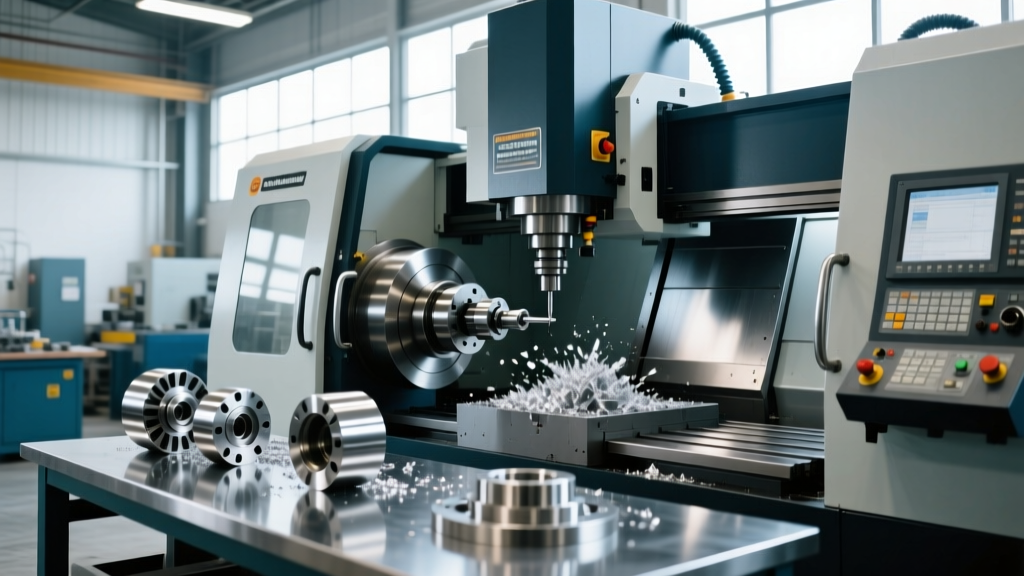
Bringing advanced CNC production in-house requires navigating a brutal capital expenditure landscape. Procuring a baseline 5-axis universal machining center, such as the Mazak Variaxis i-800 NEO or the DMG Mori DMU 50 3rd Generation, commands a base price between $450,000 and $650,000 in 2026. However, the machine tool is merely the entry fee.
To achieve competitive cycle times and hold tolerances within ±0.0002 inches on aerospace-grade alloys like Ti-6Al-4V or Inconel 718, manufacturers must invest heavily in peripheral technology:
- Workholding & Automation: Pneumatic or hydraulic zero-point clamping systems (e.g., Schunk Vero-S or Erowa ITS) add $25,000 to $45,000 per setup.
- Tooling & Presetting: A full complement of carbine end mills, custom form tools, and a Haimer or Zoller tool presetter easily pushes an additional $60,000.
- Facility Prep: Upgrading electrical service to 480V 3-phase, installing compressed air dryers, and pouring reinforced concrete foundations to isolate vibration can cost upwards of $30,000 before the machine is even uncrated.
Beyond hardware, the human capital deficit is acute. A proficient 5-axis CNC programmer versed in Siemens NX or Mastercam commands an annual salary of $105,000 to $140,000 in North America, assuming you can find one amidst the severe manufacturing talent gap.
The Technological Maturation of Vietnam CNC Machining
Historically viewed as a hub for low-cost, high-volume manual or 3-axis work, the landscape of Vietnam CNC machining has undergone a radical technological transformation. Driven by foreign direct investment and government initiatives to move up the value chain, top-tier machine shops in industrial zones like VSIP Bac Ninh and Binh Duong are now operating with Industry 4.0 infrastructure that rivals Western counterparts.
"The narrative that Southeast Asian machine shops rely solely on cheap labor is outdated. The leading Vietnamese contract manufacturers are heavily investing in automated metrology and digital twin simulations to win complex medical and aerospace contracts."
According to the World Bank's Vietnam economic overview, the nation's manufacturing sector has aggressively pivoted toward high-tech exports, supported by massive FDI inflows specifically targeted at precision engineering and electronics. This macroeconomic shift is visible on the shop floor:
Automated Metrology and In-Cycle Inspection
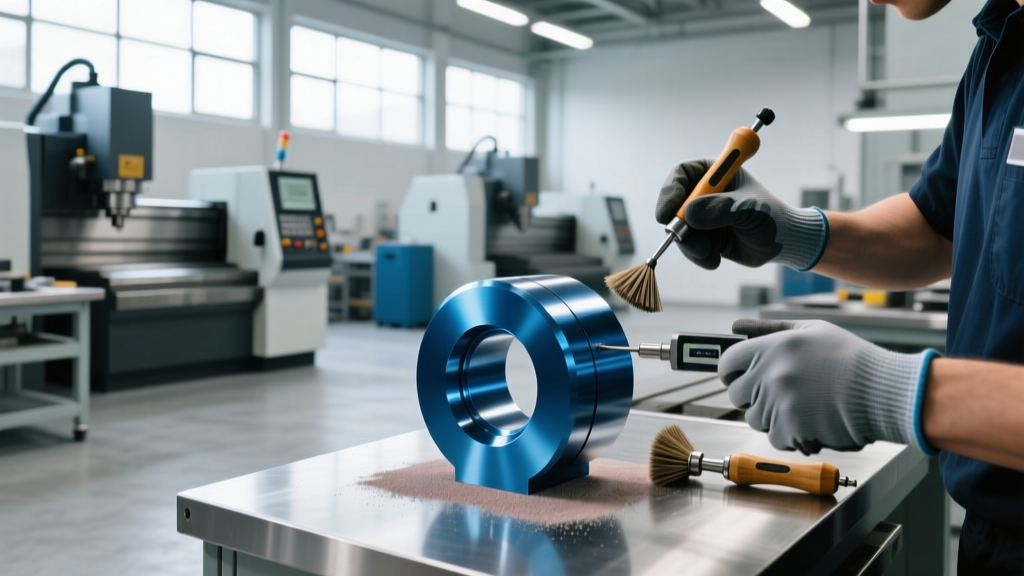
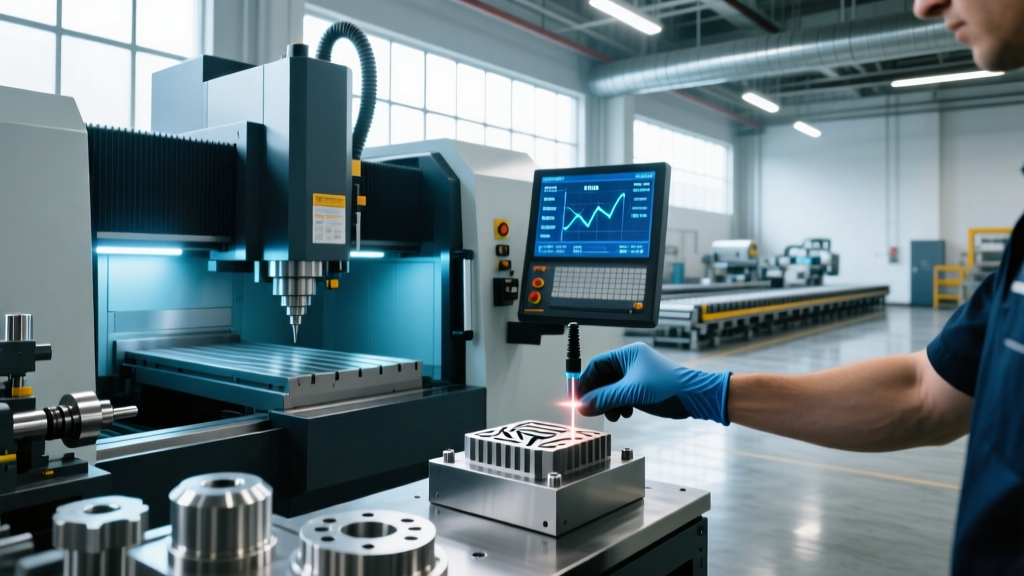
Premium Vietnamese machine shops have moved beyond manual calipers and height gauges. It is now standard practice for Tier-1 Vietnamese suppliers to utilize Renishaw Equator gauging systems for automated, in-cycle comparative inspection. Furthermore, portable CMMs like the Hexagon Absolute Arm with integrated laser scanners are routinely used to verify complex 5-axis contoured surfaces immediately after unclamping, drastically reducing scrap rates and ensuring First Article Inspection (FAI) accuracy.
Advanced CAM and Digital Twins
To eliminate spindle crashes and optimize chip evacuation in deep-cavity milling, leading Vietnam CNC machining facilities utilize VERICUT or Hexagon CAM simulations. These digital twin environments verify G-code against the exact kinematic model of the specific machine tool (e.g., a Hermle C42U or Makino DA300) before the program ever reaches the shop floor.
Head-to-Head Matrix: Tech, Cost, and Lead Times
When deciding between outsourcing to a technologically advanced Vietnamese partner or keeping production on domestic soil, the financial and operational metrics reveal distinct trade-offs.
| Metric | In-House Production (North America/EU) | Outsourcing to Vietnam CNC Machining (Tier 1) |
|---|---|---|
| Machine Hourly Rate (5-Axis) | $130 - $195 / hour | $35 - $65 / hour |
| Initial CapEx Requirement | $600,000 - $1.2M+ (Machine, Tooling, Facility) | $0 (OpEx model via purchase orders) |
| Access to Niche Tech | Limited by owned equipment; requires new CapEx for specialized processes (e.g., wire EDM, Swiss turning). | High; large Vietnamese campuses often house 5-axis, Swiss, EDM, and CMM under one roof. |
| Prototyping Lead Time | 3 - 7 Days (Immediate local turnaround) | 10 - 14 Days (Machining + DHL Express air freight) |
| Volume Scalability | Constrained by owned spindle hours and local shift labor limits. | Highly elastic; partners can shift from 10 to 10,000 parts across multiple machine cells. |
| IP & Data Security | Maximum control; physical and local network isolation. | Requires strict contractual NDAs, secure cloud portals, and ITAR/EAR compliance checks. |
Overcoming the IP and Quality Gap with Digital Threads
The primary friction point in offshoring precision components is the fear of intellectual property theft and the "black box" nature of overseas quality control. In 2026, technology has largely bridged this geographic gap through the implementation of secure digital threads.
The MTConnect and IoT Advantage
Progressive Vietnam CNC machining partners now adopt the MTConnect standard to provide real-time transparency to Western OEMs. As highlighted by NIST Advanced Manufacturing guidelines on smart manufacturing interoperability, MTConnect allows machine tools to output standardized data regarding spindle load, cycle times, and alarm states. By granting clients read-only access to a secure dashboard, Vietnamese shops prove that parts are being machined on the agreed-upon 5-axis centers, not secretly subcontracted to lower-tier 3-axis shops.
Secure File Transfer and AES-256 Encryption
Instead of emailing STEP files and 2D PDFs, top-tier contract machinists utilize secure manufacturing portals. These platforms enforce AES-256 encryption, automatic watermarking of technical drawings, and expiring download links. For non-ITAR restricted commercial aerospace and medical device components, this infrastructure provides an IP security posture that meets stringent ISO 27001 requirements.
Actionable Decision Framework: When to Outsource vs. Keep In-House
Use this diagnostic logic to determine the optimal production route for your specific component portfolio:
Route A: Keep In-House If...
- ITAR/EAR Restrictions Apply: If your components are subject to strict defense export controls, domestic production is legally mandatory.
- Extreme Design Volatility: If your R&D team requires daily design iterations and physical parts in hand within 24 hours for fit-testing, the trans-Pacific logistics delay makes outsourcing unviable.
- Low-Volume, High-Mix Proprietary Fixturing: If the part requires highly proprietary, custom-engineered fixture designs that represent core IP you refuse to share.
Route B: Outsource to Vietnam CNC Machining If...
- Stable, High-Volume Production Runs: For production runs of 500 to 50,000+ parts where the $80-$130/hour savings on 5-axis spindle time yields massive margin improvements.
- Multi-Process Assemblies: If your product requires CNC milling, turning, anodizing, and laser welding. Large Vietnamese manufacturing campuses consolidate these processes, eliminating the logistics friction of managing multiple domestic vendors.
- Surge Capacity Needs: When your domestic shop floor is at 95% OEE (Overall Equipment Effectiveness) and you need to offload "bread and butter" production to free up local engineering talent for NPI (New Product Introduction).
Final Verification: Auditing a Vietnamese Partner's Tech Stack
If you decide to leverage Vietnam CNC machining, do not rely solely on marketing brochures. Issue a technical audit questionnaire requiring proof of the following:
- Machine Calibration Certificates: Request the latest ballbar testing results (e.g., Renishaw QC20-W) to verify geometric accuracy and backlash compensation.
- CMM Correlation Data: Ask for a Gauge R&R (Repeatability and Reproducibility) study on their CMM equipment for your specific critical-to-quality (CTQ) dimensions.
- ERP/MES Integration: Verify that their shop floor tracking system (like Plex or Epicor) can provide lot-level traceability for raw material certifications (e.g., mill certs for 17-4PH stainless steel).
By shifting the evaluation criteria from simple "cost per part" to a holistic analysis of technological capability, metrology infrastructure, and digital transparency, manufacturers can successfully integrate Vietnamese precision machining into their global supply chain without sacrificing quality or IP security. For deeper insights into global manufacturing technology standards, resources from the Society of Manufacturing Engineers (SME) provide ongoing analysis on how global supply chains are standardizing smart manufacturing protocols.