Outsourcing CNC Machining for High-Volume Production
Evaluate equipment, automation, and cost structures when outsourcing CNC machining for high-volume production to ensure scalability and part consistency.
Outsourcing CNC machining for high-volume production—typically defined as runs exceeding 10,000 parts annually or continuous 24/7 manufacturing cycles—requires a fundamental shift in vendor evaluation. Buyers must look beyond basic price-per-part quotes and audit the supplier's equipment architecture, automation integration, and thermal stability protocols. As of 2026, the baseline for high-volume contract machining relies heavily on Horizontal Machining Centers (HMCs) paired with Flexible Manufacturing Systems (FMS), rendering traditional Vertical Machining Center (VMC) farms obsolete for scalable production.
The Architecture of High-Volume: HMCs and Pallet Pools
When evaluating a machine shop for high-volume outsourcing, the ratio of HMCs to VMCs on their floor is a primary indicator of their capability. VMCs are inherently limited by manual loading constraints and poor chip evacuation in deep cavity milling. In contrast, HMCs utilize 4th-axis tombstones, allowing machinists to load 20 to 40 parts per cycle while gravity naturally clears chips away from the cutting zone.
Top-tier high-volume suppliers deploy machines like the Makino a61nx or the DMG MORI NHX 5000. These 50-taper HMCs feature 14,000 RPM spindles and 2G acceleration, drastically reducing non-cutting time. More importantly, they are equipped with automated pallet changers (APCs) or multi-pallet pools. While a standard VMC achieves a spindle utilization rate of 30% to 40%, an HMC integrated with a pallet pool consistently maintains 85% to 95% spindle uptime, effectively doubling the output per square foot of factory space.
⚠️ The 'VMC Farm' Trap: Many mid-sized shops market themselves as high-volume capable by showcasing a floor with 20+ VMCs. Avoid these vendors for complex, tight-tolerance production. VMCs require manual intervention for part flipping and suffer from thermal Z-axis drift during continuous 72-hour runs (often drifting up to 0.0015 inches). HMCs with through-spindle coolant and thermal compensation maintain ±0.0002 inches over the same duration.Automation Integration: FMS and Lights-Out Manufacturing
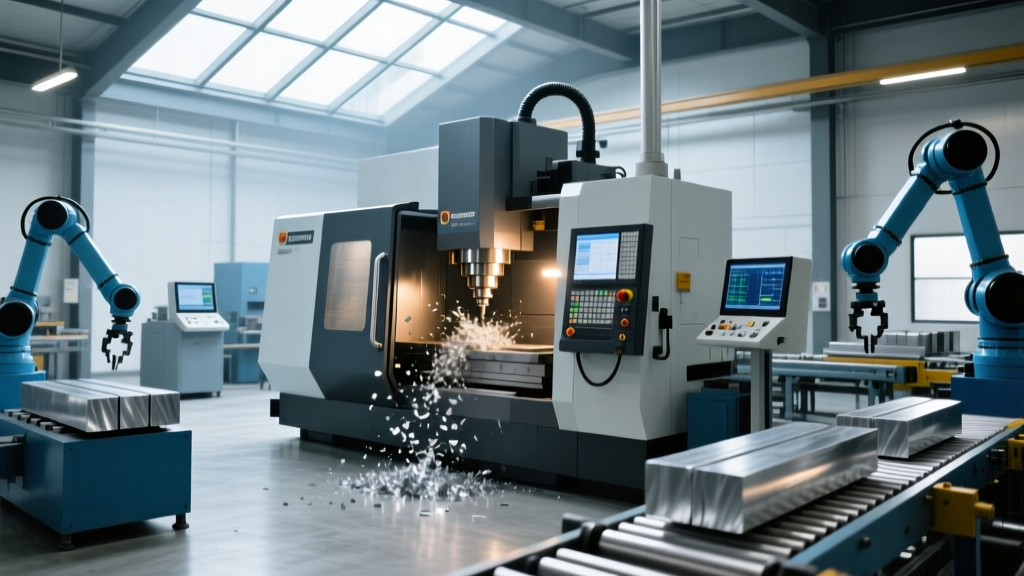
True high-volume outsourcing partners do not rely on manual labor to load pallets. You must verify the presence of an FMS, such as the Fastems FPC (Flexible Pallet Container) or Makino MMC2. These systems automate the movement of raw material and finished parts, enabling 'lights-out' machining during third shifts and weekends.
Key Automation Metrics to Audit:
- Tool Life Management: High-volume shops use RFID-tagged toolholders (e.g., Sandvik Coromant Capto C6) integrated with the FMS software to automatically swap sister tools when wear limits are reached, preventing catastrophic scrap events during unattended shifts.
- Automated Part Washing: Inline robotic washing stations that clean parts before they ever reach the inspection room, ensuring CMM sensors aren't fouled by aluminum swarf or coolant residue.
- AGV Integration: The use of Automated Guided Vehicles to transport raw billets from the saw station to the FMS load stations without forklift bottlenecks.
Cost-Per-Part Economics: CapEx vs. OpEx Matrix
The decision to outsource high-volume production is ultimately a capital expenditure (CapEx) versus operational expenditure (OpEx) calculation. Bringing a 50,000-part annual run in-house requires massive upfront investment in machinery, facility upgrades (3-phase power, compressed air, coolant filtration), and skilled labor. Outsourcing converts these fixed costs into variable costs.
| Cost Factor | In-House Production (50k parts/yr) | Outsourced High-Volume (50k parts/yr) |
|---|---|---|
| Equipment CapEx (HMC + FMS) | $1,250,000 - $1,800,000 | $0 (Amortized into part cost) |
| Custom Tombstone & Fixture Tooling | $18,000 - $25,000 | $4,500 (NRE charged once) |
| Direct Labor (Setup & Operation) | $3.40 / part | $0.85 / part (Lights-out shifts) |
| Machine Hourly Rate / Spindle Time | $95.00 / hr (Internal cost) | $135.00 / hr (Vendor rate) |
| Scrap & Rework Allowance (Year 1) | 4.5% ($11,250 loss) | 0.5% (Vendor absorbs majority) |
| Total First-Year Cost | ~$1,450,000+ | ~$485,000 |
Note: While the outsourced hourly spindle rate is higher, the elimination of CapEx, facility overhead, and the drastic reduction in direct labor via automation results in a significantly lower total cost of ownership for the buyer.
Quality Assurance at Scale: Inline vs. Post-Process
Inspecting 50,000 parts a year using manual calipers or standalone CMMs creates a massive bottleneck. High-volume CNC outsourcing partners utilize inline, automated metrology. According to data aggregated by the Society of Manufacturing Engineers (SME), automated inline inspection reduces quality-related downtime by up to 40% in high-mix, high-volume environments.
📊 Data Highlight: Automated Metrology StandardsRequire your vendor to use systems like the Renishaw Equator for high-speed comparative gauging directly on the shop floor. The Equator can inspect a complex milled feature in under 15 seconds, compared to 4 minutes on a traditional Zeiss CONTURA CMM. For true high-volume runs, the vendor must also employ Statistical Process Control (SPC) software like Polyworks or QI Macros to monitor tool wear trends and automatically trigger tool offsets before parts fall out of tolerance.
Material Sourcing and Near-Net-Shape Strategies
A frequently overlooked aspect of outsourcing CNC machining for high-volume production is how the vendor sources and prepares raw material. Machining a part from a solid billet of 6061-T6 aluminum or 304 stainless steel wastes time, tooling, and material. Elite contract machiners will collaborate with your engineering team to transition from billet machining to near-net-shape castings or forgings.
By sourcing custom extrusions or investment castings that are already 80% of the final geometry, the CNC machine only needs to perform finish passes on critical datums and bore tolerances. This strategy reduces cycle times by up to 60% and extends the life of expensive indexable end mills and drill bodies. When auditing a vendor, ask specifically about their relationships with regional foundries and their internal capabilities for bar-fed turning vs. plate sawing.
The Vendor Audit Checklist for High-Volume Buyers
Before signing a long-term production agreement, conduct an on-site audit focusing on these specific operational pillars. Reference guidelines from Modern Machine Shop regarding HMC utilization to benchmark their claims.
- Spindle Utilization Logs: Request to see the machine's internal utilization logs (via MTConnect or similar IoT protocols). If their HMCs are not running at >80% utilization, their scheduling and FMS integration are flawed.
- Coolant Management: High-volume cutting generates massive heat and swarf. Inspect their central coolant filtration system. It must maintain concentration levels within ±1% and operate at minimum 800 PSI for effective through-tool chip evacuation in deep hole drilling.
- Preventative Maintenance (PM) Schedules: Verify that PMs are scheduled during third shifts or weekends. A vendor that shuts down HMCs for 8 hours on a Tuesday afternoon for routine way-lube checks is not optimizing for high-volume output.
- Supply Chain Redundancy: Ensure the vendor has secondary suppliers for critical consumables (carbide inserts, custom reamers, specific cutting oils) to prevent line-down situations caused by global supply chain delays.
Selecting the right partner for high-volume production is an exercise in verifying engineering rigor. By demanding HMC infrastructure, automated pallet systems, and inline metrology, you secure a supply chain capable of delivering consistent quality at scale without the burden of internal capital expenditure.