Buying Guide: CNC Machining Prototype Services for Oil & Gas
Learn how to select a CNC machining prototype partner for oil and gas components. Covers API standards, exotic alloys, and machine shop requirements.
Oil and gas components operate in extreme environments characterized by pressures exceeding 15,000 PSI, high-temperature downhole conditions, and highly corrosive hydrogen sulfide (H2S) exposure. Prototyping these parts requires more than standard 3-axis milling; it demands strict adherence to metallurgical standards, advanced machine tool capabilities, and rigorous material traceability. When sourcing a cnc machining prototype partner for the energy sector, procurement engineers and product designers must evaluate a shop's ability to handle exotic superalloys while maintaining compliance with industry-specific regulations.
⚠️ CRITICAL COMPLIANCE WARNING: ISO 15156 / NACE MR0175For components exposed to sour gas (H2S), material hardness limits are strictly dictated by ISO 15156 (NACE MR0175). A prototype machined to 35 HRC might pass dimensional CMM inspection but fail catastrophically via sulfide stress cracking (SSC) in the field. Ensure your machine shop understands post-machining heat treatment limits and hardness testing protocols for sour service environments.
Material Selection & Machinability Matrix
The energy sector relies heavily on corrosion-resistant alloys (CRAs) and high-strength steels. Machining these materials for functional prototypes introduces severe tool wear, work hardening, and thermal management challenges. According to Sandvik Coromant's metallurgical guidelines, nickel-based superalloys require specialized whisker-reinforced ceramics and high-pressure coolant to prevent rapid insert degradation.
| Material | Typical Application | Primary Machining Challenge | Required Tooling & Strategy |
|---|---|---|---|
| Inconel 718 | Downhole sensors, wellhead valves | Severe work hardening, high cutting temps | Ceramic inserts, 1000+ PSI through-tool coolant |
| Duplex 2205 | Subsea manifolds, flowlines | High cutting forces, built-up edge (BUE) | PVD-coated carbide, positive rake angles |
| 17-4 PH (H1150) | Valve stems, actuator components | Abrasive wear on cutting edges | CVD-coated carbide, rigid setups, constant chip load |
| Titanium Grade 5 | Aerospace-grade downhole tools | Low thermal conductivity, springback | Flood coolant, sharp uncoated micro-grain carbide |
Mandatory Machine Tool Capabilities
Do not award a contract to a shop running standard 3-axis VMCs with 200 PSI coolant for complex energy components. A qualified cnc machining prototype facility for oil and gas parts must possess specific hardware to maintain tolerances in tough materials.
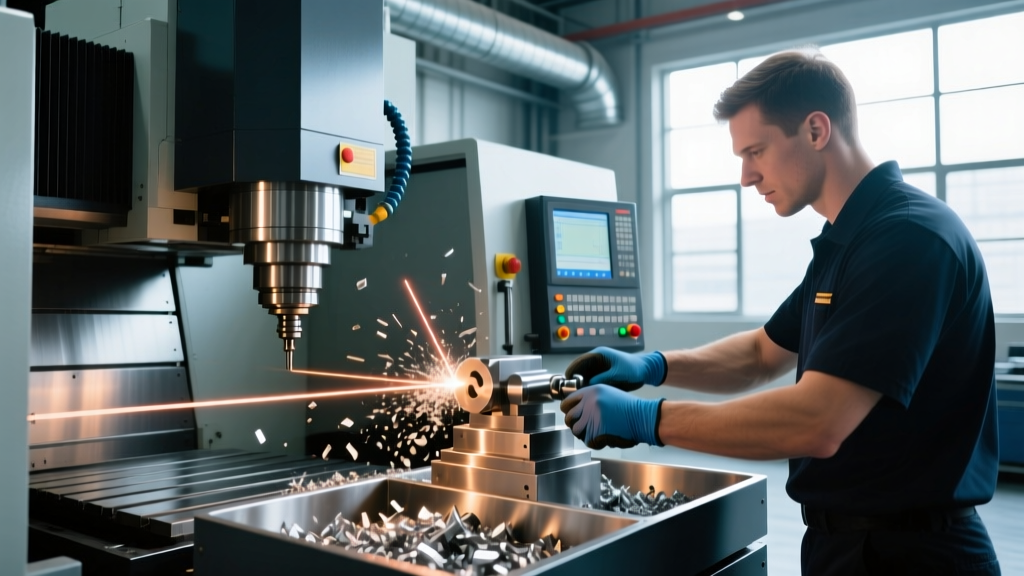
- High-Pressure Through-Spindle Coolant (TSC): Minimum 1000 PSI (preferably 1500+ PSI) is non-negotiable for evacuating chips during deep-cavity milling and BTA/gun drilling for subsea manifolds. Chip recutting in Inconel leads to immediate tool fracture and scrapped prototypes.
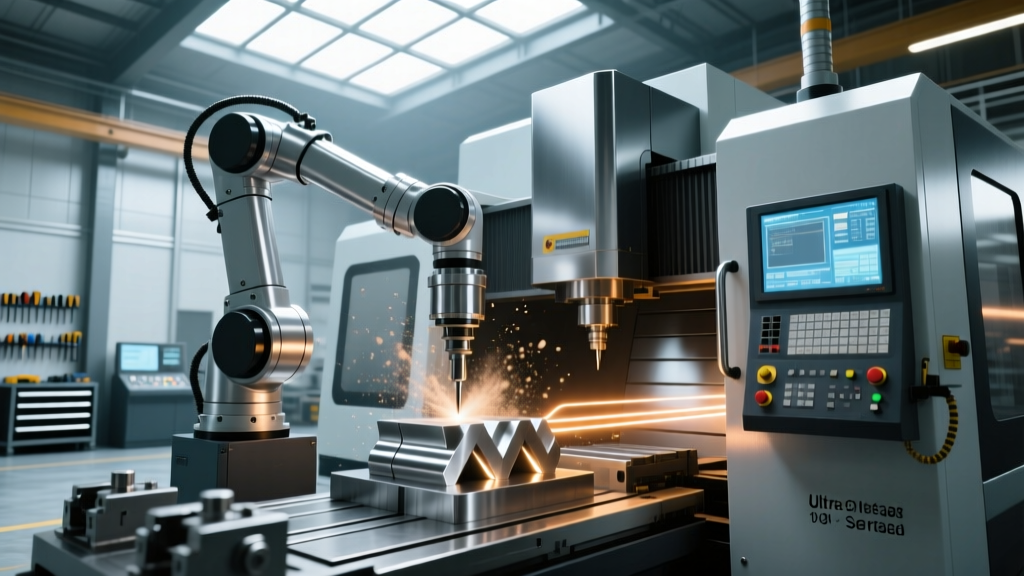
- Spindle Torque & Rigidity: Roughing Duplex stainless steel requires high torque at lower RPMs. Look for horizontal machining centers (HMCs) or heavy-duty 5-axis trunnions with a minimum of 300 Nm of spindle torque and massive cast-iron dampening to prevent chatter.
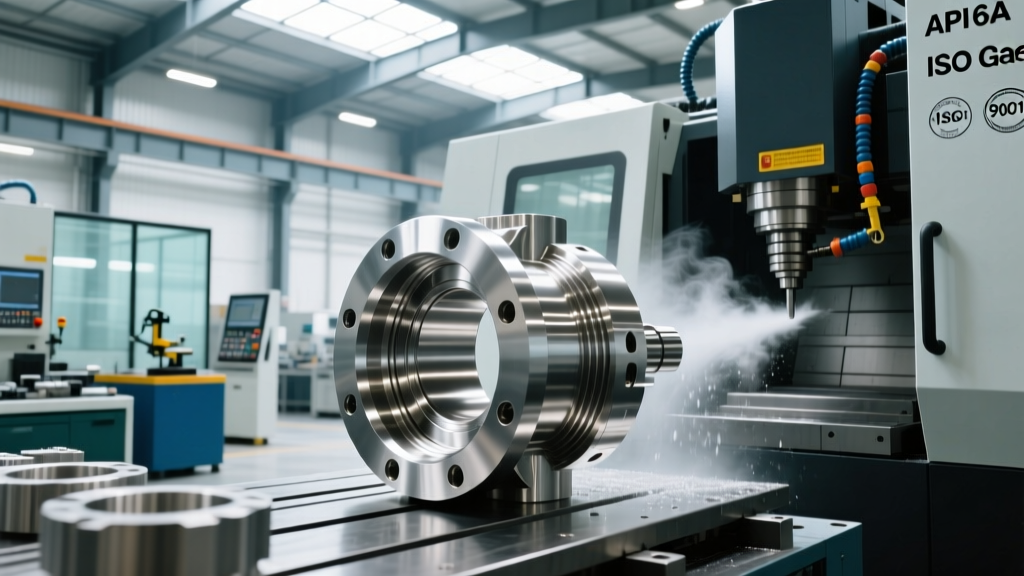
- Thermal Stability Controls: Prototyping large wellhead bodies (e.g., API 6A flanges) takes days of continuous machining. Machines equipped with spindle cooling jackets and thermal compensation software (like Makino's T.A.S. or Hermle's thermal control) are required to hold ±0.0005" positional tolerances over 48-hour cycles.
Vendor Evaluation Decision Matrix
Use this framework to audit potential machine shop partners before releasing your CAD files and purchase orders.
1. API 6A Metrology
Familiarity with API Spec 6A standards is critical. The shop must understand the strict surface finish (Ra) and dimensional tolerances required for Ring Type Joint (RTJ) grooves to ensure metal-to-metal sealing under extreme pressure.
2. Material Traceability
For US-based energy projects, DFARS 252.225-7009 compliance is often mandatory. The shop must provide certified Material Test Reports (MTRs) proving the exact heat lot and chemical composition of the prototype bar stock.
3. Advanced Inspection
Standard calipers are insufficient. Require shops equipped with multi-sensor CMMs (e.g., Zeiss Contura with VAST scanning) or laser scanners to verify complex internal geometries in 5-axis milled impellers and valve bodies.
4. NDT Capabilities
Functional prototypes for downhole tools often require Non-Destructive Testing. Ensure the shop has in-house or certified third-party access to Fluorescent Penetrant Inspection (FPI) and Magnetic Particle Inspection (MPI).
Cost Drivers & Lead Time Realities for 2026
Budgeting for energy sector prototypes requires understanding the premium placed on exotic raw materials and slow machining parameters. Below is a realistic cost breakdown for functional prototypes based on current 2026 machine shop rates ($120–$180/hour for 5-axis exotic machining).
| Component Type | Material | Estimated Cost Range | Typical Lead Time |
|---|---|---|---|
| Standard RTJ Flange (3-axis) | 17-4 PH Stainless | $800 – $1,500 | 2 – 3 Weeks |
| Subsea Hydraulic Manifold (5-axis + Deep Hole) | Duplex 2205 | $4,500 – $8,500 | 4 – 6 Weeks |
| Complex Downhole Sensor Housing (Multi-axis + EDM) | Inconel 718 | $12,000 – $22,000+ | 6 – 10 Weeks |
Supply Chain Note: As of 2026, certified Inconel 718 and Duplex 2205 bar stock can carry 4 to 8-week mill lead times. A competent machine shop will maintain strategic buffer stock of common energy-sector diameters (e.g., 4" to 8" round bar) to accelerate prototype turnaround.
Frequently Asked Questions
How does API Spec 6A affect prototype machining tolerances?
API Spec 6A governs wellhead and Christmas tree equipment. It mandates extremely tight tolerances for ring grooves (where metal gaskets seal). The surface finish in these grooves typically must not exceed 32 Ra (microinches), and dimensional tolerances are often held to ±0.001". If your prototype shop treats an RTJ groove like a standard O-ring gland, the prototype will fail pressure testing.
Can we use 3D printed metal prototypes for downhole tools?
While Direct Metal Laser Sintering (DMLS) is excellent for complex cooling channels, it is generally unsuitable for functional downhole prototypes subjected to high tensile loads or H2S environments. The anisotropic nature of 3D printed metals and potential porosity issues make subtractive CNC machining from wrought or forged bar stock the mandatory choice for API-compliant functional testing.
What is the best way to prevent work hardening during Inconel prototyping?
Work hardening occurs when the cutting tool rubs rather than shears the material. To prevent this, the shop must use a constant chip load, avoid dwelling the tool in the cut, and utilize high-pressure coolant (1000+ PSI) directed exactly at the cutting edge. Trochoidal milling toolpaths are highly recommended to maintain consistent tool engagement and dissipate heat away from the workpiece.