Multi-Axis CNC Machining Process: Cost Analysis & Budgeting
Discover how to budget for the multi-axis CNC machining process. Learn cost drivers, setup fees, and ROI metrics for complex geometry production.
Procuring complex parts requires a precise understanding of the multi-axis CNC machining process. When component geometries demand undercuts, compound angles, or deep cavity access, standard 3-axis milling reaches its physical and economic limits. Transitioning to 4-axis or 5-axis simultaneous milling introduces a distinct cost architecture that procurement teams and design engineers must navigate to avoid severe budget overruns.
The financial threshold where multi-axis machining becomes viable is not determined solely by the machine's hourly rate. It is dictated by the amortization of advanced CAM software, specialized workholding, collision-risk mitigation, and the premium on highly skilled programming labor. According to data tracked by Modern Machine Shop, shops investing in simultaneous 5-axis technology often see a 30% to 45% increase in overhead costs compared to standard 3-axis VMC operations, necessitating a strategic approach to part pricing and budget allocation.
The Multi-Axis Premium DefinedThe 'Multi-Axis Premium' is the additional 20% to 60% cost burden applied to complex parts. This premium covers the depreciation of $300,000+ machine tools (like the Haas UMC-750SS or DMG MORI DMU 50 3rd Gen), $20,000+ 5-axis CAM software licenses (such as hyperMILL or Mastercam), and the extended simulation time required to prevent catastrophic spindle collisions.
Deconstructing the CNC Machining Process Cost Matrix
To accurately budget for production, buyers must separate the mechanical cutting time from the non-recurring engineering (NRE) and setup costs. The economics shift dramatically depending on the axis configuration required for your specific geometry.
| Process Tier | Avg. Hourly Rate (2026) | CAM Programming Cost | Setup Time per Part | Best Application |
|---|---|---|---|---|
| 3-Axis VMC | $85 - $120 / hr | $100 - $300 | High (Multiple fixtures) | Prismatic parts, 2.5D pockets |
| 3+2 Axis (Indexing) | $120 - $160 / hr | $300 - $800 | Medium (Single setup) | Angled holes, inclined planes |
| Simultaneous 5-Axis | $160 - $250+ / hr | $800 - $2,500+ | Low (Complex single setup) | Blisks, impellers, organic contours |
Hidden Cost Drivers in Complex Geometry Milling
When evaluating quotes for the multi-axis CNC machining process, the raw material and cycle time only tell half the story. The most severe budget deviations stem from hidden operational realities inherent to complex milling.
CAM Programming and Toolpath Verification
Programming a simultaneous 5-axis toolpath is exponentially more complex than 3-axis contouring. A programmer must account for tool shank clearance, holder collision zones, and machine kinematics (such as trunnion table limits on a Haas UMC or rotary table dynamics on a Mazak VARIAXIS). Using advanced modules in software like hyperMILL or Siemens NX, a programmer may spend 15 to 30 hours generating and simulating toolpaths for a single aerospace impeller. At $90 to $120 per hour for specialized CAM labor, programming alone can add $1,350 to $3,600 to the NRE budget before a single chip is cut.
Advanced Workholding and Fixturing Realities
Complex geometries often lack flat, parallel surfaces for standard Kurt vise clamping. This necessitates custom workholding solutions:
- Custom Soft Jaws: Machined from 6061 aluminum or Delrin to cradle organic contours. Budget $300 to $800 per set, plus the machine time to cut them.
- Vacuum Chucks: Required for thin-walled aerospace skins where clamping force would induce deflection. Custom porous platens and vacuum generators add $1,500+ to initial setup.
- Hydraulic Tombstones: Used in multi-pallet 5-axis HMCs to maximize spindle utilization, though they require extensive upfront engineering and plumbing.
'The biggest mistake procurement teams make is assuming 5-axis machining is purely a premium service. For parts requiring more than three distinct setups on a 3-axis machine, the cumulative cost of fixture building, re-indication, and tolerance stack-up makes 5-axis the significantly cheaper option.'
— Manufacturing Engineering Lead, Tier 1 Aerospace Supplier
Budgeting Framework: When to Choose 5-Axis Over 3+2
Not all complex parts require continuous 5-axis interpolation. Indexing (3+2 axis) locks the rotary axes in place while the spindle cuts, which is vastly cheaper to program and carries lower collision risks. Use this decision matrix to allocate your budget effectively:
Choose 3+2 Axis Indexing When:
- Features are on distinct, flat angled planes (e.g., a 45-degree mounting flange).
- Undercuts are accessible via standard lollipop or T-slot cutters without shank interference.
- Tolerances are standard (±0.002' or larger) and do not require blended, continuous surface finishes.
Choose Simultaneous 5-Axis When:
- The part features organic, sculpted surfaces (e.g., turbine blades, medical implants).
- Deep cavities require continuous tool tilt to maintain optimal cutting speed and avoid chatter.
- Aerodynamic or fluid-flow surfaces demand a continuous surface finish (Ra < 16 µin) without witness lines from repositioning.
Real-World Cost Scenarios: Aerospace vs. Medical
To contextualize these metrics, consider two distinct production scenarios common in advanced manufacturing.
Scenario A: Aerospace Ti-6Al-4V Compressor Blisk
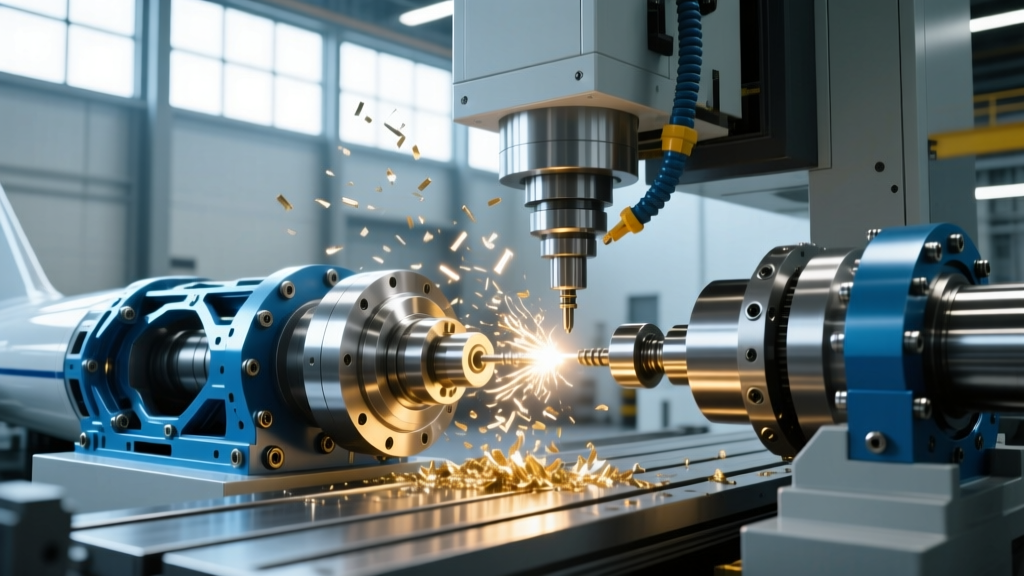
A blisk (bladed disk) machined from a solid billet of Grade 5 Titanium requires extreme tool access and continuous 5-axis interpolation to mill the inter-blade channels. While the 5-axis hourly rate is $220, attempting this on a 3-axis machine is physically impossible. However, comparing it to an older manufacturing method—casting the blisk and machining only the roots and tips—the 5-axis CNC machining process eliminates $15,000 in tooling costs for the mold and reduces lead time from 14 weeks to 3 weeks. The high hourly machining cost is offset by the elimination of casting NRE and supply chain friction.
Scenario B: Medical PEEK Spinal Implant
PEEK (Polyether ether ketone) is a high-performance polymer used in spinal cages. The geometry features complex, porous lattice structures and organic outer contours. Using a 5-axis machine allows the part to be flipped only once using a custom vacuum fixture. If processed on a 3-axis mill, the part would require 4 separate setups, custom soft jaws for each, and extensive edge blending to remove witness lines. The 5-axis process increases the hourly rate by 40% but reduces total cycle and setup time by 65%, resulting in a net per-part cost reduction of 22% at volumes above 50 units.
Actionable Strategies to Compress Multi-Axis Budgets
Design for Manufacturability (DFM) is the most effective lever for controlling costs in the multi-axis CNC machining process. Implement these specific design constraints to lower quotes:
- Standardize Internal Corner Radii: Avoid arbitrary radii like 0.118'. Design corners to match standard end mill diameters (e.g., 0.125' or 0.250'). This allows the shop to use standard, off-the-shelf tooling rather than sourcing expensive custom micro-end mills that are prone to breakage in deep 5-axis cavities.
- Limit Deep, Narrow Channels: Channels with a depth-to-width ratio greater than 4:1 require extended-reach tooling. In 5-axis milling, long tools induce chatter, forcing the programmer to reduce feed rates by up to 60% and take lighter depth-of-cut passes, drastically inflating cycle time.
- Provide Adequate Tool Clearance Angles: If a surface requires a specific draft angle, design it to be 3 to 5 degrees off vertical rather than perfectly vertical. This allows the use of standard tapered ball end mills, which are significantly more rigid and cheaper than specialized undercut tools.
- Consolidate Tolerance Callouts: Apply tight tolerances (±0.0005') only to critical mating surfaces. Holding aerospace-grade tolerances across an entire complex 5-axis contour requires slow finishing passes, temperature-controlled machine enclosures, and in-process probing, all of which compound the final invoice.
For further guidance on optimizing manufacturing expenditures and applying DFM principles to advanced machining, the NIST Manufacturing Extension Partnership (MEP) provides extensive frameworks for cost estimation and process improvement. Additionally, the Society of Manufacturing Engineers (SME) regularly publishes technical papers detailing the latest advancements in multi-axis toolpath efficiency and kinematics.
Frequently Asked Questions
Why is 5-axis machining more expensive per hour than 3-axis?
The higher hourly rate reflects the capital depreciation of the machine tool (which includes complex rotary trunnions, direct-drive torque motors, and advanced CNC controllers like the Heidenhain TNC7), the cost of 5-axis CAM software licenses, and the premium paid to programmers skilled in collision avoidance and kinematic simulation.
Does multi-axis machining reduce material waste?
Yes. Because 5-axis machines can access complex geometries from multiple angles in a single setup, engineers can design parts closer to their net-shape. Furthermore, the ability to tilt the tool allows for the use of shorter, more rigid cutting tools, which can take deeper, more aggressive cuts, reducing the overall time the material spends on the machine.
At what production volume does 5-axis become cost-effective?
For highly complex parts (like impellers), 5-axis is cost-effective even at a quantity of one due to the impossibility of 3-axis alternatives. For moderately complex parts requiring multiple 3-axis setups, the break-even point where 5-axis NRE costs are absorbed and per-part savings are realized typically occurs between 25 and 50 units.