Military CNC Machining: Prototyping vs Production Operator Guide
Train operators for military CNC machining. Compare rapid prototyping vs production workflows, MIL-SPEC tolerances, SPC, and AS9100 traceability.
Defense contractors face a critical operational bottleneck when transitioning a verified prototype into a 5,000-piece production run. Operators trained exclusively on rapid prototyping often lack the statistical process control (SPC) and traceability discipline required for full-scale military CNC machining. A scrapped prototype costs time; a scrapped production batch of MIL-SPEC guidance system housings costs hundreds of thousands of dollars and breaches AS9100 Rev D compliance.
This guide provides shop floor managers and lead machinists with a concrete training framework to bridge the gap between military CNC rapid prototyping and high-volume defense production.
The Operator Mindset Shift: Iteration vs. Replication
In a prototyping environment, the operator's primary objective is to prove part geometry and achieve a successful First Article Inspection (FAI). Tolerances are held, but process repeatability is secondary because the part may be redesigned next week. In defense production, the objective shifts entirely to proving process capability.
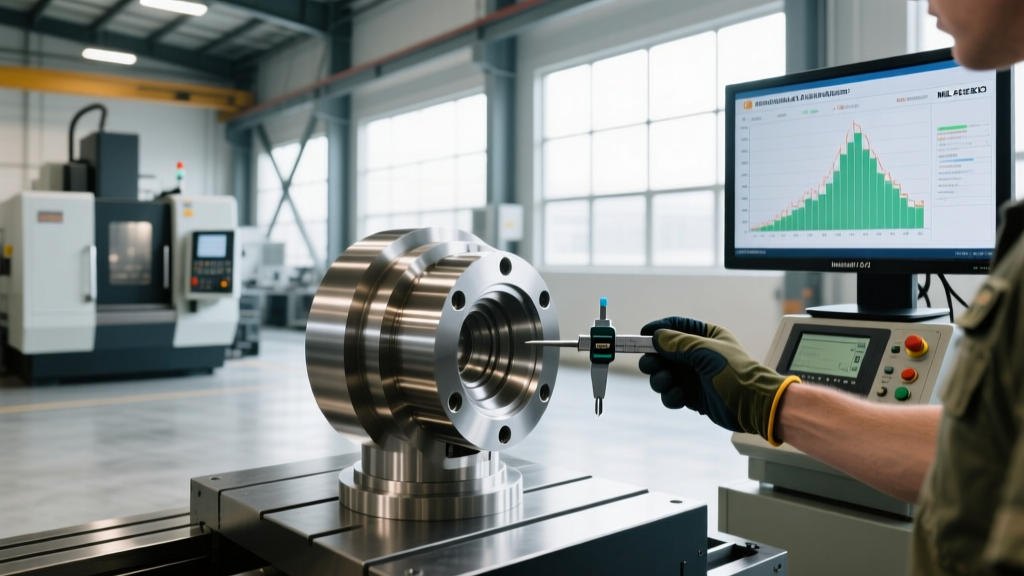
Operator Training Directive: Train production operators to monitor the Process Capability Index (Cpk). For critical military aerospace features, the target Cpk is typically ≥ 1.33. If an operator notices a dimensional drift trending toward the upper control limit on a 0.0005-inch true position tolerance, they must adjust the tool wear offset before the part breaches the specification limit. Relying on post-process CMM inspection to catch drift is a prototyping habit that fails in production.According to the NIST Engineering Statistics Handbook, maintaining a Cpk of 1.33 ensures the process mean is at least four standard deviations away from the nearest specification limit, a non-negotiable metric for Tier 1 defense suppliers.
Material Handling & Tooling Strategies for MIL-SPEC Alloys
Military CNC machining heavily relies on demanding alloys like Ti-6Al-4V (Grade 5 Titanium), 17-4 PH Stainless Steel, and 7075-T6 Aluminum. The tooling strategy for a one-off prototype differs vastly from a sustained production run.
Titanium (Ti-6Al-4V) Machining Protocols
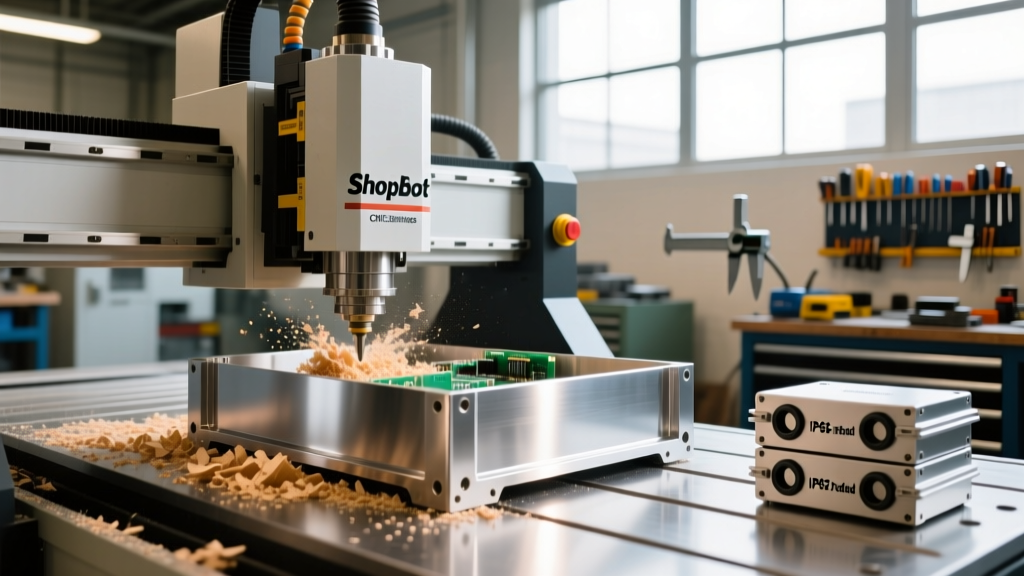
- Prototyping Approach: Operators often use standard 4-flute AlTiN coated carbide end mills, accepting aggressive tool wear and utilizing conservative feed rates to nurse a single part to completion.
- Production Approach: Operators must utilize specialized variable-helix, variable-pitch end mills (e.g., OSG Aero-End-Mills or Harvey Tool titanium-specific lines) to prevent chatter and harmonic resonance. More importantly, operators must program and monitor macro variables in the Haas NGC or Fanuc 31i control to track tool life. If a roughing end mill is rated for 120 minutes of cut time in titanium, the control must flag a tool change at 100 minutes to prevent catastrophic insert failure on part #400.
Chip Evacuation and Coolant Management
In production, chip re-cutting in deep pocket milling of 7075-T6 aluminum leads to localized work hardening and scrapped parts. Operators must be trained to verify through-tool coolant pressure (minimum 300 PSI for deep cavity milling) and ensure chip conveyors are cleared every shift, a detail often ignored during low-volume prototyping.
Metrology and Inspection: FAI vs. In-Process SPC
The inspection workflow dictates the pace of the shop floor. Prototyping relies on 100% feature verification via Coordinate Measuring Machines (CMM). Production requires a hybrid approach of in-machine probing and statistical sampling.
| Inspection Metric | Military Prototyping Workflow | Military Production Workflow |
|---|---|---|
| First Article | Full AS9102 FAIR, 100% CMM mapping of all GD&T callouts per ASME Y14.5-2018. | FAIR completed on first-off. Subsequent batches rely on approved control plans. |
| In-Process Checks | Manual micrometers and calipers at the machine; frequent CMM trips. | Renishaw OMP60 spindle probing for automated datum setting and critical bore sizing. |
| Thread Verification | Visual check and basic GO/NO-GO gage test. | Certified GO/NO-GO gages per ASME B1.2, logged with gage calibration expiration dates. |
| Surface Finish | Visual comparison to Ra plaques. | Profilometer testing for critical sealing surfaces (e.g., 32 Ra or 16 Ra requirements). |
Documentation and Traceability (The Defense Reality)
The most common point of failure for operators transitioning to military CNC production is traceability. Under DFARS (Defense Federal Acquisition Regulation Supplement) clauses, material pedigree and routing documentation are as critical as the physical dimensions of the part.
Traceability Checklist for Operators:- Material Certs: Verify the heat lot number on the raw material drop against the physical traveler routing sheet before making the first cut.
- Tooling Logs: Document specific tooling changes and offset adjustments on the traveler. If a reamer is replaced mid-batch, the exact serial number of the new reamer must be logged.
- UID Marking: For parts requiring MIL-STD-130N compliance, operators must verify the 2D Data Matrix UID (Unique Identification) mark using a dedicated validator before the part moves to final anodizing or passivation.
Failure to maintain this chain of custody violates AS9100 Rev D quality management standards, potentially resulting in the rejection of an entire production lot regardless of dimensional accuracy.
Workholding: Modular Fixturing vs. Rigid Tombstones
Rapid prototyping thrives on flexibility. Operators use soft jaws machined on the fly, modular vises (like the Kurt DX6), and double-sided tape for quick setups. Production machining demands absolute rigidity and repeatability to minimize cycle times and prevent micro-movements during heavy roughing passes.
Transitioning to Production Fixturing
Operators must be trained on hydraulic and pneumatic clamping systems mounted on custom tombstones. When loading 17-4 PH stainless steel billets onto a 4-axis horizontal machining center (HMC), operators must verify hydraulic pressure gauges (typically set between 1,500 and 2,500 PSI depending on the fixture design) to ensure clamping force is sufficient to counteract cutting forces without inducing part distortion.
Furthermore, operators must master the use of load-monitoring macros. If a hydraulic line loses pressure mid-cycle, the machine's spindle load monitor or specialized fixture pressure switches must be programmed to trigger an immediate E-stop, saving the part and the machine spindle from a catastrophic crash.
FAQ: Transitioning Defense Machining Workflows
How do we handle engineering changes (ECNs) during a production run?
In prototyping, an ECN means updating the CAM file and running a new part. In military production, an ECN requires a formal configuration management process. Operators must be trained to immediately quarantine all WIP (Work in Progress) and finished inventory associated with the old revision level until the Quality Assurance (QA) department releases the updated traveler and CAM program. Never run a 'hybrid' setup using old fixtures with new code.
What is the protocol for a scrapped part in a MIL-SPEC batch?
Scrapping a prototype is a learning opportunity; scrapping a production part requires a Non-Conformance Report (NCR). Operators must not simply throw a bad part in the scrap bin. The part must be physically tagged with a red non-conformance label, the specific failure mode (e.g., 'Bore A undersize by 0.0012 inches') must be documented, and the part must be moved to a locked quarantine cage. This data is vital for the shop's continuous improvement and SPC analysis.
Mastering the transition from military CNC rapid prototyping to production requires a fundamental shift in operator training. By focusing on statistical process control, rigorous traceability, and production-grade tooling management, machine shops can secure their position as reliable Tier 1 and Tier 2 defense contractors. For further reading on advanced manufacturing integration in defense supply chains, refer to the NIST Advanced Manufacturing Portal.