Why a CNC Machining Specialist is Vital for Medical Implants
Discover how a CNC machining specialist navigates ISO 13485, tight tolerances, and exotic alloys like Ti-6Al-4V to produce compliant medical implants.
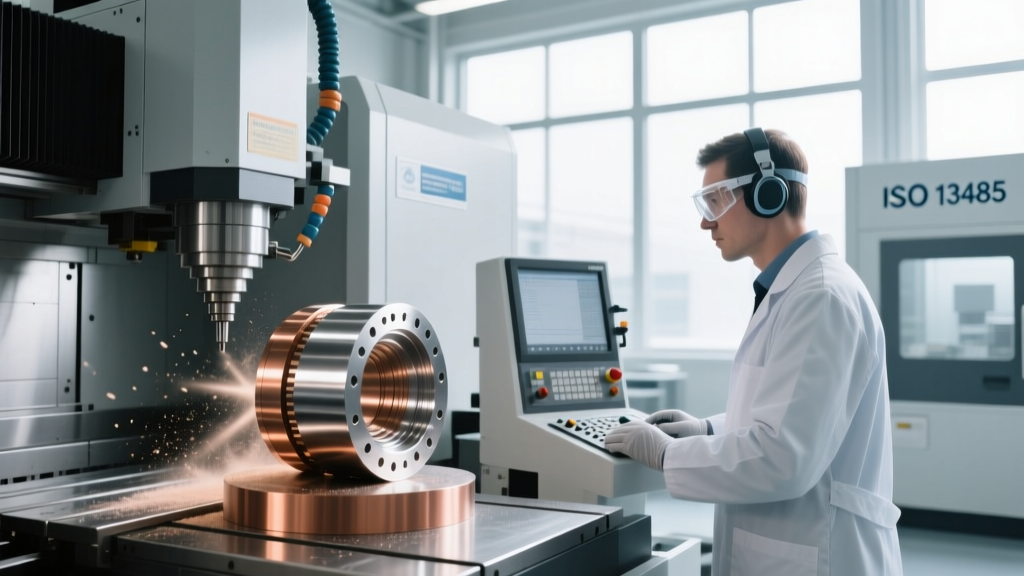
Medical device manufacturing operates under a zero-defect mandate. A single microscopic burr on a titanium bone screw, a tool mark that harbors bacteria on a surgical instrument, or a micro-fracture in a PEEK spinal cage can trigger catastrophic patient outcomes and multi-million-dollar FDA recalls. This unforgiving reality separates a standard job shop from a dedicated CNC machining specialist. Producing implantable devices requires mastering exotic metallurgy, maintaining sub-micron surface finishes, and executing rigorous process validations that generalist machine shops simply are not equipped to handle.
⚠️ Regulatory Alert: The 2026 QMSR TransitionAs of February 2, 2026, the FDA's Quality Management System Regulation (QMSR) final rule takes full effect, officially aligning 21 CFR Part 820 with the ISO 13485 standard. A true CNC machining specialist must already operate under ISO 13485:2016 certification, integrating risk management (ISO 14971) directly into the CNC programming and setup phases, rather than treating quality as an after-the-fact inspection step.
Material Science: Engineering Beyond Standard Alloys
General machine shops excel at 6061 aluminum, 304 stainless steel, and brass. Medical implants, however, demand biocompatible materials that are notoriously hostile to cutting tools. A CNC machining specialist must engineer custom toolpaths to manage the extreme work-hardening tendencies and low thermal conductivity of these alloys.
| Material | Grade / Standard | Primary Application | Machining Challenge | Est. Raw Cost (2026) |
|---|---|---|---|---|
| Titanium | Ti-6Al-4V ELI (ASTM F136) | Orthopedic screws, spinal cages, trauma plates | Gummy chips, rapid flank wear, low thermal conductivity | $90 - $130 / kg |
| Cobalt Chrome | CoCrMo (ASTM F75) | Knee/hip joint articulating surfaces, dental frameworks | Extreme hardness, requires rigid setups and ceramic tooling | $140 - $180 / kg |
| PEEK Polymer | Victrex 450G (Medical) | Cranial plates, interbody fusion devices | Thermal deformation, requires specialized cryogenic or air-blast cooling | $220 - $300 / kg |
According to research published in the National Institutes of Health (NIH), PEEK (polyetheretherketone) has become a dominant biomaterial due to its elastic modulus closely matching human cortical bone, preventing stress shielding. However, machining PEEK requires sharp, high-rake-angle carbide tools and strict temperature control to prevent melting at the shear zone, which compromises the implant's structural integrity.
Case Study: 5-Axis Milling of Titanium Spinal Cages
Interbody spinal fusion cages feature complex, porous-like lattice geometries designed to promote osteoconduction (bone ingrowth). Manufacturing these from a solid billet of Ti-6Al-4V ELI requires simultaneous 5-axis CNC milling.
The Setup and Tooling Strategy
For a recent production run of lumbar cages, a specialized medical machine shop deployed a Hermle C 42 5-axis machining center. The primary challenge with titanium is heat generation; because titanium does not dissipate heat well, the cutting edge absorbs the thermal load, leading to catastrophic tool failure.
- Cutting Parameters: Cutting speed (Vc) restricted to 45 m/min with a feed rate (fz) of 0.08 mm/tooth.
- Toolpath Strategy: Trochoidal milling (adaptive clearing) was utilized to maintain a constant radial engagement of 10%, preventing heat buildup in the cutting zone.
- Tooling: Sandvik Coromant CoroMill Plura end mills with a specialized PVD (TiAlSiN) coating designed explicitly for ISO-S materials. As noted in Sandvik Coromant's metallurgical guidelines, using uncoated or standard TiAlN coated tools on ELI titanium results in chemical diffusion and premature edge chipping.
- Coolant Delivery: Through-tool high-pressure coolant at 1,000 PSI to force fluid directly into the shear zone and break stringy titanium chips before they can weld to the flute.
"Achieving the required Ra 0.4 µm surface finish on the internal lattice of a spinal cage isn't just about aesthetics. If the surface is too rough, it harbors bacteria; if it's too smooth, the bone will not integrate. The CNC machining specialist must balance feed rates and step-overs to hit this exact topographical window straight off the machine, minimizing secondary abrasive flow machining (AFM)."
Swiss-Type Turning for Orthopedic Bone Screws
While 5-axis mills handle cages, orthopedic bone screws demand Swiss-type CNC lathes. A specialist facility will use machines like the Citizen Cincom M32-VII. Bone screws feature deep, aggressive threads and hexalobular (Torx) drive recesses. The M32-VII utilizes a B-axis and high-frequency spindles (up to 20,000 RPM) to mill the Torx recess while the part is supported by the guide bushing, eliminating deflection and ensuring the thread pitch maintains a strict ±0.0002-inch tolerance over a 60mm length.
Validation and Traceability: The Hidden Costs of Compliance
The most significant differentiator between a generalist and a CNC machining specialist is the documentation and validation infrastructure. You are not just buying machined parts; you are buying the data package that proves the parts are safe.
First Article Inspection (FAI)
Per AS9102 and medical equivalents, every dimension on a complex implant (often 150+ dimensions) must be mapped and verified via CMM (Coordinate Measuring Machine). Typical Cost: $2,500 – $5,500 per SKU.
Process Validation (IQ/OQ/PQ)
Installation, Operational, and Performance Qualification requires running 30+ consecutive parts to prove statistical process control (Cpk > 1.33). Typical Cost: $25,000 – $60,000 per production line setup.
Furthermore, material traceability is absolute. A CNC machining specialist maintains a closed-loop material tracking system where the original mill certification (CMTR) for a specific bar of titanium is laser-etched onto the final implant via UDI (Unique Device Identification) marking, ensuring a failed part can be traced back to the exact melt lot of the raw metal.
Decision Matrix: General Machine Shop vs. CNC Machining Specialist
When sourcing a contract manufacturing partner for medical devices, use this framework to evaluate vendor capabilities:
| Evaluation Criteria | General CNC Job Shop | Medical CNC Machining Specialist |
|---|---|---|
| Quality System | ISO 9001 (General manufacturing) | ISO 13485 & FDA 21 CFR 820 compliant |
| Coolant Management | Standard flood coolant; tramp oil common | Medical-grade, low-bacteria coolants; strict concentration monitoring to prevent implant contamination |
| Cleaning & Packaging | Shop-air blow off, standard plastic bin | Ultrasonic passivation, cleanroom packaging (ISO Class 7 or 8) |
| Risk Management | Reactive (fix errors after inspection) | Proactive (DFM and PFMEA integrated into CAM programming) |
Frequently Asked Questions (FAQ)
Can a standard CNC shop machine titanium for non-implant medical tools?
Yes, for external surgical instruments (like retractors or forceps) that do not enter the bloodstream or remain in the body, a high-tier general shop with ISO 9001 and experience in titanium can suffice. However, if the tool requires passivation and strict bioburden controls, a specialist is still recommended to avoid cross-contamination from shop-floor tramp oils.
Why is PEEK machining more expensive than titanium machining?
While the raw material cost of PEEK is higher, the machining cost disparity comes from the required secondary processes. PEEK parts often require specialized annealing cycles to relieve internal machining stresses, and the cutting tools must be kept razor-sharp (requiring more frequent tool changes) to prevent burnishing the polymer, which alters its biocompatibility profile.
What is the lead time for validating a new medical implant design?
From finalizing the CAD model to completing First Article Inspection (FAI) and initial IQ/OQ validation runs, expect a timeline of 8 to 14 weeks. The actual CNC machining of the prototype batch may only take 3 weeks, but the metrology, CMM programming, and quality documentation review consume the majority of the schedule. According to the FDA's Quality System Regulation guidelines, rushing validation phases is a primary trigger for warning letters during facility audits.