Top Safety Benefits of CNC Machining for Medical Device Compliance
Explore the critical safety benefits of CNC machining for medical devices, focusing on FDA compliance, ISO 13485, and biocompatibility standards.
Medical device manufacturing operates under zero-defect mandates where a single dimensional deviation can result in catastrophic patient outcomes and severe regulatory penalties. When evaluating manufacturing processes for Class II and Class III implants, the safety benefits of CNC machining become the primary driver for design engineers. Unlike additive manufacturing or manual machining, multi-axis CNC processes provide the deterministic repeatability, material traceability, and audit-ready documentation required to satisfy the FDA's Quality System Regulation and ISO 13485:2016 standards.
Regulatory Framework Baseline:Medical machine shops must comply with FDA 21 CFR Part 820 (Quality System Regulation) and maintain ISO 13485 certification. Failure to validate CNC processes or maintain Material Test Reports (MTRs) results in immediate FDA Form 483 observations and potential production shutdowns.
Material Traceability and ASTM Alloy Compliance
The foundation of medical device safety is material integrity. CNC machining facilities specializing in medical devices do not simply order 'titanium'; they procure specific, vacuum-melted alloys certified to exact ASTM standards. For example, orthopedic implants require Titanium Ti-6Al-4V ELI (Extra Low Interstitial), designated as Grade 23 under ASTM F136. The 'ELI' designation reduces oxygen content, significantly improving fracture toughness and fatigue resistance inside the human body.
Similarly, surgical instruments and bone screws frequently utilize 316LVM (Vacuum Melted) stainless steel per ASTM F138. The safety benefits of CNC machining in this context are tied to the shop's ability to maintain unbroken chain-of-custody documentation. Every billet loaded into a 5-axis CNC mill must be mapped to its specific heat lot number. When a medical device auditor requests the Material Test Report (MTR) for a batch of spinal pedicle screws, the CNC shop must instantly link the finished part's serial number back to the raw material's chemical composition and tensile test results.
Tolerance Repeatability as a Patient Safety Mechanism
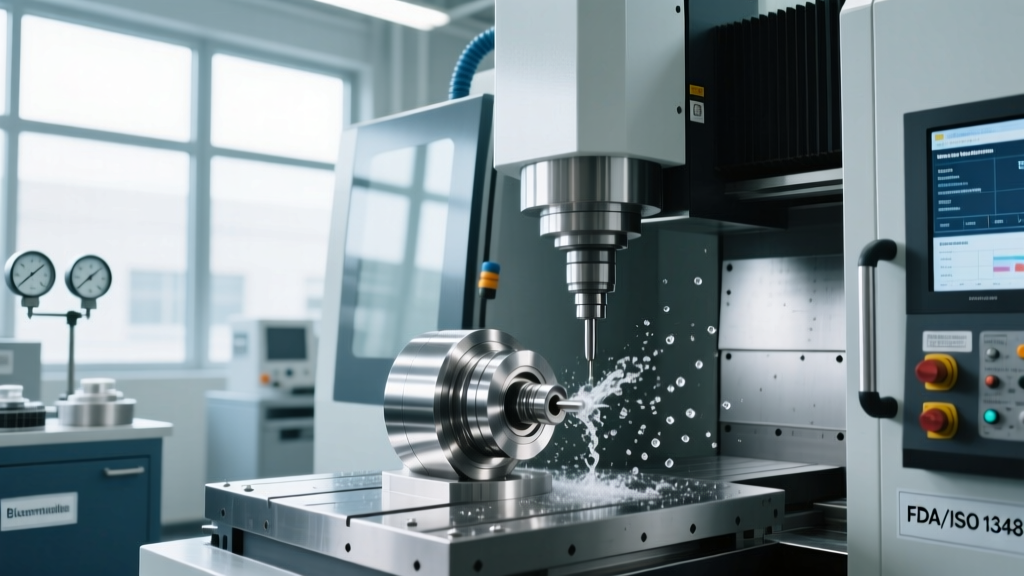
In medical manufacturing, tolerance is not merely a quality metric; it is a safety mechanism. Manual machining or standard 3-axis CNC setups cannot reliably hold the geometric dimensioning and tolerancing (GD&T) requirements of modern joint replacements. Medical-grade 5-axis CNC machining centers, such as the DMG MORI NTX 1000 or Haas UMC-500SS, utilize closed-loop feedback systems and thermal compensation to maintain sub-micron repeatability.
| Component Type | Critical Dimension | Required Tolerance | Clinical Failure Consequence |
|---|---|---|---|
| Hip Replacement Ball Head | Sphericity / Diameter | ±0.0001' (±2.5µm) | Accelerated UHMWPE wear, osteolysis, implant loosening |
| Spinal Pedicle Screw | Thread Pitch / Major Dia. | ±0.0003' (±7.5µm) | Cross-threading during surgery, bone micro-fractures |
| Surgical Drill Guide | True Position (Holes) | ±0.0005' (±12.5µm) | Misaligned bone cuts, nerve damage, revision surgery |
Surface Roughness (Ra) and Biocompatibility
Surface finish directly dictates how the human body reacts to an implant, as well as how easily a surgical tool can be sterilized. Bacterial harboring in microscopic machining marks is a leading cause of post-operative periprosthetic joint infections (PJIs). For surgical instruments and temporary implants, CNC turning and milling operations are programmed to achieve a surface roughness average (Ra) of less than 0.4 µm (16 µin).
Achieving this via CNC requires specific toolpath strategies, such as high-speed machining (HSM) with constant tool engagement, utilizing diamond-coated or TiAlN-coated carbide end mills. For polymers like Victrex 450G PEEK (commonly used in spinal cages to match the modulus of human cortical bone), CNC parameters must be tightly controlled to prevent smearing or micro-cracking, which compromises the material's biocompatibility and mechanical strength.
'Design controls are not just paperwork; they are the engineering methodology that ensures a medical device will perform safely and effectively in the hands of the end-user.' — FDA Design Control Guidance for Medical Device Manufacturers
Risk Mitigation: Manual vs. 5-Axis CNC Validation
Under FDA design controls, manufacturing processes must be validated when the results cannot be fully verified by subsequent inspection. While CNC machining results *can* be inspected, the sheer volume of medical production requires statistical process control (SPC). The safety benefits of CNC machining are most evident when comparing risk profiles against manual operations.
Manual Machining Risks:- High operator-to-operator variability
- Inability to replicate complex 3D organic contours (e.g., anatomical knee tibial trays)
- Lack of automated tool-breakage detection
- High scrap rates leading to material traceability gaps
- Deterministic repeatability (Cp/Cpk > 1.33)
- Simultaneous 5-axis interpolation for anatomical surfaces
- Renishaw spindle probes for in-cycle part verification
- Automated M-code logging for audit trails
Audit-Ready Metrology and Documentation
The final layer of CNC safety compliance is metrology. Medical CNC shops employ Coordinate Measuring Machines (CMMs), such as the Zeiss CONTURA, equipped with VAST scanning heads to capture thousands of data points per minute on complex implant geometries. Before a single production part is shipped, the shop must generate an Initial Sample Inspection Report (ISIR) or Production Part Approval Process (PPAP) package.
This package includes first-article inspection (FAI) data per AS9102, material certifications, CMM graphical overlays, and proof of IQ/OQ/PQ (Installation, Operational, and Performance Qualification) for the specific CNC program used. Expect to pay a premium for this level of compliance; while standard aerospace or automotive CNC rates hover around $90–$120 per hour, ISO 13485-certified medical machining with full metrology and validation documentation commands $150–$220 per hour, plus $15,000–$30,000 upfront for process validation per part family.
Frequently Asked Questions
Why is Ti-6Al-4V ELI preferred over standard Grade 5 Titanium for CNC implants?
Standard Grade 5 (Ti-6Al-4V) has higher oxygen content, making it stronger but more brittle. The ELI (Extra Low Interstitial) variant reduces oxygen, nitrogen, carbon, and iron impurities. This dramatically increases fracture toughness and fatigue crack growth resistance, which are critical safety requirements for load-bearing implants like hip stems and spinal rods that experience millions of cyclic loads in the body.
How does CNC machining handle the sterilization requirements of surgical tools?
Surgical tools must withstand repeated autoclave cycles (high-pressure steam at 121°C+). CNC machining ensures the tool's geometry lacks deep, unpolishable crevices where biological matter can hide. Furthermore, CNC shops leave specific surface finishes or apply post-machining electropolishing to remove the amorphous 'Beilby layer' left by cutting tools, exposing a pure chromium-oxide layer on stainless steel that prevents rust and pitting during autoclaving.
What is the cost impact of FDA compliance on CNC machined medical parts?
Compliance adds roughly 20% to 35% to the base machining cost. This covers the overhead of maintaining a Class 7 or Class 8 cleanroom for final part washing and packaging, the labor required to maintain Device History Records (DHR), and the capital depreciation of advanced metrology equipment like 3D optical scanners and CMMs required for 100% inspection of critical-to-quality (CTQ) dimensions.