Lean Manufacturing Workflows for High-Precision CNC Machining Products
Discover how lean manufacturing workflows and SMED techniques optimize cycle times, tolerances, and surface finishes for high-precision CNC machining products.
The Physics of Flow: How Workflow Dictates Tolerances
Most machine shops view lean manufacturing strictly as an inventory and scheduling methodology. However, in the production of high-precision cnc machining products, workflow optimization is fundamentally a technical variable that directly impacts part geometry, metallurgical integrity, and surface finish. When a CNC spindle sits idle during prolonged setups or waits for batch-and-queue inspection, it loses thermal equilibrium. This thermal drift introduces Z-axis and spindle-growth errors that can easily exceed ±0.0005 inches on a standard VMC.
By implementing lean principles—specifically Single-Minute Exchange of Die (SMED) and continuous single-piece flow—shops maintain spindle thermal stability. A machine that is cutting metal 85% of the time remains at a predictable thermal growth curve, allowing CAM software and machine controllers to accurately compensate for expansion. The result is a batch of cnc machining products that consistently holds tight Geometric Dimensioning and Tolerancing (GD&T) callouts without requiring manual secondary operations.
Technical Insight: According to the Lean Enterprise Institute, eliminating batch-and-queue processing reduces lead times by up to 90%. In CNC environments, this continuous flow also eliminates the "cold start" thermal shock that causes premature carbide insert micro-chipping during the first 15 minutes of a new batch.SMED and Zero-Point Workholding Matrices
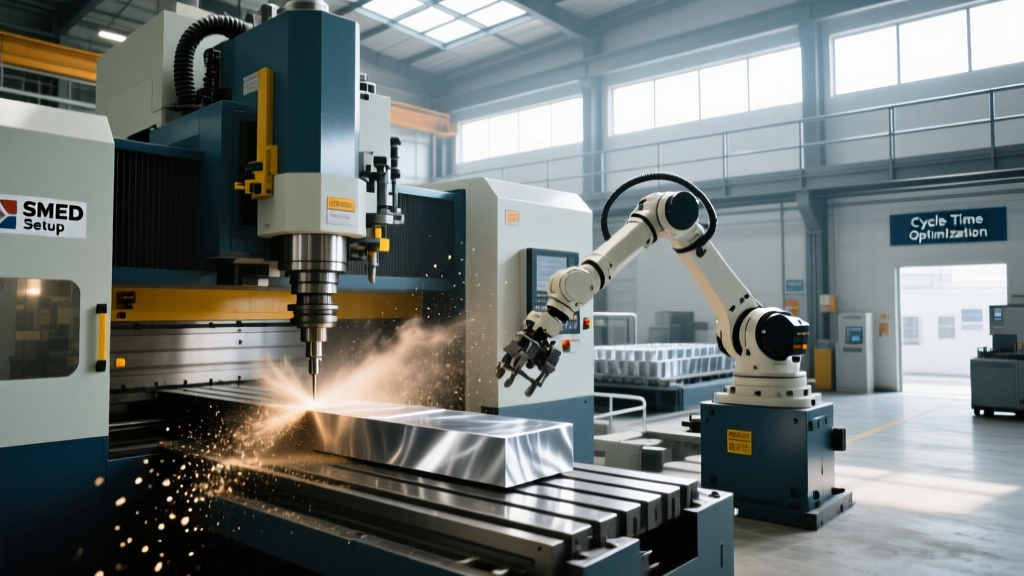
The cornerstone of lean CNC workflow is SMED, which converts internal setup tasks (done while the machine is stopped) into external tasks (done while the machine is running). To achieve this technically, modern shops rely on zero-point clamping systems. These systems utilize pneumatic or hydraulic actuators to pull and lock workpiece pallets into the machine table with micron-level repeatability.
Workholding Technical Comparison
Selecting the right workholding interface is critical for maintaining lean flow. Below is a technical matrix comparing traditional setups against lean-optimized zero-point systems for 5-axis and HMC applications.
| System Type | Example Product | Repeatability | Avg. Setup Time | Clamping Force | Impact on Lean Flow |
|---|---|---|---|---|---|
| Standard Kurt Vise (Manual) | Kurt D688 | ±0.0010" | 25-40 mins | ~8,000 lbs | High internal setup time; disrupts continuous flow. |
| Zero-Point Pneumatic | Schunk Vero-S NSL | ±0.0002" | 2-4 mins | Up to 44,000 lbs | Enables external pre-staging; maximizes spindle uptime. |
| Tombstone Modular (HMC) | Erowa ITS System | ±0.0001" | < 1 min (Auto) | Variable (Hydraulic) | Facilitates lights-out machining and unattended lean cells. |
By standardizing on a system like the Schunk Vero-S, an operator can pre-stage raw material and workholding on a secondary bench. When the cycle ends, the machine table unclamps, the crane swaps the pallet, and the pneumatic system locks it in. The machine transitions from cut-to-cut in under 120 seconds, drastically increasing Overall Equipment Effectiveness (OEE).
Closed-Loop Metrology in Continuous Flow
Traditional quality control relies on moving finished cnc machining products to a temperature-controlled CMM (Coordinate Measuring Machine) room. This creates a bottleneck, violating the lean principle of single-piece flow and delaying feedback to the machine operator. If a tool wears out of tolerance, an entire batch may be scrapped before the CMM room flags the issue.
Lean technical workflows solve this by integrating in-machine metrology. Using touch probes and laser tool setters, the CNC controller performs automated in-cycle gauging. For high-volume precision components, systems like the Renishaw Equator gauging system sit adjacent to the machine. The Equator uses a master part to establish a baseline and rapidly compares production parts in seconds, feeding tool-wear offsets directly back to the CNC macro variables.
"Integrating automated probing routines into the G-code program adds roughly 14 seconds to a cycle time but eliminates 45 minutes of offline CMM inspection per batch, yielding a net-positive time savings while guaranteeing CpK values above 1.33."
Thermal Stability, Chip Evacuation, and Coolant Management
A frequently overlooked aspect of lean CNC workflow is chip management. In a poorly optimized shop, operators must pause the machine every two hours to clear bird-nested chips from the workholding and tool changer. This interruption breaks the lean flow and introduces thermal variance.
High-Pressure Coolant Specifications for Lean Flow
To maintain uninterrupted cutting, technical specifications for coolant delivery must be upgraded. Standard flood coolant operates at roughly 300 PSI, which is insufficient for breaking chips in sticky aerospace alloys like Inconel 718 or 304 Stainless Steel.
- Standard Flood (300 PSI): Relies on volume; prone to chip welding and long, stringy nests that require manual intervention.
- High-Pressure Through-Tool (1,000 - 1,500 PSI): Creates a localized hydraulic wedge between the chip and the cutting edge. This forces chip curl and breakage, allowing gravity to evacuate chips into the conveyor without operator intervention.
- Cryogenic / Minimum Quantity Lubrication (MQL): Eliminates coolant disposal waste (a core lean environmental metric) while maintaining precise thermal boundaries on the cutting edge.
Upgrading to a 1,000 PSI pump system ensures that chips are evacuated automatically, allowing the machine to run unattended through breaks and shift changes, which is a mandatory requirement for true lean manufacturing.
Tooling Standardization and Runout Reduction
Lean manufacturing demands predictability. If a shop uses a mix of ER collets, Weldon flats, and set-screw holders, tool life and surface finishes will vary unpredictably, forcing conservative feed rates and slowing down production. Standardizing toolholding is a critical technical step.
According to Sandvik Coromant's machining fundamentals, utilizing high-precision hydraulic or shrink-fit toolholders reduces Total Indicated Runout (TIR) to less than 3 microns at 3xD projection. This micro-level precision ensures that every flute on an endmill shares the cutting load equally. The technical benefits include:
- Extended Tool Life: Predictable wear patterns allow shops to set exact tool-life limits in the controller, triggering automatic sister-tool replacements without human inspection.
- Superior Surface Finish: Eliminating chatter marks allows parts to go straight from the mill to assembly, bypassing secondary deburring or polishing stations.
- Optimized Feeds and Speeds: With guaranteed rigidity, CAM programmers can safely increase Material Removal Rates (MRR) by 15-20%, shrinking cycle times.
Implementation Checklist for the Machine Shop Floor
Transitioning to a lean workflow for cnc machining products requires a systematic overhaul of both software and hardware. Use this technical checklist to audit your current operations:
- Audit Spindle Uptime: Track actual cutting time versus loading/unloading time. Target a minimum of 75% spindle utilization during a standard shift.
- Implement 5S at the Tool Crib: Pre-kit all tools, offsets, and raw materials for the next job on a shadow-board cart before the current cycle ends.
- Standardize Workholding: Phase out manual vises in favor of zero-point pallet systems to enable external setup staging.
- Automate Metrology: Write Renishaw or Blum probing macros directly into the post-processor to automate first-article and in-cycle inspections.
- Upgrade Chip Evacuation: Ensure all through-spindle coolant lines are rated for a minimum of 1,000 PSI to prevent manual chip clearing.
Ultimately, producing premium cnc machining products is not just about owning a 5-axis machine; it is about engineering a workflow where the machine is never waiting on the operator. By applying lean technical specifications to workholding, metrology, and thermal management, shops can achieve aerospace-grade tolerances at commercial production speeds.