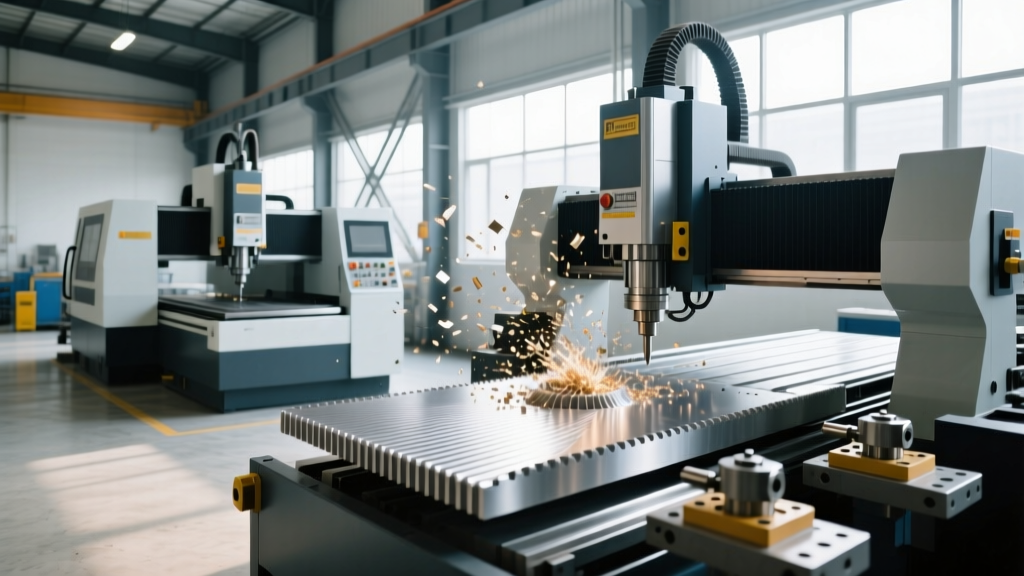
Lean vs Traditional: Choosing a CNC Precision Machining Company
Compare lean and traditional workflows when selecting a CNC precision machining company. Learn how lean manufacturing impacts lead times, costs, and quality.
The Hidden Cost of Shop Floor Workflow
When sourcing complex components, procurement teams typically evaluate a CNC precision machining company based on their equipment list—checking for 5-axis capabilities, Swiss-type lathes, or CMM inspection rooms. However, the machine model is only half the equation. A shop running a DMG MORI DMU 50 with a chaotic, batch-and-queue workflow will consistently underperform a shop running an older Haas VF-2SS with a disciplined, lean manufacturing system.
The operational workflow dictates your actual lead times, part consistency, and final unit cost. As supply chain volatility persists in 2026, understanding the structural differences between traditional and lean machine shop operations is critical for making an informed vendor selection.
Core Workflow Definitions
Traditional Workflow: Operates on a 'batch and queue' model. Machines are grouped by type (all mills in one area, all lathes in another). Parts are machined in large batches to minimize setup frequency, resulting in high Work-In-Progress (WIP) inventory and long lead times.
Lean Workflow: Operates on 'single-piece flow' or cellular manufacturing. Equipment is grouped by part family. Setup times are aggressively minimized, allowing for smaller batch sizes, reduced WIP, and rapid response to engineering changes.
Side-by-Side Comparison: Lean vs. Traditional CNC Operations
The following matrix highlights the operational metrics you should request during a vendor audit. Data reflects industry benchmarks for mid-sized job shops producing tight-tolerance (<0.0005 in) aluminum and stainless steel components.
| Metric | Traditional Shop | Lean-Optimized Shop |
|---|---|---|
| Overall Equipment Effectiveness (OEE) | 40% - 55% | 75% - 85% |
| Average 5-Axis Setup Time | 90 - 180 minutes | 12 - 30 minutes |
| Work-In-Progress (WIP) Days | 12 - 21 days | 2 - 5 days |
| First-Pass Yield (Scrap Rate) | 88% - 92% | 97% - 99.5% |
| Quoting Turnaround Time | 5 - 10 business days | 24 - 48 hours |
Deconstructing the Setup: SMED and Zero-Point Clamping
The most significant differentiator between a traditional and lean CNC precision machining company is how they handle machine setup. In a traditional shop, a machinist spends hours indicating vises, finding part zeros, and manually loading tools into the carousel. This necessitates large batch sizes to amortize the setup cost across more parts.
The Lean Approach: Single-Minute Exchange of Die (SMED)
Lean shops apply SMED principles to CNC machining. They convert internal setup tasks (done while the machine is stopped) into external tasks (done while the machine is running).
- Zero-Point Clamping: Systems like the Schunk Vero-S or System 3R allow operators to load workpieces onto pallets outside the machine. The pallet locks into the machine bed with a repeatability of 0.0002 inches, eliminating manual indication.
- RFID Tool Management: Tools are pre-measured on an offline presetter (e.g., Zoller smileLine). The tool holder's RFID chip automatically uploads the exact length and diameter offsets to the CNC control (like the Heidenhain TNC7), bypassing manual tool probing.
- Standardized CAM Templates: Programmers use standardized tool libraries and verified post-processors, ensuring the G-code is perfect before it reaches the floor.
By implementing these technologies, a lean shop can drop a 5-axis setup from two hours to under fifteen minutes, making batches of 10 or 20 parts economically viable without inflating the unit price.
Material Flow and WIP: The Silent Margin Killers
According to the Lean Enterprise Institute, excess inventory is one of the primary wastes in manufacturing. In a traditional machine shop layout, a single part might travel 2,000 feet across the facility, sitting in queues between the saw, lathe, mill, deburring bench, and CMM room. Every time a part sits in a bin, it risks damage, loss, or obsolescence due to an engineering change order (ECO).
Warning for Buyers: If you require frequent design iterations (common in aerospace prototyping or medical device development), a traditional shop's high WIP means your ECO will halt the entire batch. A lean shop's single-piece flow ensures only the immediate next part is affected, saving thousands in scrapped material and delayed timelines.Lean shops utilize cellular manufacturing. A manufacturing cell might include a CNC lathe, a 3-axis vertical mill, and a robotic deburring arm, all arranged in a U-shape. Automated Guided Vehicles (AGVs), such as the MiR250, move raw material to the start of the cell and finished goods to shipping, drastically reducing forklift traffic and part handling damage.
Cost Implications: Where the Money Actually Goes
When comparing quotes, a traditional shop might appear cheaper on paper for high-volume runs, but hidden overhead costs often emerge. Let us break down the cost structure for a hypothetical batch of 500 complex 6061-T6 aluminum housings.
Traditional Shop Cost Allocation
- Raw Material: $4,500
- Direct Machine Time: $6,000 (150 hours @ $40/hr)
- Setup & Programming Amortization: $1,200 (High setup time divided by 500 parts)
- WIP Carrying & Handling Costs: $1,800 (Floor space, secondary handling, queue management)
- Scrap/Rework Allowance (8%): $1,080
- Total Estimated Cost: $14,580 ($29.16 / part)
Lean Shop Cost Allocation
- Raw Material: $4,500
- Direct Machine Time: $5,250 (Optimized toolpaths and continuous spindle engagement)
- Setup & Programming Amortization: $400 (SMED reduces setup to minutes)
- WIP Carrying & Handling Costs: $300 (Single-piece flow eliminates queues)
- Scrap/Rework Allowance (1.5%): $202
- Total Estimated Cost: $10,652 ($21.30 / part)
The lean shop delivers a 27% cost reduction, not by cutting corners on quality, but by systematically eliminating non-value-added activities. The NIST Manufacturing Extension Partnership (MEP) consistently reports that shops adopting lean principles see a 15% to 30% reduction in overall operational costs within the first 24 months of implementation.
Evaluating the Shop Floor: 4 Audit Questions for Buyers
Do not rely solely on a vendor's marketing materials. When touring a facility or conducting a virtual audit, ask these specific questions to verify their lean claims:
- 'Show me your tool crib and presetting area.'
What to look for: A lean shop will have a dedicated, climate-controlled tool crib with offline presetters. A traditional shop will have tools scattered in machine-side cabinets and operators measuring tools directly in the spindle. - 'How do you handle an Engineering Change Order (ECO) mid-batch?'
What to look for: Look for digital work instructions on shop-floor monitors (e.g., MachineMetrics or ProShop ERP). If they rely on paper travelers that must be physically hunted down and redlined, they are not operating a lean workflow. - 'What is your spindle utilization rate?'
What to look for: Lean shops track IoT spindle data and typically boast 70%+ cutting time. Traditional shops often confuse 'machine on' time with 'cutting' time, masking the hours spent on setup and part loading. - 'Are you certified to ISO 9001:2015 or AS9100D?'
What to look for: While ISO certification does not guarantee lean operations, adherence to ISO 9001:2015 quality management standards ensures they have documented processes for corrective actions and continuous improvement, which are foundational to lean manufacturing.
When to Choose Which: A Decision Matrix
While lean manufacturing is universally beneficial, the degree to which you should prioritize a lean-optimized CNC precision machining company depends on your specific project parameters.
| Project Scenario | Recommended Workflow | Rationale |
|---|---|---|
| High-Volume, Low-Mix (e.g., 10,000 identical automotive fittings) | Traditional or Dedicated Lean Cell | Setup time is amortized over thousands of parts. A traditional shop with dedicated bar feeders can compete on price here. |
| High-Mix, Low-Volume (e.g., 50 different aerospace brackets, qty 5 each) | Strictly Lean (SMED & Zero-Point) | Without rapid changeover capabilities, setup costs will eclipse material and machining costs, destroying your budget. |
| Rapid Prototyping with Expected Iterations | Lean (Single-Piece Flow) | Single-piece flow prevents large batches of obsolete parts when design changes inevitably occur on iteration 2 or 3. |
| Tight-Tolerance Medical Implants (Titanium/PEEK) | Lean (Cellular with In-Line CMM) | Material costs are extreme. Lean shops integrate probing and in-line inspection to catch tool wear immediately, preventing batch-wide scrap. |
Selecting the right manufacturing partner requires looking past the paint on the machines and examining the flow of material across the floor. By prioritizing a CNC precision machining company that has structurally integrated lean principles, SMED methodologies, and digital workflow tracking, you secure a supply chain that is resilient, cost-effective, and capable of scaling with your engineering demands.