Lean vs Traditional Workflow: Choosing a CNC Precision Machine Shop
Compare lean vs traditional workflows in a CNC precision machine shop. Discover how manufacturing alternatives impact lead times, setup costs, and part quality.
The Hidden Variable: Workflow Architecture in Part Sourcing
When sourcing complex components, procurement teams and lead engineers typically audit a cnc precision machine shop based on its equipment list. They look for 5-axis DMG Mori DMU machines, Mazak Variaxis centers, or Zeiss CMM inspection labs. However, the equipment list only tells half the story. The true determinant of lead time, unit cost, and defect rates is the shop's underlying workflow architecture.
Evaluating a machine shop requires a direct comparison between two fundamentally different operational models: the traditional batch-and-queue job shop and the lean single-piece flow production facility. Understanding the mechanical and financial differences between these alternatives is critical for matching your specific supply chain needs to the right manufacturing partner.
Executive Summary: Traditional batch shops excel at high-mix, ultra-low-volume prototypes where flexibility outweighs efficiency. Lean single-piece flow shops dominate in medium-to-high volume production (50 to 50,000 units), utilizing SMED (Single-Minute Exchange of Die) and zero-point clamping to slash setup costs by up to 95% and eliminate work-in-progress (WIP) handling damage.Traditional Batch-and-Queue vs. Lean Single-Piece Flow
The core divergence between these two models lies in how they handle work-in-progress (WIP) and machine setup. Below is a direct comparison of operational metrics based on current industry benchmarks for mid-sized precision facilities.
| Metric | Traditional Batch Shop | Lean Single-Piece Shop |
|---|---|---|
| Setup Time (Avg 3-Axis VMC) | 45 - 90 minutes | 3 - 8 minutes |
| Spindle Utilization Rate | 30% - 45% | 80% - 95% |
| WIP Inventory Footprint | High (Totes, racks, floor space) | Minimal (Direct transfer) |
| Defect Discovery Lag | Days (Found at final CMM) | Minutes (In-line probing) |
| Handling Damage Risk | High (Multiple tote transfers) | Near Zero |
Deconstructing the Traditional Machining Workflow
In a traditional job shop, workflow is organized by machine type. All 3-axis mills are in one row, all lathes in another, and all CMMs in a separate inspection room. Parts are machined in large batches. A batch of 500 aluminum valve bodies will be fully milled on the VMC, loaded into plastic totes, moved to a staging rack, and later loaded onto a lathe for secondary turning operations.
The Hidden Financial and Quality Costs of WIP
This batch-and-queue method creates massive amounts of WIP. According to principles outlined by the Lean Enterprise Institute, parts in a traditional batch system spend up to 95% of their lead time sitting idle in queues rather than being cut. This introduces two severe penalties:
- The Setup Cost Penalty: If a shop charges $150 per hour for machine time, a 60-minute manual setup (indicating the vise, dialing in the part, setting tool offsets) costs $150. Amortized over a batch of 50, the setup cost is $3.00 per part. If you only need 10 prototypes, that setup cost becomes $15.00 per part.
- The Handling Damage Penalty: Every time a machined part is dropped into a tote, stacked, or moved across the shop floor, it risks cosmetic and dimensional damage. Anodized surfaces scratch, and delicate thin-walled geometries warp under the weight of other parts in the bin. Traditional shops often see a 2-4% scrap rate purely from inter-operation handling.
The Lean Alternative: SMED and Zero-Point Clamping
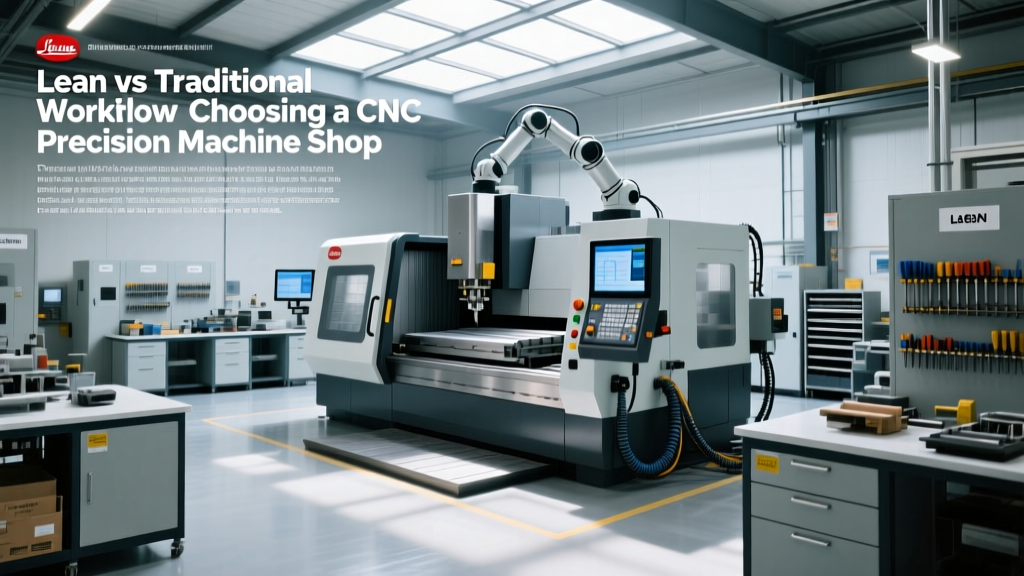
A lean cnc precision machine shop abandons departmental layouts in favor of cellular manufacturing and single-piece flow. The goal is to machine a part from raw stock to finished CMM inspection without it ever sitting in a queue. The technological enabler for this in modern CNC machining is SMED (Single-Minute Exchange of Die) combined with zero-point clamping systems.
Real-World Setup Reduction: Erowa and System 3R
Top-tier lean shops utilize standardized pallet systems like Erowa ITS or System 3R Macro. Instead of an operator spending 45 minutes manually indicating a raw block of 6061-T6 aluminum in a Kurt vise, the raw stock is pre-mounted to a standardized pallet chuck outside the machine envelope while the spindle is still cutting the previous part.
When the cycle finishes, the operator swaps the pallet. The machine's zero-point receiver locks the pallet into place with a repeatability of 0.00008 inches (2 microns). The CNC program automatically calls the corresponding work offset. The spindle is back in the cut within 120 seconds. This drops the setup cost for a batch of 10 parts from $15.00 down to roughly $0.50 per part.
Warning: Beware of 'Fake' Lean ShopsMany machine shops market themselves as 'lean' simply because they have 5S floor markings and shadow boards for their wrenches. True lean CNC machining requires capital investment in automated pallet pools (e.g., a Fastems or Erowa robotic loading system, which can add $150,000+ to a cell) and integrated in-machine Renishaw or Blum touch probes for automated first-article verification. Always ask to see their spindle utilization data and setup time logs before awarding high-volume contracts.
2026 Technology Stack: Automating the Lean Workflow
As we navigate the manufacturing landscape of 2026, the lean workflow is heavily augmented by Industry 4.0 software integration. A true lean alternative to the traditional job shop will feature the following technology stack to guarantee single-piece flow:
- Digital Twin Simulation: Using software like Vericut or Mastercam 2026's machine simulation modules, lean shops verify toolpaths against a digital twin of the exact machine kinematics. This eliminates the traditional 'prove-out' cycle where a machine sits idle for 2 hours while an operator single-blocks through a new program.
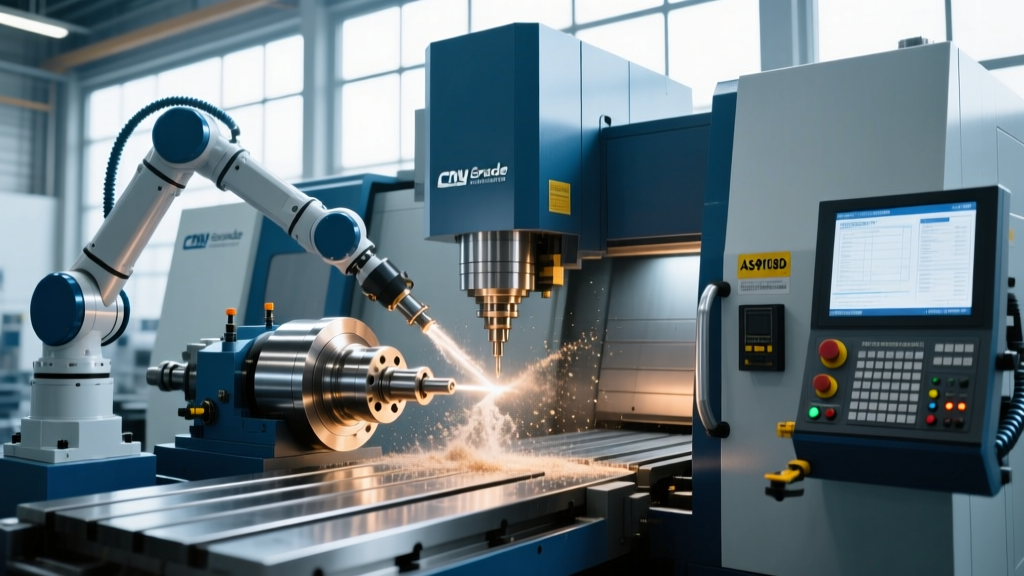
- In-Line CMM Automation: Instead of moving parts to a separate metrology lab, lean cells integrate robotic arms (like a FANUC CRX cobot) that transfer the finished part directly from the VMC to an in-cell Equator gauging system. If a tool wears and a dimension drifts by 0.0002 inches, the Equator feeds an offset back to the Siemens Sinumerik ONE control automatically, adjusting the next cut without human intervention.
- Automated Chip Management: Unattended lean workflows fail if chip entanglement occurs. High-pressure coolant systems (1000+ PSI) and specialized auger conveyors are mandatory to prevent bird-nesting in deep cavity milling of materials like 17-4 PH stainless steel or Ti-6Al-4V.
Decision Matrix: Which Shop Model Fits Your Supply Chain?
Choosing between a traditional and lean cnc precision machine shop is not about finding the 'best' shop, but aligning the shop's operational model with your specific project parameters. Use the framework below to make your sourcing decision.
| Project Scenario | Recommended Shop Model | Why? |
|---|---|---|
| Complex 5-Axis Prototypes (1-5 pcs) | Traditional / High-Mix Job Shop | Flexibility and engineering collaboration outweigh the need for automated setup reduction. High hourly rates are offset by zero tooling investment. |
| Bridge Production (50-500 pcs) | Lean Single-Piece Shop | SMED and zero-point clamping drastically reduce the per-part setup amortization, making small batches economically viable. |
| High-Volume Annual Runs (10k+ pcs) | Lean Lights-Out Facility | Requires robotic pallet pools and in-line probing to run unmanned third shifts, dropping the effective machine rate by 40%. |
| Legacy / Obsolete Material Machining | Traditional Job Shop | High risk of material inclusions or hard spots requires manual operator intervention and adaptive toolpath adjustments that automated lean cells cannot handle safely. |
Sourcing and Verification
Transitioning your supply chain to a lean manufacturing partner requires rigorous verification. The NIST Manufacturing Extension Partnership (MEP) frequently highlights that small-to-medium manufacturers can increase throughput by 20-30% purely through setup reduction without buying new spindles. When auditing a potential shop, do not just ask for their ISO 9001:2015 certificate. Ask for their OEE (Overall Equipment Effectiveness) reports, specifically looking at the 'Availability' metric to see how much time their spindles spend in setup versus actual cutting.
By shifting your evaluation criteria from a simple equipment checklist to a deep analysis of workflow architecture, you secure a manufacturing partner capable of delivering precision components with predictable lead times, minimized handling defects, and optimized unit economics.