Top CNC Machining Manufacturers for Automotive Aftermarket Parts
Explore how top CNC machining manufacturers produce high-performance automotive aftermarket parts, from billet throttle bodies to motorsport suspension uprights.
The automotive aftermarket sector relies heavily on precision engineering to outperform original equipment manufacturer (OEM) cast and forged components. When performance shops, off-road builders, and motorsport teams require bespoke intake manifolds, lightweight suspension uprights, or high-flow turbo compressor wheels, they turn to specialized cnc machining manufacturers. These manufacturers bridge the gap between low-volume prototyping and mid-volume production runs (50 to 5,000 units), delivering tolerances and material integrity that traditional casting simply cannot achieve.
Material Selection: The Foundation of Aftermarket Performance
Automotive aftermarket parts operate under extreme thermal and mechanical stress. Selecting the correct alloy and temper is the first critical decision in the machining process. Reputable manufacturers adhere strictly to material certifications, such as the ASTM B209 Standard Specification for Aluminum and Aluminum-Alloy Sheet and Plate, to ensure batch-to-batch consistency.
Quick Reference: Aftermarket Alloy Matrix
- 6061-T6 Aluminum: The workhorse for intake manifolds, general brackets, and fluid reservoirs. Excellent machinability and corrosion resistance. Yield strength: ~40,000 psi.
- 7075-T6 Aluminum: Reserved for high-stress, high-fatigue components like suspension uprights, wheel hubs, and steering knuckles. Yield strength: ~73,000 psi. Poor corrosion resistance requires anodizing.
- 303 Stainless Steel: Used for AN-fittings, fuel rails, and exhaust flanges. High sulfur content improves machinability but slightly reduces corrosion resistance compared to 304.
- 4140 Pre-Hardened Steel: Ideal for drivetrain components, axles, and heavy-duty steering linkages. Offers high impact toughness and wear resistance.
Case Study 1: Billet Throttle Bodies and Intake Manifolds
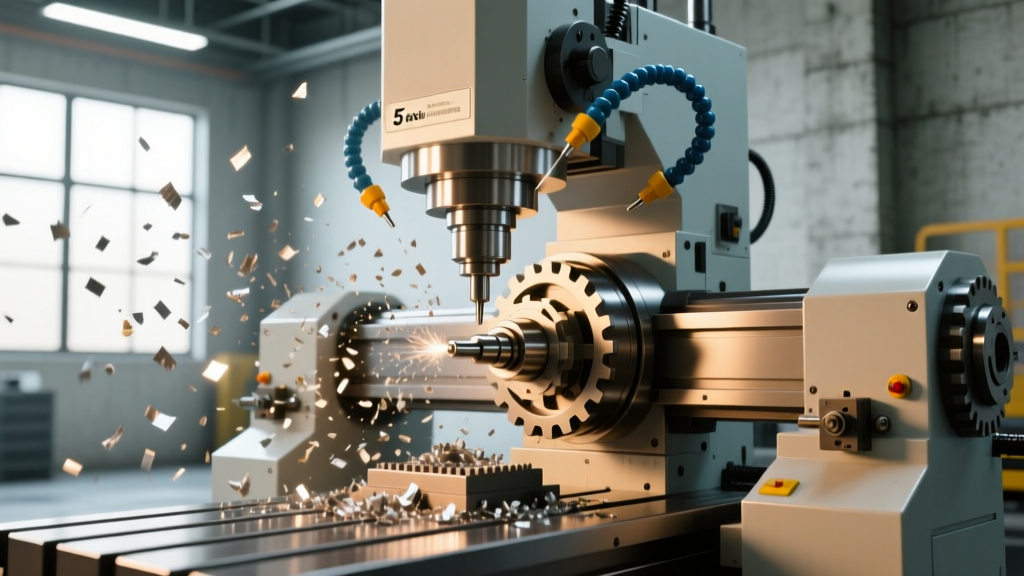
Upgrading from a restrictive OEM plastic intake to a CNC-machined billet aluminum intake manifold is a staple of the performance aftermarket. Machining a 90mm billet throttle body requires complex 5-axis simultaneous machining to handle the intersecting bore angles, butterfly valve pockets, and coolant passage routing.
Machine and Tooling Specifications
To achieve the necessary geometric complexity without multiple setups (which introduce cumulative tolerance stack-up), top-tier shops utilize advanced 5-axis trunnion table machines, such as the Haas UMC-750. This allows the machine to access the angled flange faces and deep bore pockets in a single clamping operation.
- Bore Tolerance: The throttle blade bore must be held to ±0.0002 inches to prevent vacuum leaks while ensuring the blade does not bind at wide-open throttle (WOT).
- Surface Finish: Internal airflow passages require a Ra 32 µin (microinch) finish or better to minimize boundary layer friction and maximize volumetric efficiency.
- Tooling Strategy: Long-reach carbide end mills with variable helix angles are used to dampen harmonic chatter when pocketing deep runner plenums.
Case Study 2: Motorsport Suspension Uprights
In road racing and time-attack builds, reducing unsprung weight is paramount. CNC-machined 7075-T6 aluminum suspension uprights replace heavy cast iron or stamped steel OEM parts. The design process typically involves topology optimization software, resulting in organic, bone-like structures that are incredibly difficult to cast but perfectly suited for multi-axis CNC milling.
Manufacturing these uprights requires aggressive material removal rates (MRR) followed by precision finishing. A standard motorsport upright might start as a 15-pound billet block and finish as a 3.5-pound part, requiring the removal of 76% of the raw material. To manage the high cutting forces and prevent part deflection during the roughing passes, manufacturers employ adaptive toolpaths that maintain a constant tool engagement angle, extending tool life and protecting the spindle bearings.
Production Economics: OEM Casting vs. CNC Billet
Understanding the cost-to-performance ratio is vital for aftermarket brands deciding between tooling up for a casting run or contracting a CNC machine shop. The table below illustrates the economic realities for a production run of 500 rear suspension trailing arms.
| Metric | Sand Cast Aluminum (OEM Style) | CNC Machined Billet (7075-T6) |
|---|---|---|
| Initial Tooling / Setup Cost | $18,000 - $25,000 (Pattern & Core Boxes) | $1,500 - $3,000 (CAD/CAM Programming & Fixtures) |
| Unit Cost (at 500 qty) | $45.00 / unit | $115.00 / unit |
| Lead Time to First Part | 8 - 12 Weeks | 2 - 3 Weeks |
| Tensile Strength & Fatigue Life | Moderate (Prone to porosity inclusions) | Exceptional (Continuous grain structure) |
| Design Iteration Agility | Low (Requires new physical patterns) | High (Modify CAD and regenerate toolpaths) |
For high-end, low-volume aftermarket applications (under 2,000 units per year), CNC machining is almost always more cost-effective and yields a vastly superior mechanical part compared to die or sand casting.
Vetting CNC Machining Manufacturers for Automotive Contracts
Not all machine shops are equipped to handle the stringent demands of the automotive aftermarket. When sourcing a manufacturing partner for safety-critical components like brake calipers or steering racks, buyers must evaluate specific quality management and metrology capabilities.
1. Quality Management Certifications
While ISO 9001:2015 is a baseline requirement, the gold standard for automotive manufacturing is the IATF 16949 Quality Management System. Shops holding this certification have proven their ability to execute Advanced Product Quality Planning (APQP) and Production Part Approval Processes (PPAP), ensuring that the 500th part off the pallet is identical to the first.
2. Metrology and Inspection Hardware
Visual inspection and hand tools (calipers/micrometers) are insufficient for complex 5-axis automotive parts. Manufacturers must possess Coordinate Measuring Machines (CMM) equipped with scanning probes (such as the Renishaw SP25M) to capture true-position data on angled bolt holes and profile tolerances on aerodynamic surfaces. Require a First Article Inspection (FAI) report per AS9102 standards for every new part number.
3. Supply Chain and Material Traceability
Counterfeit or out-of-spec aluminum is a persistent issue in global supply chains. Top-tier CNC machining manufacturers maintain strict material traceability, providing certified mill test reports (MTRs) for every batch of billet used. This ensures that a 7075-T6 suspension component actually possesses the required zinc and magnesium alloying percentages to withstand track-day cornering loads.
The 2026 Frontier: EV Conversion Aftermarket Parts
As the automotive landscape shifts, the aftermarket is aggressively pivoting toward Electric Vehicle (EV) conversions and performance upgrades. This has created a massive surge in demand for specific CNC-machined components that internal combustion engine (ICE) vehicles never required.
- Custom Battery Enclosure Flanges: Machined from 5083 aluminum for its superior marine-grade corrosion resistance, requiring deep-pocket 3-axis milling and friction-stir welding preparation.
- High-Voltage Busbar Insulators: Precision-machined from Delrin (POM) or PEEK plastics, requiring strict thermal management during cutting to prevent material melting and edge burring.
- EV Motor Mount Adapters: Mating modern Tesla or Chevrolet E-Crate motors to vintage ICE chassis requires complex, multi-plane adapter plates machined from 1-inch thick 6061-T6 tooling plate, demanding absolute flatness (within 0.001 inches) to prevent drivetrain binding.
Partnering with experienced cnc machining manufacturers who understand both the metallurgical requirements of traditional motorsports and the electrical/thermal demands of EV platforms is the key to capturing market share in the modern automotive aftermarket.