High-Volume Cost Strategies for a Large Part CNC Machining Shop
Discover high-volume cost analysis and budget planning strategies for a large part CNC machining shop. Optimize production ROI with expert frameworks.
The High-Volume Large-Part Paradox: Redefining Unit Economics
Historically, machining large-format components—parts exceeding 1,500mm in any primary axis—was synonymous with low-volume, high-mix job shop work. However, the explosive demand for electric vehicle (EV) battery enclosures, aerospace wing spars, and renewable energy structural hubs has forced the modern large part cnc machining shop to adopt high-volume production strategies. This operational shift fundamentally alters the financial modeling required to remain profitable.
When transitioning a large-format machine shop from prototype runs to high-volume production (defined here as 500+ identical large parts annually), the primary budget focus must shift from minimizing initial capital expenditure (CapEx) to aggressively optimizing operational expenditure (OpEx) and cycle time. A $50 reduction in cycle time cost per part on a 10,000-unit annual run yields $500,000 in reclaimed margin, far outweighing the upfront premium paid for advanced automation.
Strategic Shift Required
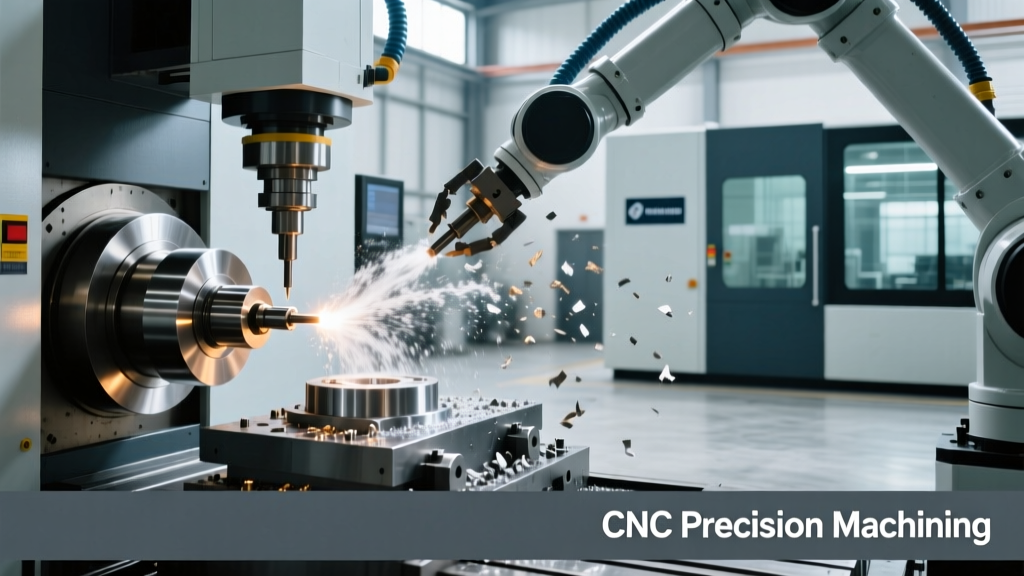
High-volume large-part machining requires treating the machine tool not as an isolated island of production, but as the central node in a continuous-flow material handling and fixturing ecosystem. Budgets must allocate a minimum of 25% of total machine CapEx toward peripheral automation and custom workholding.
Machine Selection Matrix: CapEx vs. Throughput for Large Formats
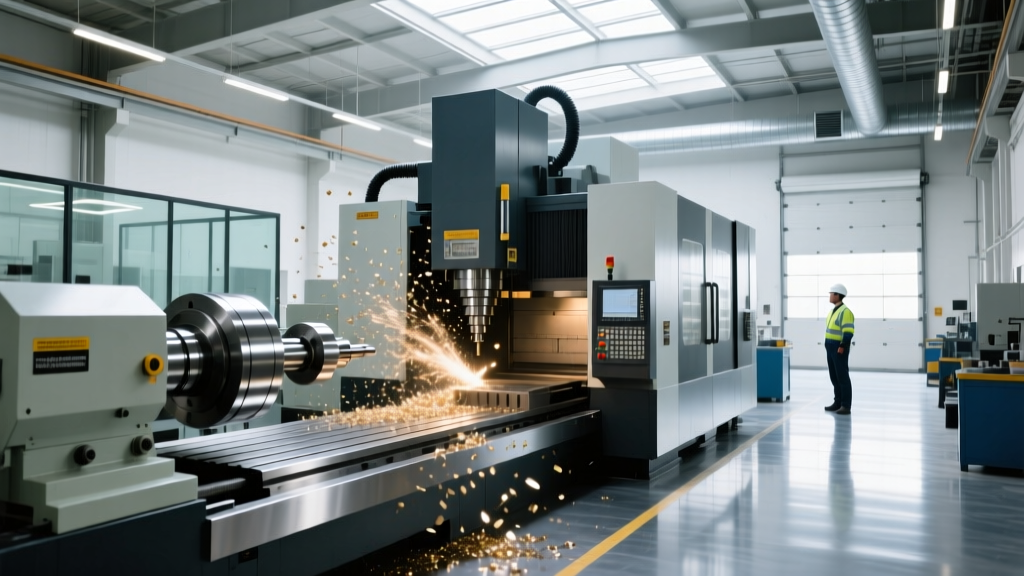
Selecting the right machine architecture is the most critical budget decision. Double-column machining centers and 5-axis gantry mills dominate this space, but their financial profiles differ drastically based on production volume and material.
| Machine Architecture | Representative Models | Est. CapEx (USD) | Volume Suitability | Primary Cost Driver |
|---|---|---|---|---|
| Double Column (Bridge) Mill | Okuma MCR-BV, Mazak VTC-800 | $1.2M - $2.4M | Medium-High (Prismatic parts, EV trays) | Spindle torque upgrades for heavy roughing |
| 5-Axis Gantry Mill | Zimmermann FZ33, Handtmann HF55 | $2.8M - $4.5M | High (Aerospace monoliths, complex contours) | Thermal stability systems and linear drives |
| Horizontal Boring Mill (HBM) | Kuraki KBT-13, Toshiba BF-13B | $1.5M - $3.0M | Medium (Housings, gearboxes, heavy castings) | Rotary table payload capacity and rigidity |
For a shop targeting high-volume EV battery tray production (typically 6061-T6 or 7075-T6 aluminum, 2000mm x 1500mm footprint), a double-column mill equipped with a high-speed spindle (24,000+ RPM) and specialized aluminum evacuation systems offers the best ROI. Conversely, if the shop is machining titanium aerospace structural members, the budget must prioritize a 5-axis gantry with high-torque direct-drive spindles and high-pressure coolant (70+ bar) to manage tool wear costs.
Fixturing and Material Handling: The Hidden Budget Killers
In large-part production, the time spent loading, indicating, and clamping a 2,000 kg workpiece can easily exceed the actual machining cycle if not properly engineered. Budgeting for high-volume large-part work requires dedicated investments in both fixturing and material movement.
Fixturing Budget Allocation
- Modular Fixturing (e.g., Bluco, AMF): Initial budget of $15,000 - $25,000. Ideal for the first 50-100 parts or for shops running mixed volumes. However, setup times of 45-60 minutes per part destroy high-volume margins.
- Dedicated Hydraulic Tombstones & Vacuum Chucks: Initial budget of $60,000 - $120,000. For thin-walled aluminum EV enclosures, custom vacuum fixture arrays with automated hydraulic clamping reduce load/unload times from 45 minutes to under 8 minutes. This is a non-negotiable investment for runs exceeding 500 units.
Material Handling Infrastructure
A lean manufacturing framework dictates that parts must flow without interruption. For large parts, this means moving beyond standard forklifts.
CapEx Trap: Failing to budget for automated overhead crane systems or heavy-payload Automated Guided Vehicles (AGVs) rated for 3,000+ kg will result in severe bottlenecking. A machine costing $300/hour sitting idle for 20 minutes waiting for a forklift destroys the unit economics of the entire production run.
Cycle Time Compression: Tooling Strategies for $/Part Reduction
Tooling budgets in large-part machining are frequently underestimated. When machining deep pockets in aerospace monoliths, tool deflection and chatter can force conservative feed rates, artificially inflating the cost per part.
To achieve high-volume profitability, the tooling budget must prioritize advanced geometries and adaptive control software over standard carbide end mills.
- Dynamic Milling Toolpaths: Utilizing CAM software (like Mastercam or Siemens NX) with trochoidal milling strategies maintains constant tool engagement. This allows for axial depths of cut (DOC) up to 2x the tool diameter, drastically reducing roughing cycle times in titanium and Inconel.
- Specialized Roughing Cutters: Investing in variable-flute, variable-pitch end mills (e.g., Sandvik Coromant CoroMill or Harvey Tool specialty series) dampens harmonic vibration. While these tools cost 30-40% more upfront ($250-$400 per tool vs. $150 standard), they extend tool life by up to 200% in deep-cavity large-part milling, reducing both tooling OpEx and machine downtime for tool changes.
- On-Machine Probing: Integrating Renishaw or Blum laser tool setters and spindle probes ($15,000 - $25,000 add-on) eliminates manual part indication and mid-cycle tool wear measurement, saving 10-15 minutes per cycle.
Digital Twin Simulation: Mitigating the $50,000 Crash Risk
In high-volume large-part machining, a single spindle crash on a $3 million gantry mill can result in $50,000+ in repair costs and weeks of downtime, instantly obliterating the profit margin of hundreds of parts.
Implementing digital twin architectures, as defined in standards like ISO 23247 for manufacturing frameworks, allows shops to simulate exact machine kinematics, toolholder clearances, and material removal rates before G-code ever reaches the shop floor. Budgeting $20,000 annually for advanced simulation software (such as Vericut or CGTech) and the necessary compute hardware is a critical risk-mitigation strategy that insurance underwriters and financial planners must account for.
'The transition to high-volume production of large-format components requires a fundamental shift in how we view machine utilization. It is no longer about keeping the spindle turning; it is about ensuring the spindle is cutting at optimal parameters 95% of the time, which requires massive upfront investment in simulation, fixturing, and automated material flow.' — Analysis derived from McKinsey's operations practice on advanced manufacturing scalability.
Financial Framework: Calculating the True Break-Even Point
To accurately budget and quote high-volume large parts, shop owners must abandon standard shop-rate multipliers and adopt a dedicated unit-economics model. The true cost per part (CPP) must account for the accelerated depreciation of high-stress tooling and the amortization of dedicated fixturing.
The Large-Part Unit Economics Formula
CPP = (M_c + T_c + F_a) + (S_r * H) + (M_h * H) + O_h
- M_c (Material Cost): Raw billet or casting cost, including the 15-20% scrap/remnant value recovery.
- T_c (Tooling Cost per Part): Total tooling consumed divided by expected tool life in parts (not just hours, as large parts cause uneven wear).
- F_a (Fixture Amortization): Total dedicated fixture cost divided by the total contracted production volume.
- S_r (Spindle Rate): Fully burdened machine hourly rate (including depreciation, floor space, and maintenance).
- H (Cycle Hours): Total machining time, including automated probing but excluding load/unload.
- M_h (Material Handling Rate): Hourly cost of crane operators, AGV maintenance, and staging.
- O_h (Overhead Allocation): Quality assurance (CMM time for large parts), CAM programming amortization, and facility utilities.
By rigorously applying this framework, a large part cnc machining shop can identify exactly where capital investments—such as a $40,000 automated pallet pool or a $15,000 high-pressure coolant upgrade—will yield a sub-12-month payback period by compressing cycle times and reducing manual intervention. High-volume success in the large-part sector is not achieved by buying bigger machines; it is achieved by engineering the micro-economics of every minute the machine is in operation.