Advanced CNC Machining Processes for Defense Applications
Explore advanced CNC machining processes for defense applications, covering ITAR compliance, aerospace alloys, and 5-axis milling innovations.
Defense manufacturing demands extreme precision, material integrity, and uncompromising security. The integration of advanced cnc machining processes into military supply chains is no longer just about removing metal; it is about managing thermal dynamics, mitigating tool deflection in exotic superalloys, and adhering to strict data protection protocols. As modern warfare relies increasingly on hypersonic vehicles, advanced radar arrays, and next-generation propulsion systems, contract machine shops must deploy highly specialized manufacturing methodologies to meet Department of Defense (DoD) specifications.
The Material Matrix: Exotic Alloys in Modern Defense CNC
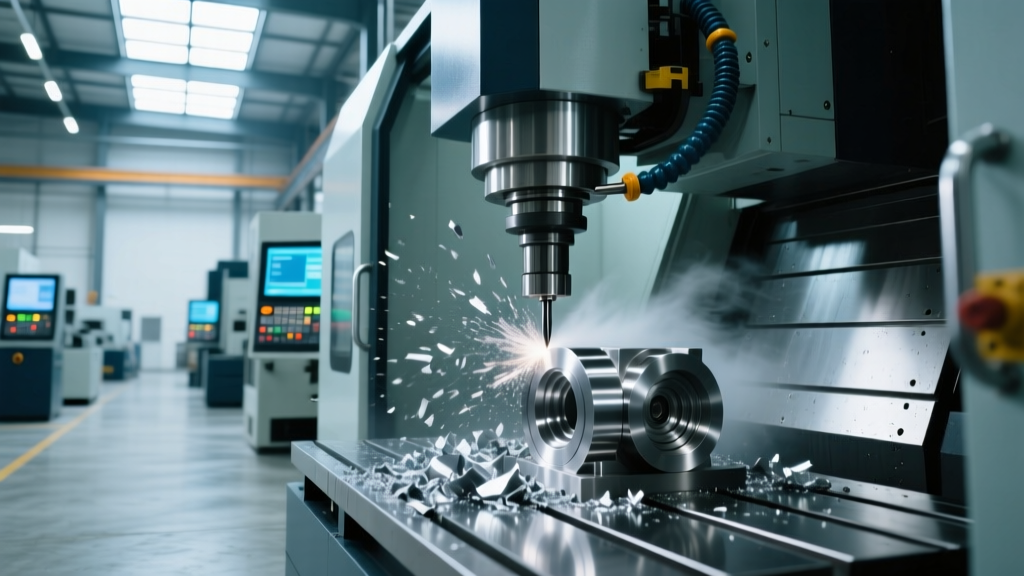
Military components frequently operate in extreme thermal and high-stress environments. Standard aluminum or mild steel is insufficient for turbine blades, missile guidance housings, or armor-piercing projectile cores. Machining these exotic materials requires specific cnc machining processes tailored to their unique metallurgical properties.
| Material | Defense Application | Machinability Challenge | Required CNC Process Adaptation |
|---|---|---|---|
| Ti-6Al-4V (Grade 5 Titanium) | Airframe structural members, rotor hubs | Low thermal conductivity, high chemical reactivity leading to chip welding | High-pressure flood coolant (1,000+ PSI) directed at the cutting edge; rigid tapping; low SFM (150-200) |
| Inconel 718 | Jet engine afterburner components, exhaust manifolds | Severe work hardening, abrasive carbide particles in the microstructure | Constant chip load (never dwell); ceramic inserts for roughing at 400-600 SFM; trochoidal toolpaths |
| 17-4 PH Stainless Steel | Firearms components, landing gear actuators | Hardness variations post-heat treatment, galling tendencies | Peel milling for roughing; high-speed machining (HSM) for finishing with AlTiN coated carbide |
| 7075-T6 Aluminum | Radar enclosures, UAV fuselage frames | Residual stress causing part distortion during material removal | Symmetrical machining sequences; stress-relieving thermal cycling between roughing and finishing passes |
5-Axis Simultaneous Milling and Mill-Turn Configurations
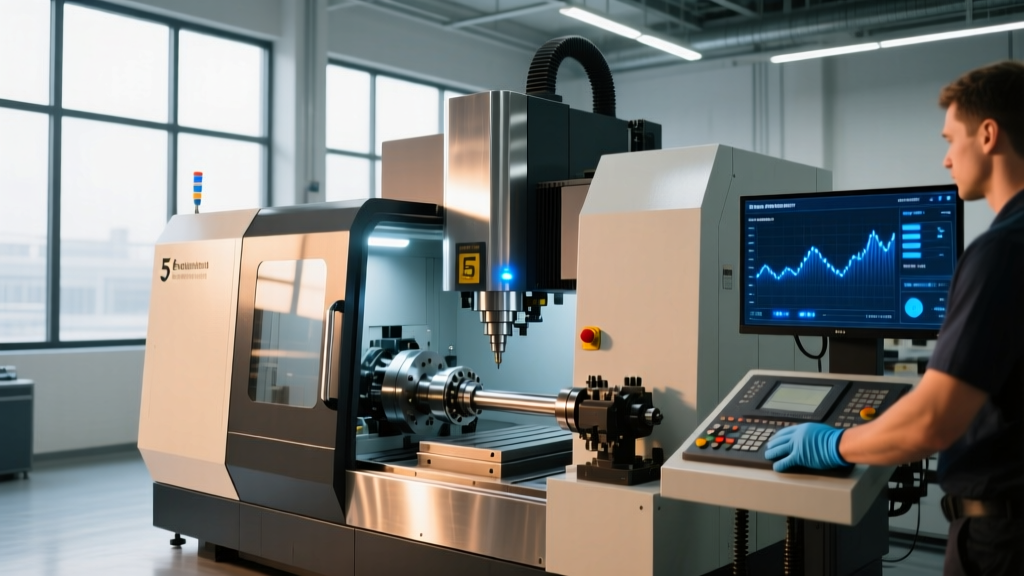
Complex defense geometries, such as impellers for auxiliary power units (APUs) or radar waveguide assemblies, require continuous 5-axis simultaneous interpolation. Machines like the Mazak INTEGREX i-400 or DMG MORI DMC 80 FD dominate this space by combining turning and multi-axis milling in a single setup. This 'Done-In-One' approach eliminates cumulative tolerance stacking that occurs when moving a part across multiple machines.
Trochoidal Milling for Hardened Steels
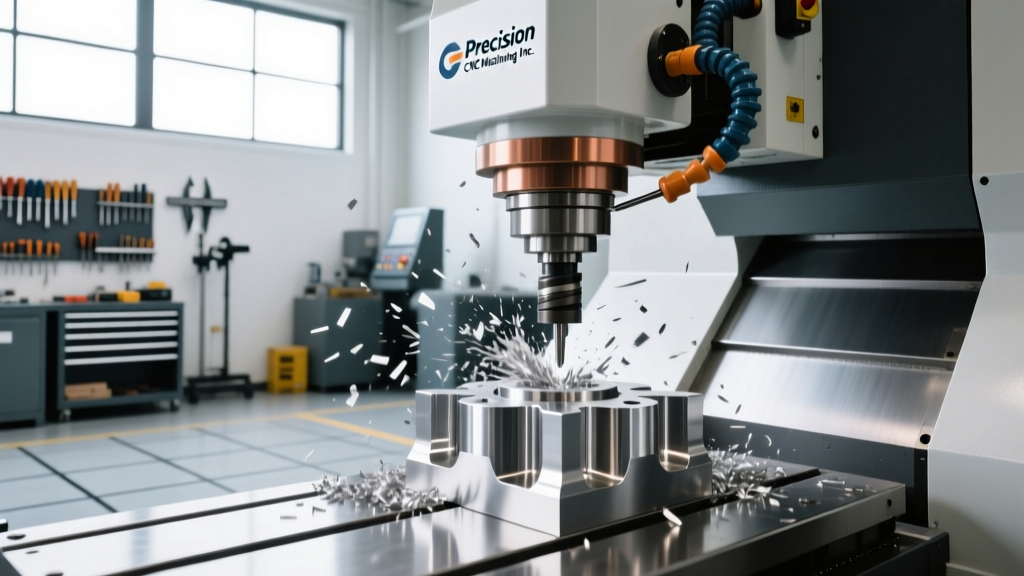
When machining hardened armor steels or high-strength fasteners, traditional plunge milling generates excessive radial heat, destroying cutting tools in minutes. Advanced cnc machining processes now rely heavily on dynamic trochoidal milling. By maintaining a constant radial engagement angle (typically 5% to 10% of the tool diameter) and utilizing high feed rates, the tool is allowed to cool during the non-cutting portion of the circular path. This extends carbide tool life by up to 300% when milling materials exceeding 45 HRC.
⚠️ CRITICAL SECURITY WARNING: ITAR and NIST 800-171 ComplianceDefense machine shops handling technical data for military items must comply with the International Traffic in Arms Regulations (DDTC ITAR Portal). Furthermore, protecting Controlled Unclassified Information (CUI) requires adherence to NIST SP 800-171. Shop floors must utilize air-gapped DNC (Direct Numerical Control) networks or localized, encrypted servers for G-code transmission to prevent foreign state actors from intercepting CAD/CAM toolpaths or part geometries via cloud-connected machine controllers.
Metrology and Closed-Loop Tolerance Control
In defense machining, a dimension that is 'in spec' but at the extreme edge of the tolerance band can cause catastrophic failure in field conditions. For missile guidance gyro housings, true position tolerances frequently demand ±0.0002 inches. Achieving this requires moving beyond post-process inspection to in-machine, closed-loop metrology.
Leading defense contractors integrate Renishaw OMP60 high-accuracy touch probes directly into the CNC spindle. Combined on-machine probing allows the controller to automatically update work offsets in real-time, compensating for thermal expansion of the machine casting or tool wear mid-cycle. For final validation, parts are moved to temperature-controlled metrology labs (maintained at exactly 68°F / 20°C) equipped with Zeiss CONTURA Coordinate Measuring Machines (CMM) utilizing VAST XT active scanning technology to map complex contoured surfaces with sub-micron accuracy.
'The shift toward closed-loop manufacturing in the defense sector means the CNC machine is no longer just a cutting tool; it is a data-generating node that feeds real-time geometric corrections back into the CAM software, effectively creating a self-optimizing production cell.' — Manufacturing Engineering Insights, NIST Manufacturing Extension Partnership
Automation in High-Mix, Low-Volume Defense Runs
Unlike commercial automotive production, defense contracts are characterized by high-mix, low-volume (HMLV) runs. A machine shop might produce 50 titanium turbine blades on Monday and 200 aluminum radar brackets on Tuesday. Traditional robotic arm tending is too rigid and time-consuming to reprogram for this variability.
Instead, advanced defense shops deploy flexible pallet pool systems, such as the Fastems MLS or Makino MMC2. These systems utilize standardized tombstones and quick-change hydraulic fixturing. The CNC operator loads raw material and sets work offsets offline at a dedicated setup station while the spindle is cutting another part. The automated guided vehicle (AGV) or rail system then swaps the pallet in under 15 seconds, enabling unattended 'lights-out' machining over weekends and nights, drastically reducing the per-part cost of low-volume defense contracts.
Decision Framework: Selecting a Defense Contract Machinist
Sourcing a machine shop for military applications requires looking far beyond basic ISO 9001 certification. Procurement officers and prime contractors must evaluate specific technological and security capabilities. Use the following matrix to vet potential CNC partners:
- Quality Management System: Must hold AS9100 Rev D certification, which includes specific clauses for counterfeit part prevention and configuration management.
- Cybersecurity Posture: Must possess a current CMMC (Cybersecurity Maturity Model Certification) Level 2 or higher, verifying their ability to protect CUI on the shop floor network.
- Material Traceability: Ability to provide full heat-lot traceability and Certified Material Test Reports (CMTRs) for every ounce of titanium or Inconel machined.
- Special Process Access: Established supply chain for Nadcap-accredited non-destructive testing (NDT), such as fluorescent penetrant inspection (FPI) and magnetic particle inspection, which are mandatory for flight-critical hardware.
- Machine Tool Calibration: Proof of annual ballbar and laser interferometer calibration to verify volumetric accuracy of 5-axis trunnion tables.
Mastering the cnc machining processes required for the defense sector is an exercise in managing extremes—extreme material hardness, extreme geometric complexity, and extreme regulatory scrutiny. By investing in simultaneous 5-axis mill-turn technology, closed-loop metrology, and rigorous cybersecurity frameworks, machine shops can secure their position in the most demanding tier of the global manufacturing supply chain.