Outsourcing vs In-House Advanced CNC Machining: Decision Framework
Evaluate the ROI of outsourcing vs in-house advanced CNC machining. Compare 5-axis CapEx, digital thread integration, and 2026 tech trends.
The Capital Reality of 5-Axis and Multi-Tasking Integration
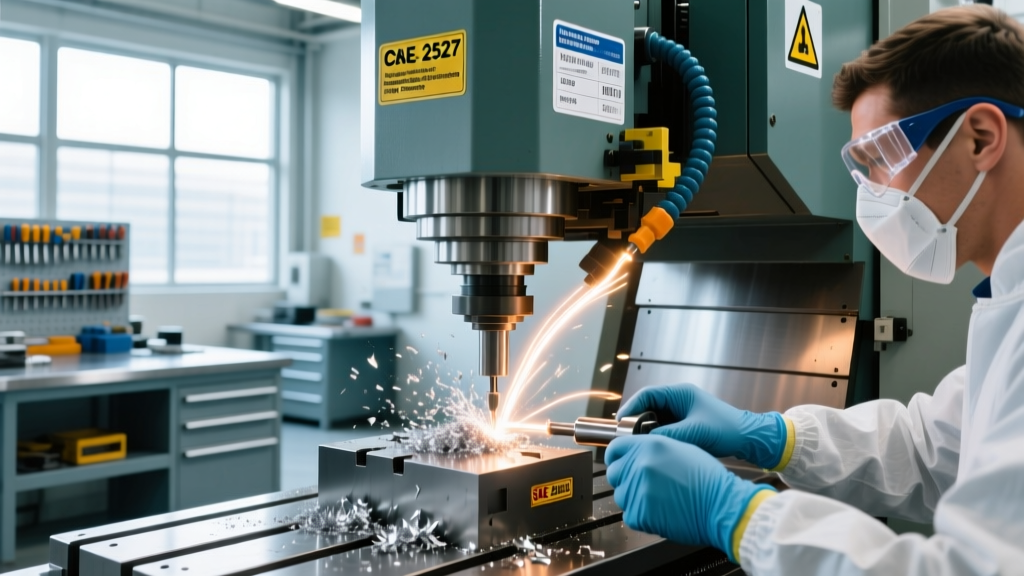
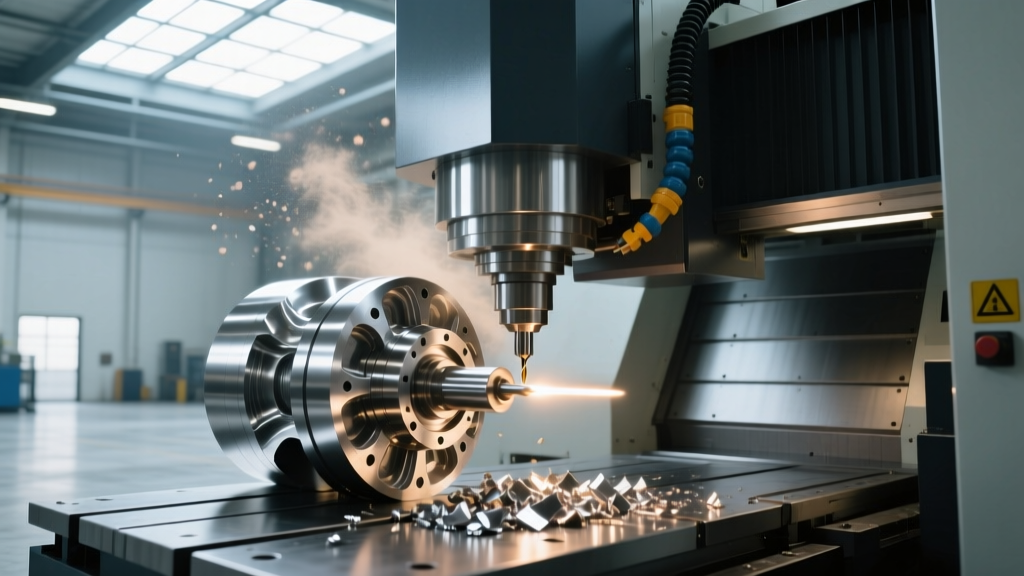
Bringing advanced CNC machining capabilities in-house requires navigating a steep capital expenditure (CapEx) curve that extends far beyond the base price of the machine tool. As of 2026, the barrier to entry for true 5-axis simultaneous milling or mill-turn multi-tasking is defined by the ecosystem required to support it, not just the iron on the floor.
Consider a standard advanced CNC machining cell built around a machine like the Haas UMC-500 or the DMG MORI DMU 50 3rd Generation. The machine itself represents only 40% to 50% of the total initial investment required to achieve production-ready volumetric accuracy.
In-House 5-Axis Cell CapEx Breakdown (2026 Estimates)
- Machine Tool (5-Axis VMC): $175,000 – $260,000
- CAM & Verification Software: Mastercam Multiaxis ($7,500) + CGTech Vericut ($16,000/seat) for G-code simulation and collision avoidance.
- Automation & Workholding: Erowa or System 3R pallet pooling systems ($45,000 – $80,000) to enable lights-out operation.
- Precision Tooling & Presetting: Haimer or Zoller presetters ($35,000+) and advanced carbide endmill inventories.
- Facility Upgrades: 3-phase power drops, climate control for thermal stability (±1°C), and foundation trenching for vibration isolation ($20,000+).
Total Initial Outlay: $300,000 – $450,000+ per fully validated cell.
According to macro-economic data tracked by the U.S. Census Bureau's Annual Survey of Manufactures, capital spending on metalworking machinery remains heavily concentrated in top-tier contract manufacturing facilities, leaving mid-market OEMs to weigh the financial risk of underutilized in-house assets against the agility of outsourced partners.
The Digital Thread: Why Outsourcing is No Longer a Black Box
Historically, the primary argument for keeping advanced CNC machining in-house was the perceived loss of quality control and IP security when handing off 2D drawings to a job shop. The proliferation of the digital thread has fundamentally dismantled this barrier.
Modern contract machine shops now operate on Model-Based Definition (MBD) workflows. By utilizing STEP AP242 files, engineers can embed Product and Manufacturing Information (PMI)—including geometric dimensioning and tolerancing (GD&T), surface finish requirements, and tool access vectors—directly into the 3D CAD model. This eliminates translation errors and allows outsourced partners to automatically generate CMM (Coordinate Measuring Machine) inspection paths.
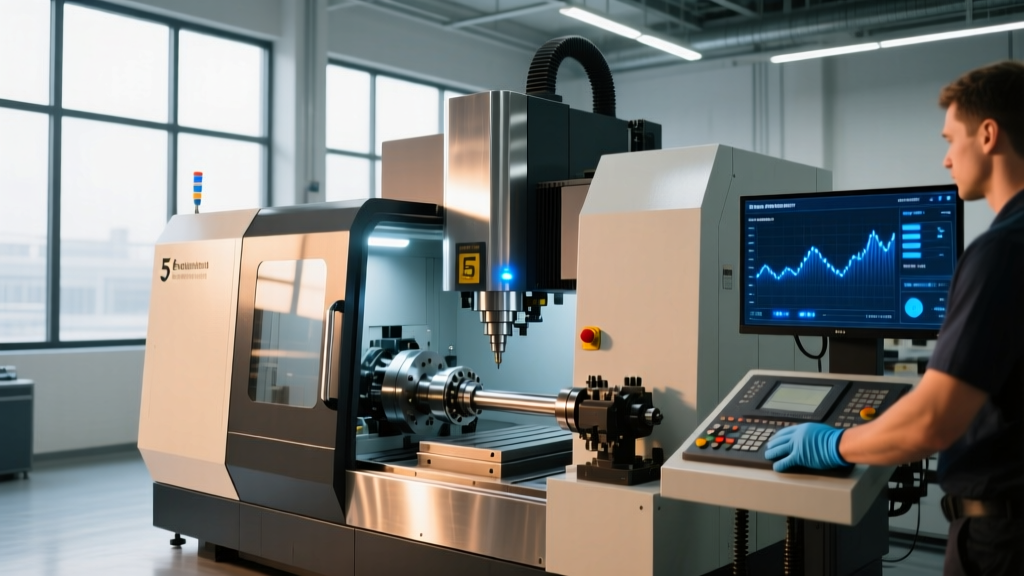
Furthermore, the adoption of the ISO 23247-1 Digital Twin framework has enabled top-tier outsourcing partners to provide clients with real-time, read-only IoT dashboards. OEMs can now monitor spindle load, tool wear telemetry, and First Article Inspection (FAI) data remotely, achieving the same visibility as an in-house operation without bearing the maintenance overhead. Initiatives outlined by NIST's Smart Connected Manufacturing program continue to standardize these secure data-sharing protocols, making IP leakage a manageable risk rather than a dealbreaker.
Strategic Decision Matrix: In-House vs. Contract Manufacturing
Choosing between internal production and outsourcing advanced CNC machining requires evaluating your specific production velocity, part complexity, and engineering bandwidth. Use the following matrix to map your operational profile to the optimal manufacturing strategy.
| Evaluation Vector | In-House Production | Outsourced Partner |
|---|---|---|
| NPI (New Product Introduction) Speed | High. Engineers can walk to the floor, tweak fixtures, and iterate CAM toolpaths in hours. | Moderate. Requires formalized engineering change orders (ECOs) and digital file revisions. |
| 5-Axis Utilization Rate | Often low (30-40%) for OEMs with fluctuating demand, leading to poor ROI on CapEx. | High (75%+). Shops pool demand across multiple clients to keep spindles turning 24/7. |
| IP Security | Maximum. Data never leaves the internal network. | High, but requires strict NDA enforcement, ITAR compliance (if applicable), and secure MBD portals. |
| Scaling to Production Volumes | Constrained by physical floor space and local skilled labor availability. | Highly scalable. Partners can shift production to multi-spindle or automated pallet cells seamlessly. |
| Maintenance & Downtime Risk | High. A crashed spindle or failed ball screw can halt production for 4-8 weeks awaiting OEM parts. | Low. Contract shops maintain redundant machine capacity and in-house maintenance teams. |
The Hybrid Framework: Prototyping In-House, Scaling via Partners
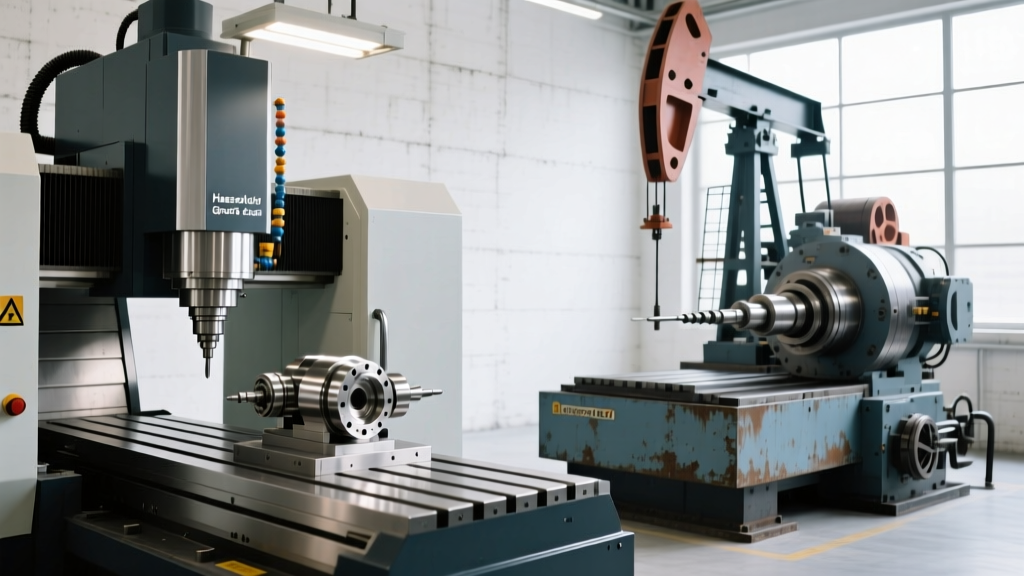
For many mid-sized robotics, aerospace, and medical device OEMs, the optimal strategy in 2026 is not a binary choice, but a hybrid workflow. This approach leverages the speed of internal engineering while offloading the capital risk of high-volume advanced CNC machining.
- Phase 1: In-House Rapid NPI (3-Axis + Indexing): Utilize an internal 3-axis VMC (e.g., Haas VF-2SS) equipped with a multi-axis tombstone or a basic trunnion table. This allows engineering teams to rapidly prototype complex geometries using 3+2 indexing, validating fixturing concepts and material behavior without tying up a high-value 5-axis machine.
- Phase 2: Digital Handoff and DFM Review: Once the design is frozen, package the CAD data using STEP AP242. Include explicit PMI notes regarding critical datums and required surface finishes (e.g., 32 Ra on sealing surfaces). Submit this digital twin to a vetted contract machining partner for Design for Manufacturability (DFM) analysis.
- Phase 3: Outsourced Lights-Out Production: The contract partner leverages their 5-axis simultaneous milling capabilities and automated pallet systems to run production volumes. Because the digital thread is intact, the CMM inspection data is automatically pushed back to the OEM's PLM (Product Lifecycle Management) software for compliance tracking.
⚠️ Warning: The Hidden Cost of In-House 5-Axis Crashes
When calculating the ROI of in-house advanced CNC machining, engineering managers frequently underestimate the cost of operator error during setup. A single kinematic collision on a 5-axis machine can destroy a $25,000 high-frequency spindle and damage the RTCP (Rotary Tool Center Point) calibration. Replacing the spindle and re-laser calibrating the machine volumetrics can result in $40,000+ in direct costs and 6 weeks of downtime. Outsourcing transfers this catastrophic risk to the contract shop's insurance and maintenance budgets.
Aligning Technology Investments with Core Competencies
The decision to insource or outsource advanced CNC machining ultimately hinges on whether multi-axis metal removal is a core competitive differentiator for your business. If your IP relies on proprietary, highly classified geometries that require daily engineering intervention and iterative toolpath tweaking, the CapEx of an in-house DMG MORI or Mazak Variaxis cell is justified.
However, if your competitive advantage lies in software, system integration, or end-user design, treating advanced CNC machining as a non-core utility is the financially superior move. By leveraging the digital thread, ISO-standardized data formats, and the immense scale of modern contract machine shops, OEMs can access world-class 5-axis precision without absorbing the crippling overhead of machine depreciation, CAM software licensing, and specialized labor recruitment.