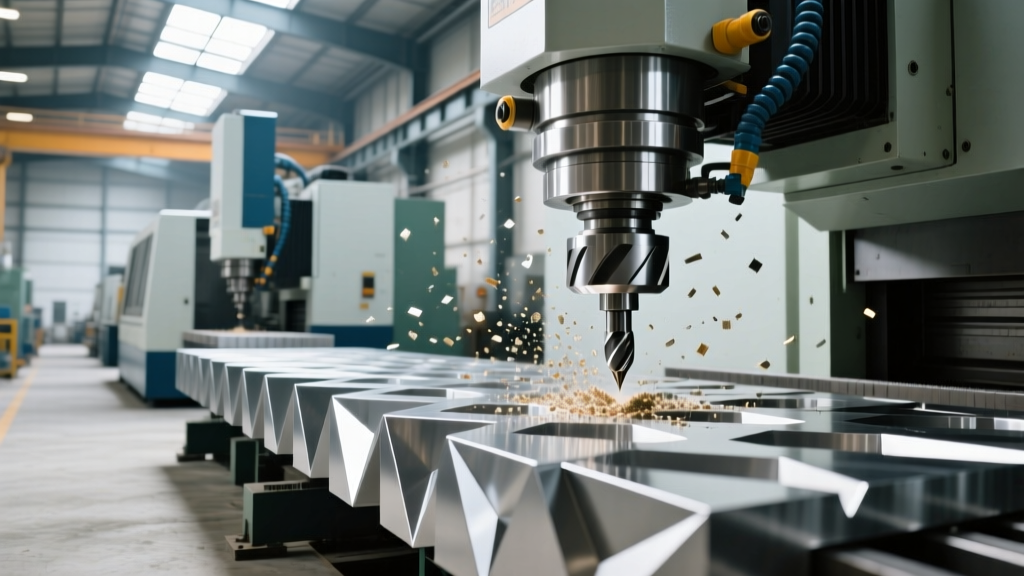
CNC Machining for Defense vs. Architectural Facades: A Comparison
Compare CNC machining for defense contracts with architectural facade production. Analyzes tolerances, materials, machine tools, and shop rates.
The Operational Dichotomy: Mil-Spec Precision vs. Architectural Aesthetics
Machine shops evaluating capacity allocation between CNC machining for defense contracts and commercial architectural metalwork face a fundamental operational paradox. While both sectors rely on advanced subtractive manufacturing, their core performance metrics are diametrically opposed. Defense machining prioritizes extreme dimensional accuracy, material traceability, and structural integrity under dynamic loads. Conversely, CNC machining for architectural facades—such as parametric sunshades, curtain wall mullions, and kinetic building envelopes—prioritizes large-format scalability, flawless surface aesthetics, and rapid throughput.
Understanding the technical and financial distinctions between these two markets is critical for shop owners, procurement officers, and manufacturing engineers deciding where to deploy capital and floor space in 2026.
Tolerance Realities: Functional Fit vs. Visual Continuity
The most immediate divergence lies in tolerance allocation and surface finish requirements. In defense applications, such as UAV fuselage bulkheads or guided missile fin actuators, mating surfaces routinely demand tolerances of ±0.0005 inches (0.0127 mm). Failure to meet these specs results in catastrophic assembly interference or aerodynamic instability.
Architectural metalwork operates on a completely different scale. A custom aluminum facade bracket or tension rod clevis typically allows for dimensional variances up to ±0.020 inches (0.5 mm). However, architecture introduces the 'Aesthetic Tolerance' paradox: while the part may be dimensionally forgiving, the surface finish must be visually perfect.
The Aesthetic Tolerance Paradox
Architectural aluminum components destined for AAMA 2605 fluorocarbon coatings or clear anodizing cannot hide tool marks. A defense part with a 125 Ra µin (3.2 µm) finish is perfectly acceptable if it holds dimensional spec. An architectural facade panel with the same finish will visibly telegraph CNC toolpaths through the anodized layer, resulting in immediate rejection by the architect. Architectural CNC operators must utilize PCD (Polycrystalline Diamond) tooling and specialized mist-cooling systems to achieve sub-32 Ra µin finishes directly off the machine, eliminating secondary hand-polishing steps.
Material Grades and the Certification Burden
The material supply chains for defense and architecture rarely overlap, dictating entirely different inventory management and compliance protocols.
Defense Material Requirements
Defense contracts heavily utilize high-strength, difficult-to-machine alloys. 7075-T651 aluminum, 4340 alloy steel, and Titanium 6Al-4V are standard. Procuring these materials requires strict adherence to Mil-Spec certifications. Every heat lot must be tracked, and shops must maintain AS9100D quality management systems. Furthermore, any shop handling classified or controlled technical data must comply with ITAR (International Traffic in Arms Regulations), requiring segregated servers, physical access controls, and U.S.-citizen-only machining floors.
Architectural Material Requirements
Architectural facades predominantly rely on 6061-T6 and 5005-H32 aluminum alloys, chosen for their extrudability, corrosion resistance, and anodizing consistency. For coastal or high-salinity environments, 316L stainless steel is specified. While ITAR compliance is irrelevant here, architectural shops must navigate LEED (Leadership in Energy and Environmental Design) material tracking, providing environmental product declarations (EPDs) and verifying that aluminum is sourced from low-carbon smelters to meet modern green building codes.
Machine Tool Configurations: VMCs vs. Large-Format Gantry Routers
The physical footprint and kinematics of the required CNC equipment represent the largest capital expenditure difference between the two sectors.
- Defense CNC Equipment: Defense machining relies on high-rigidity, multi-axis Vertical Machining Centers (VMCs) and mill-turn centers. Models like the Haas UMC-750SS or DMG MORI DMU 50 3rd Gen are industry staples. These machines feature high-pressure coolant systems (up to 1,000 PSI) to break chips in deep-pocket titanium milling, thermal compensation packages to maintain ±0.0002-inch repeatability, and enclosed work envelopes typically under 40 x 30 inches.
- Architectural CNC Equipment: Facade production requires large-format 5-axis gantry routers. Machines from manufacturers like CMS (e.g., the Brembana ECHO series) or Biesse feature massive work envelopes—often 10 feet wide by 40 feet long. These machines utilize vacuum pod fixturing or mechanical sweep-clamps to hold large aluminum composite panels and extrusions. Spindle speeds frequently exceed 24,000 RPM, optimized for high-feed-rate aluminum routing rather than heavy metal removal.
Operational and Financial Comparison Matrix
The following matrix outlines the distinct financial and operational realities of running these two types of machining operations in the current market.
| Metric | CNC Machining for Defense | Architectural Facades & Metalwork |
|---|---|---|
| Standard Tolerances | ±0.0005" to ±0.001" | ±0.010" to ±0.020" |
| Primary Alloys | 7075-T6, Ti 6Al-4V, 4340 Steel | 6061-T6, 5005-H32, 316L SS |
| Fully-Burdened Shop Rate (2026) | $165 - $245 / hour | $95 - $140 / hour |
| Average Setup Time | 4 to 12 hours (complex fixturing) | 1 to 3 hours (vacuum/sweep clamps) |
| Scrap Cost Impact | Extreme (material + NADCAP processing) | Moderate (raw material replacement) |
| Quality System Standard | AS9100D, NADCAP, ITAR | ISO 9001, AAMA, LEED Tracking |
| Production Volume | Low to Medium (10 - 500 pcs) | Medium to High (500 - 10,000+ pcs) |
Tooling and Coolant Strategies
Tooling wear and coolant management represent a hidden cost center that varies wildly between the two disciplines. In defense machining, particularly when milling titanium or Inconel for radar housings, shops utilize solid carbide endmills with AlTiN (Aluminum Titanium Nitride) coatings. Trochoidal milling toolpaths are mandatory to manage heat, and flood coolant mixed with heavy-duty EP (Extreme Pressure) additives is required to prevent work hardening and tool welding.
Architectural CNC routing of aluminum extrusions relies on 2-flute or 3-flute PCD (Polycrystalline Diamond) tipped endmills. PCD tools can run at surface speeds exceeding 3,000 SFM and maintain a mirror finish on 6061 aluminum for thousands of linear feet before requiring indexing. Because large-format architectural routers often utilize MDF spoil boards, flood coolant is impossible; instead, shops use micro-drop mist lubrication or compressed air blast systems to evacuate chips without saturating the machine bed.
Strategic Crossover: Can a Shop Do Both?
Many mid-sized contract manufacturers attempt to bridge the gap, using defense contracts to pay for overhead while running architectural facades to fill machine capacity. However, cross-contamination is a severe risk. Running 6061 architectural aluminum on a Haas VF-4SS previously used for 4340 steel defense parts without a rigorous 8-hour teardown and chip-flushing protocol will result in embedded steel chips scratching the architectural aluminum, ruining the anodized finish. Furthermore, the ITAR physical security requirements (badged access, opaque windowing) severely restrict the ability to give commercial architectural clients the open-floor facility tours they often request during the vendor qualification process.
According to manufacturing extension data from NIST MEP, shops that segment their floor into physically distinct 'Defense' and 'Commercial/Architectural' cells see a 22% higher first-pass yield rate compared to shops that attempt to intermingle the workflows on the same spindles. If a shop chooses to pursue both CNC machining for defense and architectural metalwork, dedicating specific large-format routers strictly to architectural work while reserving 5-axis VMCs for defense is the only financially viable strategy in 2026.
Frequently Asked Questions
Do architectural facade parts require AS9100D certification?
No. AS9100D is specific to the aerospace and defense sectors. Architectural metalwork typically requires ISO 9001 certification, alongside compliance with AAMA (American Architectural Manufacturers Association) specifications for coating and structural performance.
Why is CNC machining for defense so much more expensive per hour?
Defense shop rates ($165-$245/hr) reflect the massive overhead of compliance. Maintaining ITAR security, AS9100D auditing, NADCAP-certified subcontractor management, and the high cost of scrap in exotic alloys forces shops to charge a premium. Architectural routing operates on thinner margins with higher throughput.
Can 5-axis architectural routers machine titanium defense parts?
Technically, a gantry router can cut titanium, but it is highly discouraged. Architectural routers lack the structural rigidity, high-torque low-speed spindle characteristics, and 1,000 PSI through-spindle coolant required to machine titanium without catastrophic tool failure and severe work-hardening of the part.