CNC Machining Albuquerque: In-House vs Outsource Tech Trends 2026
Evaluate in-house vs outsourced CNC machining Albuquerque options for 2026. Compare 5-axis IoT tech, ITAR costs, and AI-driven production frameworks.
The 2026 Technology Divide: In-House Capabilities vs. Contract Shops
Albuquerque's manufacturing ecosystem, heavily anchored by Sandia National Laboratories, Kirtland Air Force Base, and a growing commercial aerospace sector, demands extreme precision and rapid iteration. For engineering firms and OEMs in this region, the decision to build in-house CNC capabilities or outsource to local contract shops is no longer just a matter of volume. In 2026, this decision hinges on IoT integration, 5-axis economics, and ITAR compliance infrastructure.
Regional Tech Adoption Data (2026):- 68% of New Mexico aerospace suppliers have adopted MTConnect 2.0 for real-time spindle monitoring.
- Average lead time for outsourced 5-axis titanium parts in the Southwest has dropped from 14 days to 6.5 days due to AI-driven toolpath optimization.
- In-house CapEx for a fully automated 5-axis cell has increased by 22% since 2024 due to advanced sensor fusion requirements.
According to NIST Advanced Manufacturing guidelines, modern smart manufacturing requires seamless data flow from the CAM software to the machine controller and back to the ERP. Achieving this in-house requires significant capital, whereas top-tier contract shops in the Albuquerque area have already amortized these costs across multiple clients.
Hidden Costs of In-House 5-Axis and Multi-Tasking
Bringing CNC production in-house is often justified by the desire to protect intellectual property and accelerate prototyping. However, the financial reality of deploying advanced machinery extends far beyond the base price of the equipment. Consider the deployment of a Haas UMC-750SS (5-axis, ~$235,000 base) or a Mazak INTEGREX i-200S (multi-tasking, ~$450,000 base).
| Cost Category | In-House Setup (Year 1) | Outsourced Model (Annual) |
|---|---|---|
| Machine CapEx & Installation | $250,000 - $480,000 | $0 |
| CAM Software (e.g., Mastercam 2026, Siemens NX) | $12,000 - $18,000/yr | $0 (Included in part price) |
| Specialized Tooling & Workholding | $35,000 - $60,000 | $0 |
| 5-Axis Programmer / Operator Salary | $95,000 - $130,000/yr | N/A |
| Facility Upgrades (3-phase power, coolant mgmt) | $20,000 - $45,000 | $0 |
| Total First-Year Burden | $412,000 - $733,000+ | Variable (Pay per part) |
Furthermore, maintaining consistent tolerances on 5-axis machines requires annual laser calibration and ballbar testing, adding $8,000 to $12,000 in recurring maintenance. Contract shops absorb these overheads, offering regional hourly rates that reflect their optimized utilization: typically $95-$110/hr for 3-axis, $140-$185/hr for 5-axis, and $160-$210/hr for Swiss-type turning in the Albuquerque market.
Decision Matrix: When to Keep It In-House vs. Outsource
Use the following framework to evaluate your specific production requirements against current technological capabilities.
| Criteria | Lean Toward In-House | Lean Toward Outsourcing |
|---|---|---|
| Volume & Iteration | High iteration, low volume (R&D, daily prototype tweaks). | Production runs (50+ parts) or bridge tooling. |
| Geometric Complexity | Simple 2.5D or 3D geometries; standard tolerances (+/- 0.005 in). | Simultaneous 5-axis, micro-machining, or tight aerospace tolerances (+/- 0.0002 in). |
| Material Exotics | Standard aluminum (6061/7075), mild steels, basic plastics. | Inconel 718, Titanium Ti-6Al-4V, Waspaloy, or metal matrix composites. |
| IP Security | Highly classified, unreleased core tech without cleared vendor. | Standard commercial IP or parts covered by established NDAs. |
CNC Machining Albuquerque: The ITAR and Sandia Ecosystem Factor
Operating in proximity to national security installations introduces strict regulatory hurdles. If your components fall under ITAR (International Traffic in Arms Regulations, 22 CFR Parts 120-130), outsourcing requires partnering with a shop that maintains rigorous digital and physical security protocols. In-house production allows you to control the FOCI (Foreign Ownership, Control, or Influence) environment directly.
Warning: ITAR Digital Compliance. It is not enough for a contract shop to simply restrict physical access. Under 2026 compliance standards, the shop's CAM network, toolpath servers, and CMM (Coordinate Measuring Machine) inspection data must be hosted on air-gapped or strictly segmented domestic servers. Always audit a vendor's cybersecurity framework, specifically their adherence to NIST SP 800-171 for Controlled Unclassified Information (CUI).
However, building an ITAR-compliant in-house facility from scratch requires massive investment in SCIF-like server rooms, badged access controls, and cleared personnel. Many Albuquerque-based OEMs solve this by outsourcing to established AS9100 Rev D contract shops that already possess the necessary ITAR registration and secure digital infrastructure.
Tech Trend: Digital Twins and Cloud CAM Integration
The most significant technological shift altering the outsource dynamic is the maturation of cloud-based manufacturing and digital twins. Platforms like Autodesk Fusion and Siemens NX now allow engineering teams to simulate the exact kinematics of a contract shop's specific machine model before sending the file.
This eliminates the traditional 'black box' of outsourcing. You can now:
- Validate Toolpaths Remotely: Run collision detection against the digital twin of the shop's Mazak Variaxis i-800 NEO.
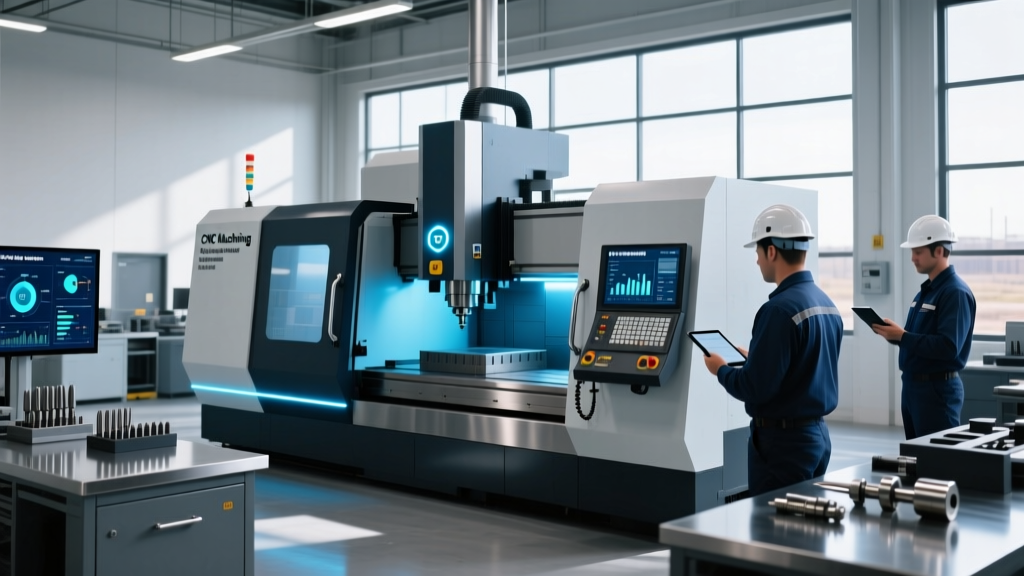
- Monitor Production via IoT: Leading contract shops now offer client portals where you can view real-time MTConnect data, including spindle load, tool wear metrics, and cycle times for your specific batch.
- Automate CMM Reporting: Inspection data from Zeiss or Hexagon CMMs is automatically pushed to your cloud dashboard, complete with GD&T color maps.
As noted in recent analyses by McKinsey Industry 4.0, the integration of digital twins reduces first-article inspection (FAI) failures by up to 40%, making outsourced precision machining nearly as transparent as having the machine on your own floor.
Actionable Framework: The 3-Step Hybrid Sourcing Model
Rather than viewing this as a binary choice, advanced manufacturing firms in the Southwest are adopting a hybrid model to balance agility with cost-efficiency.
Step 1: Establish an In-House 'Skunkworks' Cell
Invest in a single, high-speed 3-axis or trunnion-table 5-axis machine (e.g., Haas VF-2SSYT or DMG MORI DMU 50 3rd Gen). Dedicate this cell strictly to R&D, rapid prototyping, and design-for-manufacturability (DFM) validation. This keeps your engineers close to the metal during the critical iteration phase without the overhead of a full production floor.
Step 2: Transition to Local Contract Shops for Bridge Production
Once the design is frozen and FAI is passed, transfer the validated digital twin and toolpaths to an Albuquerque-based AS9100D contract shop for runs of 50 to 5,000 units. Leverage their multi-pallet horizontal machining centers (HMCs) and lights-out automation to drive down the per-part cost.
Step 3: Implement API-Driven Quality Feedback Loops
Require your outsourcing partner to integrate their CMM and in-cycle probing data into your ERP via API. If a tool wears out and shifts a bore diameter by 0.0004 inches, your system should flag the deviation before the batch is shipped, ensuring continuous quality control without requiring your own metrology staff to re-inspect incoming lots.
Ultimately, the choice between in-house and outsourced CNC machining in Albuquerque depends on your firm's core competency. If your value proposition is rooted in rapid, highly classified hardware iteration, absorb the CapEx and build the secure cell. If your value lies in system integration and software, leverage the region's mature, tech-enabled contract machining network to scale production efficiently.