ABS CNC Machining Post-Processing: Operator Best Practices for Secondary Operations
Master ABS CNC machining post-processing with operator best practices for mechanical finishing, acetone vapor smoothing, heat-set inserts, and surface coating.
The Thermal Challenge in ABS Post-Processing
Acrylonitrile Butadiene Styrene (ABS) is a staple in contract machining for prototypes, jigs, and low-volume production due to its excellent impact resistance and dimensional stability. However, the material properties that make ABS easy to mill also make it highly susceptible to thermal damage during post-processing. With a glass transition temperature (Tg) of approximately 105°C (221°F) and a melting point around 210°C to 240°C, ABS softens rapidly under friction.
For machine shop operators, this means secondary operations cannot simply mirror the workflows used for aluminum or steel. Standard operating procedures (SOPs) for ABS CNC machining post-processing must prioritize heat dissipation, chemical compatibility, and stress management. Training operators to recognize the thermal limits of ABS is the first step in reducing scrap rates during finishing and assembly.
⚠️ Operator Safety Warning: Acetone Vapor SmoothingAcetone is highly flammable and a central nervous system depressant. Vapor smoothing must only be performed in specialized, spark-proof, ventilated chambers. Operators must adhere strictly to OSHA Permissible Exposure Limits (PEL), which cap acetone exposure at 1,000 ppm (2,400 mg/m³) over an 8-hour TWA. Always use appropriate organic vapor respirators when transferring parts from the chamber.
Mechanical Finishing Protocols: Sanding and Polishing
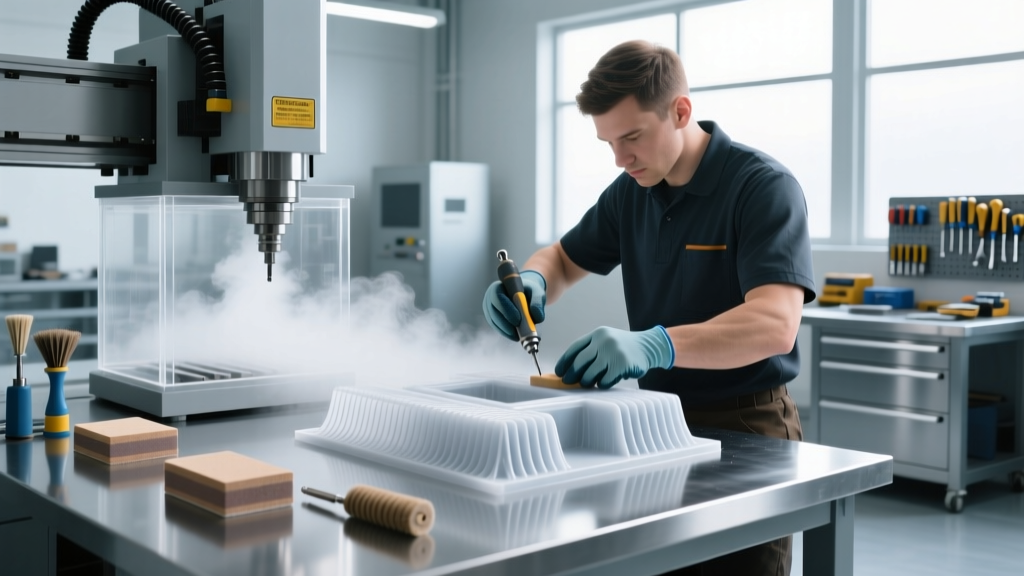
Removing tool marks from CNC milled ABS requires a disciplined, progressive sanding approach. Dry sanding generates localized friction heat, which melts the ABS surface, causing the sandpaper to gum up and leaving deep, unrepairable gouges in the workpiece.
Operators must be trained to use wet sanding techniques exclusively for grits finer than 220. The water acts as a coolant and a lubricant, flushing away swarf and preventing the thermoplastic from reaching its Tg. When utilizing automated orbital sanders or spindle buffers, the rotational speed must be strictly governed.
Standard Grit Progression and RPM Limits
| Grit Sequence | Abrasive Type | Method | Max Automated RPM | Operator Notes |
|---|---|---|---|---|
| 180 - 220 | Aluminum Oxide | Dry or Light Mist | 1,200 RPM | Use only for heavy tool mark removal. Apply minimal downward pressure. |
| 320 - 400 | Silicon Carbide | Wet (Water) | 1,500 RPM | Transition to wet sanding. Check paper frequently for ABS buildup. |
| 600 - 800 | Silicon Carbide | Wet (Water + Drop of Dish Soap) | 1,800 RPM | Soap reduces surface tension, improving finish uniformity. |
| 1000 - 1500 | Micro-Mesh / Wet Paper | Wet | Hand Sanding Only | Prepares surface for chemical vapor smoothing or high-gloss clear coating. |
Acetone Vapor Smoothing: Operator Parameters
Chemical vapor smoothing is the most effective method for achieving an injection-molded finish on CNC machined ABS. Acetone dissolves the outer microns of the ABS, allowing surface tension to level out microscopic tool paths. However, improper execution leads to 'orange peel' textures or dimensional inaccuracy.
According to material guidelines from the British Plastics Federation, ABS exhibits excellent chemical resistance to many aqueous solutions but is highly soluble in ketones and esters. Operators must control three critical variables in the vapor chamber:
- Chamber Temperature: Maintain the ambient air inside the chamber between 40°C and 50°C. This ensures the acetone vapor remains suspended and condenses evenly on the cooler part surface.
- Acetone Pool Temperature: The liquid acetone reservoir should be heated via a water bath to roughly 56°C (its boiling point) to generate a dense, consistent vapor cloud.
- Exposure Time: For standard 320-grit prepped surfaces, 3 to 5 minutes of vapor exposure is sufficient. Overexposure (>10 minutes) will pool liquid acetone on horizontal surfaces, causing severe dimensional loss and structural weakening.
The most common operator error in vapor smoothing is handling the part immediately after removal from the chamber. The surface of the ABS remains chemically softened and highly tacky for 15 to 30 minutes post-exposure. Parts must be hung on PTFE-coated racks in a dust-free environment to air-dry. Touching the part before it fully cures will result in permanent fingerprint marring.
Secondary Operations: Threading and Insert Installation
ABS has relatively low tensile and shear strength compared to engineered plastics like PEEK or Ultem. Cutting standard 75% depth threads directly into ABS often results in thread stripping under minimal torque. Operators should be trained to reduce thread depth or utilize secondary hardware.
Tapping Best Practices
When direct tapping is required, operators must use spiral-flute taps designed specifically for plastics (which feature a sharper rake angle to shear the material cleanly rather than tearing it). Reduce the thread depth to 50% or 60%. A 60% thread in ABS retains approximately 90% of the pull-out strength of a 75% thread, but reduces the torque required to cut the thread by nearly half, drastically minimizing the risk of cracking the parent boss.
Heat-Set Brass Inserts (SOP)
For high-stress assemblies, ultrasonic or thermal heat-set brass inserts are the industry standard. Operators using manual soldering irons or thermal presses must adhere to the following parameters for standard M3-M6 brass inserts:
- Tool Temperature: Set the iron tip or thermal press to 220°C - 240°C. This is just above the melting point of ABS, allowing the brass knurling to melt into the plastic without degrading the polymer chains.
- Insertion Speed: Apply steady, moderate downward pressure. Do not force the insert. The heat should do the work.
- Dwell Time: Hold the tool in place for 2 to 3 seconds after the insert is flush to allow the surrounding ABS to reflow and lock around the brass knurls.
- Cooling: Allow 60 seconds for the localized heat to dissipate before applying any torque to the inserted fastener.
Surface Coating and Adhesion Protocols
Painting ABS requires specific surface preparation to prevent solvent-welding failures or peeling. While ABS is easily painted, the mold release agents or machining coolants left on the surface will cause fisheyes in the clear coat.
- Cleaning: Wipe the machined part with isopropyl alcohol (IPA). Avoid using acetone or MEK for cleaning prior to painting, as these will prematurely soften the surface and trap contaminants in the pores.
- Priming: Apply a dedicated plastic adhesion promoter (e.g., Rust-Oleum Automotive Plastic Primer or equivalent epoxy-based primer). Standard metal primers will not cross-link properly with the ABS surface.
- Topcoat Application: Use acrylic or polyurethane topcoats. Avoid lacquer-based paints with high ketone content, as they can chemically attack the ABS substrate, leading to micro-cracking under thermal cycling.
Troubleshooting Matrix: Common Post-Processing Defects
When training new operators on the CNC floor, use this diagnostic matrix to identify and correct post-processing failures in ABS components.
| Defect Symptom | Root Cause | Operator Corrective Action |
|---|---|---|
| Orange Peel Texture (Vapor Smoothing) | Under-exposure to acetone vapor or starting with too coarse a sanding grit (below 220). | Increase vapor exposure by 1-minute increments. Ensure pre-smoothing sanding reaches at least 400 grit. |
| Gummed Sandpaper / Pilling | Friction heat exceeding ABS Tg (105°C) during mechanical finishing. | Switch to wet sanding immediately. Reduce automated sander RPM by 30%. Use lighter downward pressure. |
| Cracked Threaded Boss | Tap generating excessive outward radial pressure; 75% thread depth used in thin-walled section. | Switch to a 50% or 60% thread depth tap. Ensure spiral-flute tap is used to clear chips upward, preventing binding. |
| Wavy / Melted Edges | Heat-set insert temperature too high, or dwell time too long, degrading the surrounding polymer. | Lower thermal press temperature to 220°C. Pre-heat the insert slightly if using a manual iron to reduce required dwell time. |
| Paint Fisheyes / Peeling | Residual synthetic machining coolant or operator skin oils on the substrate. | Implement strict IPA wipe-down protocol. Mandate nitrile gloves for all operators handling finished ABS parts post-cleaning. |
Mastering ABS CNC machining post-processing requires shifting the operator mindset from traditional metalworking to thermal-aware polymer handling. By enforcing strict RPM limits during mechanical finishing, precisely controlling acetone vapor parameters, and utilizing reduced-depth threading protocols, machine shops can consistently deliver high-tolerance, aesthetically flawless ABS components.