Buying Guide: 4-Axis CNC Machining for Complex Parts
Evaluate 4-axis CNC machining platforms for complex geometries. Compare indexing vs. continuous setups, costs, and top machine models for precision shops.
Indexing vs. Continuous: The Fundamental Divide
Before evaluating specific machine models, buyers must define their rotational requirements. The market splits 4-axis CNC machining into two distinct operational modes, each demanding different hardware investments.
4-Axis Indexing (3+1)The machine locks the rotary table at a specific angle (e.g., 45°, 90°), and the spindle performs 3-axis milling. This is ideal for machining features on multiple faces of a cubic part, such as valve bodies or pump housings. Hardware requirement: Standard worm-gear rotary tables with high clamping torque (e.g., Haas HRT210) are sufficient and cost-effective.
Continuous 4-Axis (Simultaneous)
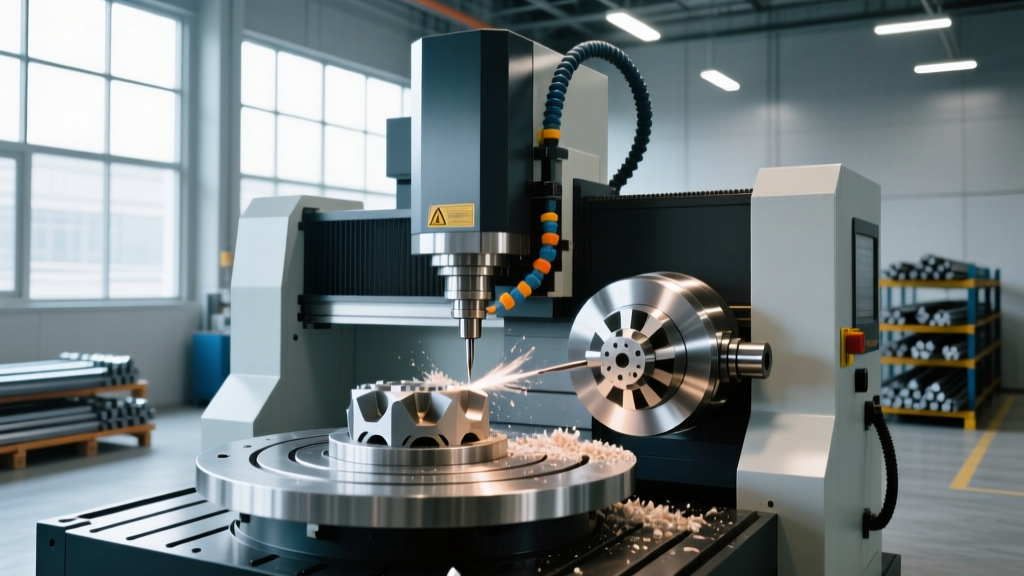
The spindle cuts material while the rotary table moves continuously. This is mandatory for complex geometries like impeller blades, helical gears, and cylindrical cam profiles. Hardware requirement: Direct-drive or harmonic-drive rotary tables with zero backlash and high-resolution encoders to maintain true position within 0.0002 inches during motion.
Equipment Matrix: Evaluating 4-Axis Platforms
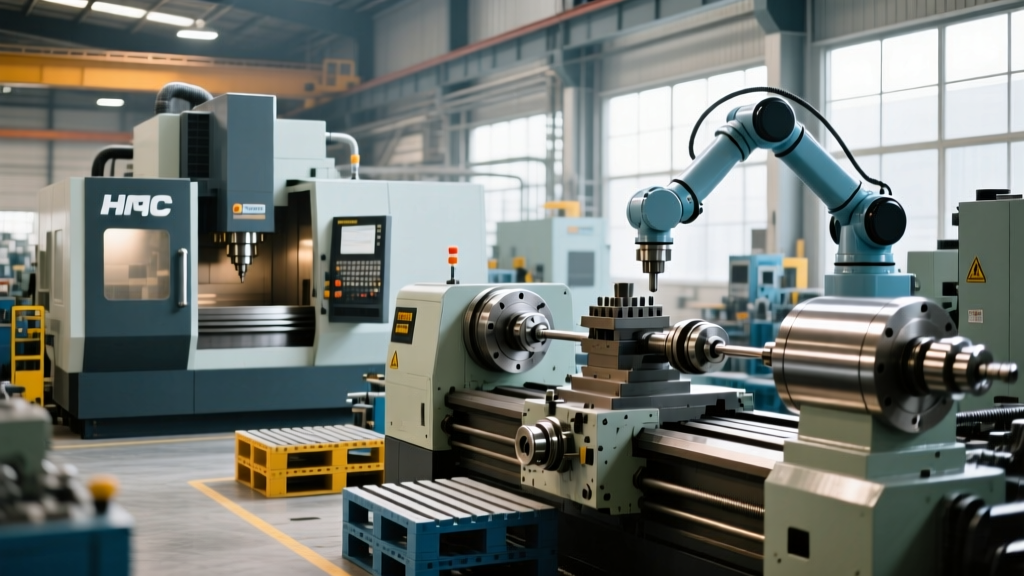
Shops generally approach 4-axis CNC machining via two routes: retrofitting a vertical machining center (VMC) with a 4th-axis trunnion, or investing in a native horizontal machining center (HMC) with an integrated rotary pallet system. Below is a comparison of mid-to-high-tier platforms dominating the 2026 market.
| Machine Platform | Configuration | Best For Complex Geometry | Approx. Base Price |
|---|---|---|---|
| Haas VF-3SS + HRT210 | VMC + Add-on Rotary | Indexing, multi-face prismatic parts | $115,000 - $135,000 |
| Makino a51nx | Native HMC (B-Axis) | High-volume aerospace, tombstone work | $280,000 - $320,000 |
| Mazak VARIAXIS i-600 | 5-Axis (Used in 4-Axis Mode) | Continuous wrap-around features, impellers | $250,000 - $290,000 |
| Doosan DVF 5000 | Trunnion Table VMC | Mixed production, medical implants | $190,000 - $220,000 |
For shops primarily handling complex cylindrical geometries, the VMC + Trunnion route offers the highest ROI. According to Haas Automation's rotary table specifications, pairing a high-speed spindle (12,000+ RPM) with a precision plug-and-play rotary unit allows shops to maintain tight geometric tolerances without the massive footprint and cost of an HMC.
The True Cost of 4-Axis Integration
Novice buyers often budget strictly for the machine tool and rotary table, missing the auxiliary costs required to actually cut complex geometries. A realistic capital expenditure (CapEx) breakdown for a fully operational 4-axis cell includes:
- Base VMC (e.g., 40-taper, 12k RPM): $85,000 – $110,000
- 4th Axis Rotary Table & Tailstock: $18,000 – $28,000 (Do not skip the tailstock; unsupported rotary tables deflect under heavy side-milling loads, ruining true position tolerances).
- Multiaxis CAM Software Seat: $8,000 – $15,000 (Upgrading from 3-axis Mastercam or Fusion 360 to a multiaxis license).
- Specialized Workholding: $5,000 – $12,000 (Custom tombstones, 5C collet chucks, or low-profile pneumatic clamps to avoid spindle collisions).
- Tool Length Measurement & Probing: $6,000 (Renishaw OMP60 or Blum laser tool setter is mandatory for tracking tool wear across varying rotational angles).
Workholding and Tooling for Multi-Axis Geometries
Complex geometries in 4-axis CNC machining are frequently ruined not by the machine's lack of precision, but by workholding interference and tool deflection. When the part rotates, the spindle must reach deep pockets without the tool holder colliding with the vise or rotary table platter.
Workholding Strategies
Standard 6-inch milling vises are often too bulky for 4-axis work. Instead, invest in Kurt DX6 low-profile vises or transition to Schunk zero-point clamping systems mounted directly to the rotary faceplate. For high-volume cylindrical parts, a custom-machined aluminum tombstone mounted between the rotary table and a heavy-duty tailstock can increase parts-per-cycle by 400%.
Tooling Selection
When performing continuous 4-axis milling, the tool engagement angle changes constantly. Sandvik Coromant's multi-axis milling guidelines emphasize using variable-helix end mills to disrupt harmonic chatter frequencies. For undercutting complex internal geometries, standard ball nose end mills fall short. Equip your tool crib with Harvey Tool lollipop cutters and tapered reach end mills, which provide the necessary clearance when the A-axis tilts the part into the spindle.
CAM Software and Toolpath Generation
Hardware is useless without the software to drive it. Generating toolpaths for 4-axis CNC machining requires specific CAM strategies that 3-axis programmers must learn.
- Wrap Toolpaths: Used for engraving or cutting features around a cylinder. The CAM software 'wraps' a 2D toolpath around the rotary axis. Ensure your CAM system supports 'Rotary Axis Substitution' to output G-code (typically G93 inverse time feed rates) that the machine controller can process smoothly.
- Swarf Machining: Utilizes the side of a flat end mill to cut walls while the 4th axis tilts. This is critical for aerospace structural components where floor and wall surface finish requirements demand single-pass finishing.
- Collision Avoidance: In continuous 4-axis, the tool holder is in constant motion relative to the part. Use CAM modules like Autodesk Fusion 360 machining extensions or Mastercam's Machine Simulation to verify clearances between the spindle nose, tool holder, and the rotary table's physical limits before sending code to the floor.
Real-World Failure Modes and Mitigation
Even with premium equipment, shops encounter specific failure modes unique to multi-axis setups. Recognizing these edge cases during the buying and setup phase prevents costly scrap.
Warning: Worm Gear Backlash in Continuous ModeIf you purchase a standard worm-gear rotary table for continuous 4-axis machining, the inherent mechanical backlash (often 30-60 arc seconds) will cause visible dwell marks on the part surface during direction reversals. Mitigation: If your part geometry requires continuous simultaneous motion, you must specify a direct-drive (torque motor) rotary table, which offers zero mechanical backlash and repeatability down to 5 arc seconds.
Thermal Growth on the A-Axis
The braking mechanism on 4th-axis rotary tables generates significant heat during heavy indexing operations. Over an 8-hour shift, the rotary housing can expand by 0.001 to 0.003 inches, shifting the part centerline. When buying a machine for tight-tolerance aerospace work, verify that the rotary table features internal air-oil cooling channels or liquid cooling jackets to maintain thermal stability.
Chip Evacuation in Trunnion Setups
When a trunnion table tilts a part 90 degrees, gravity pulls chips directly into the vise mechanisms and rotary faceplate seals. Ensure the selected VMC features high-volume, high-pressure coolant-through (minimum 300 PSI) and an aggressive auger conveyor system. Machines with standard low-pressure flood coolant will suffer premature rotary table bearing failure due to chip ingestion.
Final Purchasing Directive
Do not default to the cheapest 4th-axis add-on available. The bottleneck in 4-axis CNC machining for complex geometries is rarely the spindle speed; it is the rigidity of the rotational axis and the clearance of the workholding. Allocate at least 25% of your total 4-axis budget toward direct-drive rotary technology, low-profile pneumatic workholding, and multiaxis CAM verification. By matching the machine's mechanical architecture to your specific geometry type—indexing for prismatic, continuous for organic—you will secure a production cell capable of holding ±0.0005-inch true position tolerances across complex multi-face parts.