Large Scale CNC Machining: Equipment Guide for High-Volume Production
Discover the best equipment strategies for large scale CNC machining. Compare HMCs, multi-spindle lathes, and automation for high-volume production.
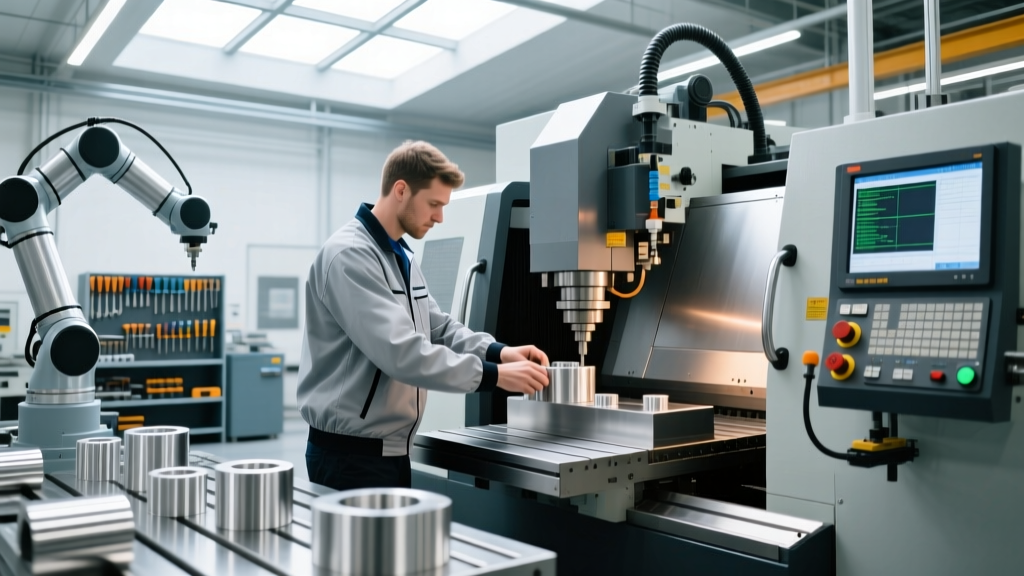
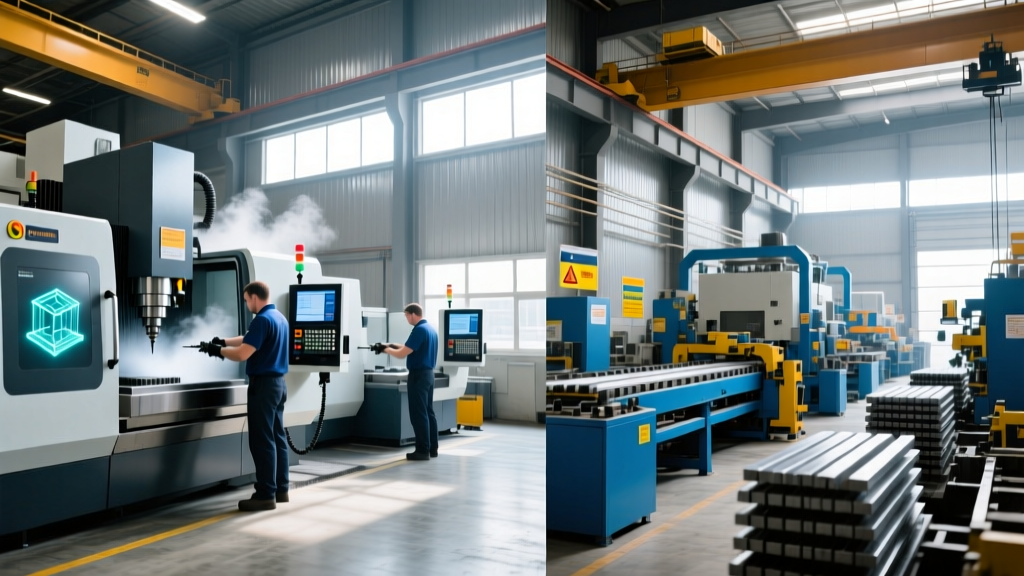
Transitioning from prototype fabrication to mass production requires a fundamental shift in capital equipment strategy. When annual part volumes exceed 50,000 units, the limiting factor in profitability is no longer the machine's ability to hold tight tolerances on a single complex part, but rather spindle utilization, chip evacuation efficiency, and automated material handling. Selecting the right iron for large scale CNC machining means prioritizing uptime and cycle-time reduction over 5-axis contouring flexibility.
The High-Volume Equipment Matrix
Not all CNC platforms are built for continuous, lights-out manufacturing. The table below breaks down the primary equipment categories used in high-volume production, comparing their ideal applications, volume thresholds, and estimated 2026 capital costs.
| Equipment Class | Best For | Volume Threshold | Est. Capital Cost (2026) | Target OEE |
|---|---|---|---|---|
| VMC (Vertical) | Low/Med volume, large flat parts | < 10,000/yr | $150k - $250k | 65% - 75% |
| HMC + Pallet Pool | Prismatic, multi-face, high volume | 50,000+/yr | $450k - $850k | 85% - 92% |
| Multi-Spindle Lathe | Complex rotational, high volume | 100,000+/yr | $700k - $1.2M | 80% - 88% |
| Swiss-Type CNC | Small diameter (<32mm), long parts | 250,000+/yr | $350k - $550k | 85% - 95% |
Core Equipment Categories for Large Scale CNC Machining
Horizontal Machining Centers (HMCs): The Prismatic Workhorse
For prismatic parts requiring machining on multiple faces—such as transmission housings, valve bodies, and pump enclosures—Horizontal Machining Centers equipped with pallet pools are the undisputed standard. Unlike VMCs, where chips fall directly onto the part and fixture (requiring frequent manual or high-pressure wash-downs), HMCs leverage gravity to drop chips straight into the conveyor below. This eliminates recutting of chips, drastically extending insert life in high-volume aluminum and cast iron runs.
Platforms like the Makino Horizontal Machining Center lineup, specifically the a61nx, dominate this space. When configured with a 10-pallet linear pool or a rotary tombstone system, operators can load raw material on one side of the machine while the spindle cuts on the other. This effectively reduces non-cutting time (load/unload, tool changes, and indexing) to near zero.
Pro-Tip: The 1000 PSI Coolant MandateWhen spec'ing an HMC for high-volume deep-hole drilling or tapping, do not settle for standard 300 PSI coolant pumps. Specify a minimum of 1000 PSI (70 bar) through-spindle coolant (TSC). High-pressure TSC clears stringy chips from deep cavities, preventing the tap breakages that cause catastrophic downtime in unattended mass-production shifts.
Rotational Parts: Multi-Spindle vs. Swiss-Type Architectures
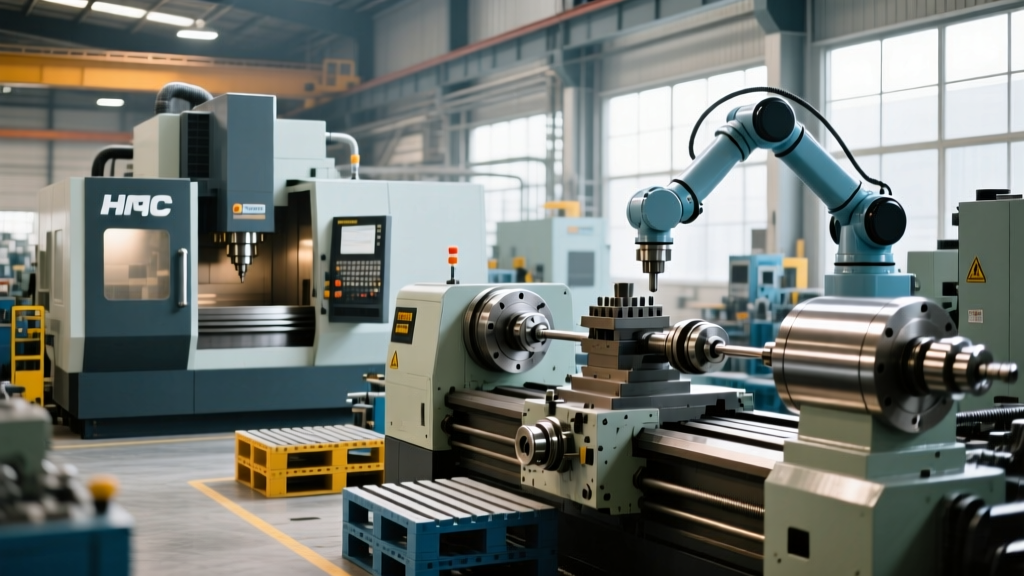
When your production run consists of high volumes of rotational components (shafts, fittings, fasteners), single-spindle CNC lathes become a bottleneck. The decision between a multi-spindle automatic and a Swiss-type lathe depends entirely on part geometry and diameter.
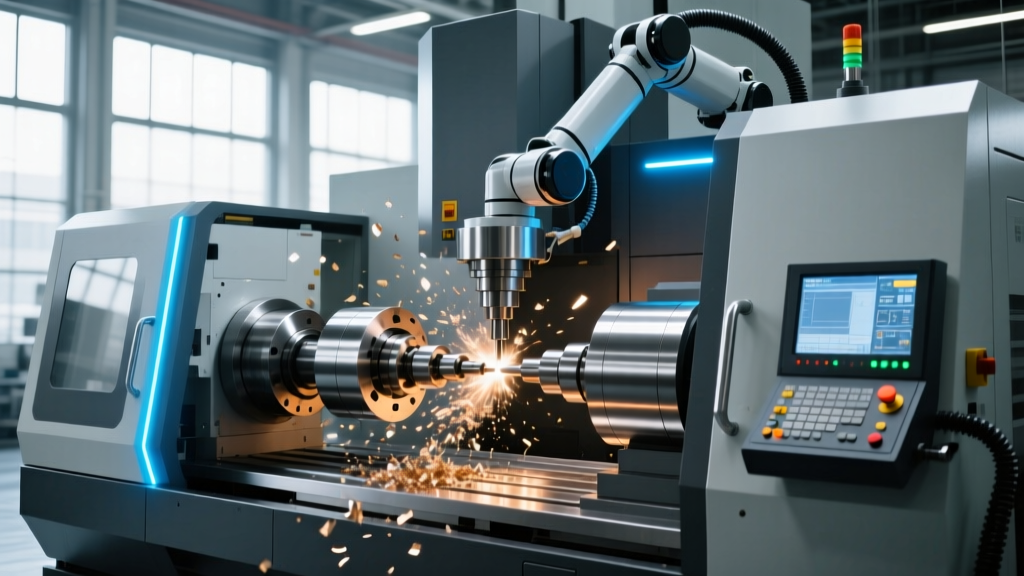
- Multi-Spindle CNC Lathes: Machines like the INDEX MS32 (6-spindle) or MS40 (8-spindle) divide the cycle time across multiple stations. A part that takes 60 seconds on a single-spindle lathe can be completed in roughly 10 to 12 seconds on a 6-spindle machine. These are ideal for parts up to 32mm in diameter that require heavy milling, cross-drilling, and back-working.
- Swiss-Type CNC Lathes: For long, slender parts where the length-to-diameter ratio exceeds 3:1, Swiss-types (e.g., Citizen Cincom L32) use a guide bushing to support the material directly adjacent to the cutting tool. This prevents deflection and eliminates the need for secondary centerless grinding operations to achieve tight OD tolerances.
Automation Integration: The True Multiplier
According to industry data from The Association For Manufacturing Technology (AMT), the integration of automated material handling is no longer optional for shops competing in high-volume contract machining. The labor shortages of the mid-2020s have cemented automation as a baseline requirement for large scale CNC machining profitability.
'Spindle utilization is the ultimate metric in mass production. If your spindle stops to wait for a human operator to unclamp a vise, you are burning overhead.'
Selecting the Right Automation Tier
- Integrated Bar Feeders (Rotational): For Swiss and multi-spindle lathes, hydrostatic bar feeders (like those from Iemca or LNS) are mandatory. They allow 12-foot bar stock to be pushed continuously, enabling 72-hour unattended weekend runs. Budget $40,000 to $65,000 per feeder.
- Gantry Loaders (Prismatic): For HMCs and high-speed VMCs producing identical parts in cycles under 45 seconds, a fixed gantry loader is faster and more cost-effective than an articulated robot. Expect to add $75,000 to $110,000 to the machine cost.
- Flexible Manufacturing Systems (FMS): For high-volume families of parts (where the raw material size varies but the fixturing interface remains standard), an FMS with rail-guided vehicles (RGVs) and centralized tool management is required. These systems start at $1.5M and scale upward, but they consistently push OEE above 90%.
Workholding and Tooling for Mass Production
Equipment selection extends beyond the machine casting. In high-volume environments, manual vise tightening is an unacceptable variable. You must specify hydraulic or pneumatic workholding integrated directly into the machine's M-code outputs.
For HMC tombstones, utilize hydraulic clamping systems from brands like Schunk or Smw Autoblok. These systems allow the machine to clamp and unclamp parts in under 1.5 seconds with exact, repeatable clamping force, preventing part distortion in thin-walled aluminum castings. Furthermore, implement quick-change workholding systems (such as the Kostyrka clamping sleeves or Roemheld zero-point systems). This allows operators to swap out entire fixture plates in minutes rather than spending hours indicating in new vises during changeovers.
ROI Calculation & Breakeven Analysis
To justify the capital expenditure of large scale CNC machining equipment, shops must calculate the breakeven point based on cycle time reduction and labor reallocation. Consider a scenario requiring 100,000 aluminum pump housings annually.
Scenario: 100,000 Aluminum HousingsOption A (2x Standard VMCs): Cycle time: 14 mins. Requires 2 full-time operators. Total annual machine hours: 23,333. Capital cost: $400,000. Labor cost (2 operators): $160,000/yr.
Option B (1x HMC with 8-Pallet Pool): Cycle time: 11 mins (due to aggressive tombstone toolpaths and no load/unload spindle idle time). Requires 1 operator managing the pool. Total annual machine hours: 18,333. Capital cost: $750,000. Labor cost (1 operator): $80,000/yr.
Result: While the HMC requires a $350,000 higher upfront investment, it saves $80,000 annually in direct labor and frees up 5,000 spindle hours per year for secondary revenue streams. The true breakeven, factoring in scrap reduction and tool life extension, typically occurs between month 22 and month 28.
Productivity benchmarks tracked by the NIST Manufacturing Extension Partnership consistently show that shops transitioning to palletized HMCs and automated lathes see a 30% to 45% increase in overall revenue per employee. When spec'ing your next large-scale production cell, prioritize chip flow, automated load/unload, and high-pressure coolant over raw axis speed. The machine that cuts the fastest is useless if it spends 20% of its shift waiting for an operator to clear chips and swap vises.