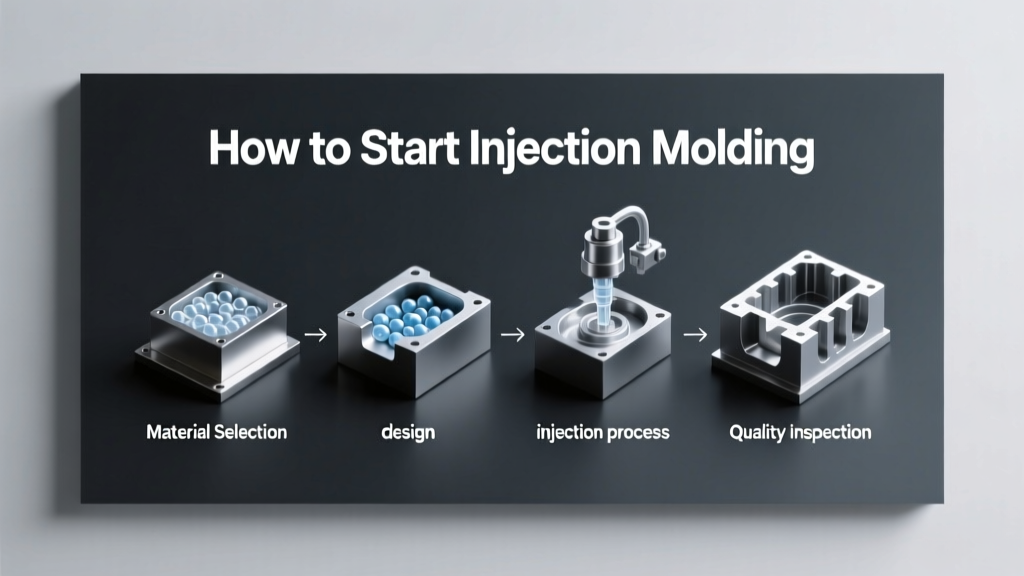
How to Start Injection Molding: A Practical, Step-by-Step Roadmap for Manufacturers
A no-fluff, engineer-tested guide to launching an injection molding operation — covering machine selection, tooling economics, material science, cycle optimization, and real-world startup costs. Includes data from Arburg, Engel, and Husky; mold cost benchmarks; and actionable checklists.
What Injection Molding Actually Is (and Why It’s Not Just for Big Corporations)
Injection molding is a high-precision manufacturing process where thermoplastic or thermoset polymer granules are melted, injected under high pressure into a closed steel mold cavity, cooled, and ejected as a finished part. Contrary to common perception, it’s no longer exclusive to Fortune 500 companies: micro-molding systems like the Arburg Allrounder 270V with clamping forces as low as 35 tons now enable startups to produce parts with tolerances of ±0.01 mm at volumes starting from 500 units/year. Unlike CNC machining or 3D printing, injection molding achieves repeatability, surface finish consistency (Ra < 0.4 µm on polished steel), and per-part cost advantages below $0.38 for components like medical syringe barrels or consumer electronics housings — once tooling is amortized. The barrier isn’t technical impossibility; it’s strategic sequencing. This guide details exactly how to sequence capital, expertise, and validation — without overcommitting before your first production run.
Step 1: Define Your Product Requirements With Engineering Rigor
Before quoting a mold or selecting a machine, lock down five non-negotiable parameters: part geometry (including draft angles ≥ 1° for polypropylene, ≥ 0.5° for ABS), wall thickness uniformity (target 1.5–3.0 mm; avoid sudden transitions >25% thickness change), functional load requirements (e.g., 12 N·m torque resistance for power tool housings), regulatory needs (ISO 13485 for Class I medical devices), and annual volume forecast. Skipping this leads to costly redesigns: in 2023, a Midwest startup producing Bluetooth earbud cases underestimated thermal expansion coefficients for PC/ABS blend, causing 22% warpage in early runs until they adjusted gate location and added 0.8 mm ribs to stiffen thin walls.
Material Selection Must Match Function — Not Just Cost
Polymer choice dictates mold design, cycle time, and long-term reliability. Polypropylene (PP) offers chemical resistance and flexibility but shrinks 1.5–2.0% — requiring oversized cavities. Polycarbonate (PC) delivers impact strength (notched Izod > 850 J/m) but demands mold temperatures ≥ 80°C to prevent stress cracking. For food-grade applications, Eastman Tritan™ copolyester meets FDA 21 CFR §177.1520 and resists clouding after 1,000 dishwasher cycles. Avoid generic ‘engineering plastic’ labels: specify grade (e.g., BASF Ultramid® B3WG6 for glass-filled nylon 6/6) and verify melt flow index (MFI) — a value of 24 g/10 min @ 275°C/5 kg ensures consistent fill for thin-walled connectors.
Design for Manufacturability (DFM) Is Non-Negotiable
DFM isn’t optional feedback — it’s your first quality gate. Key rules: maintain uniform wall thickness within ±0.1 mm tolerance; use radii ≥ 0.3 mm on all interior corners to reduce stress concentration; place ejector pins on non-cosmetic surfaces; and avoid undercuts requiring side-actions unless absolutely necessary (they increase mold cost by 35–60%). Use Autodesk Fusion 360’s built-in DFM checker or send native STEP files to Quickparts or Protolabs for free automated analysis. Their 2024 benchmark shows 68% of startup mold quotes get revised after DFM feedback — saving average upfront tooling costs of $12,400.
Step 2: Choose the Right Machine — Size, Speed, and Precision
Clamping force (measured in tons) must exceed the projected area of your part multiplied by melt pressure. For a 120 cm² automotive sensor housing made of PBT, peak melt pressure reaches 120 MPa — requiring minimum clamping force = 120 cm² × 120 MPa ÷ 9.81 ≈ 147 tons. Select machines with 20% headroom: a 180-ton Engel e-motion 180/40 is optimal. Smaller machines like the 85-ton Haitian Jupiter II J85AN deliver faster cycles (12.3 sec vs. 18.7 sec on larger units) for high-volume small parts (< 50 g), but lack platen rigidity for large molds. Prioritize electric servo-hydraulic hybrids (e.g., Sumitomo (SHI) Demag IntElect series) for energy savings: they consume 30–50% less kWh than full-hydraulic units and hold position repeatability within ±0.02 mm.
Key Specifications That Impact Real-World Output
Don’t just compare tonnage. Examine shot size range (e.g., Arburg 370S has 24–460 cm³ capacity — ideal for parts from 5 g to 380 g); platen parallelism (±0.05 mm over 400 mm width is industry standard for low-flash production); and dry-cycle time (critical for automation integration — the Husky Hylectric 1200 achieves 1.8 sec dry cycle vs. 3.2 sec on legacy hydraulic presses). Also verify screw L/D ratio: 20:1 or higher ensures homogeneous melt for engineering resins. Machines with barrel temperature control stability ≤ ±1°C (like all Wittmann Battenfeld EcoPower models) reduce color-streaking risk in multi-material overmolding.
Step 3: Tooling Investment — Costs, Timelines, and Smart Sourcing
Mold cost dominates startup CAPEX. A single-cavity, two-plate steel mold for a 100 g consumer part averages $28,500–$41,000 USD (2024 Machinist’s Handbook data), while a 4-cavity family mold with hot-runner manifold and cooling circuit simulation pushes $124,000–$189,000. Timeline is equally critical: domestic U.S. mold shops (e.g., Progressive Tool & Industries, Michigan) deliver in 8–12 weeks; Chinese suppliers (DME-certified partners like Dongguan Yifeng Mould) quote 6–9 weeks but require 3–4 physical design reviews. Never accept ‘soft tooling’ (aluminum or P20 steel) for production runs exceeding 10,000 units — H13 hardened steel (52–54 HRC) is mandatory for >500,000 cycles.
- Core/cavity materials: H13 (52–54 HRC) for general purpose; S7 for high-impact zones; 420 stainless for corrosive resins (e.g., PVC with chlorine stabilizers)
- Cooling: Conformal cooling channels (via metal AM like EOS M 400) reduce cycle time by 18–25% versus drilled lines — worth the +$18,000 premium for molds running >200,000 units/year
- Hot runners: Mold-Masters Eletrostream systems offer ±0.5°C zone control; avoid generic Chinese manifolds — failure rate jumps from 1.2% to 9.7% in first year
| Mold Complexity | Steel Grade | Avg. Lead Time (U.S.) | Estimated Cost Range (USD) | Max Recommended Production Volume |
|---|---|---|---|---|
| Single-cavity, 2-plate | H13 (52 HRC) | 10–12 weeks | $28,500 – $41,000 | 250,000 units |
| 2-cavity, cold runner | H13 (54 HRC) | 12–14 weeks | $52,000 – $74,000 | 500,000 units |
| 4-cavity, hot runner + conformal cooling | H13 + beryllium copper inserts | 16–20 weeks | $124,000 – $189,000 | 2,000,000+ units |
Step 4: Process Development and Validation Protocol
Never jump straight to full-rate production. Follow a three-phase validation: (1) Dry-run verification (no material) to confirm mold opening/closing, ejector stroke, and sensor response; (2) Short-shot study using 25%, 50%, 75%, and 100% fill to map weld line locations and air trap zones; (3) Design of Experiments (DoE) on 3 critical parameters — melt temperature (±5°C), packing pressure (±15 bar), and cooling time (±2 sec) — using Minitab or JMP software. At Protolabs’ Minnesota facility, 92% of first-article failures trace to unvalidated packing profiles — not mold geometry.
First-Article Inspection Must Be Data-Driven
Use calibrated CMMs (e.g., Hexagon Absolute Arm 7525) with certified styli to measure 12 critical dimensions — not just ‘as-built’. Tolerances must meet GD&T callouts: for a medical fluid connector, position tolerance on inlet port must be ≤ Ø0.1 mm at MMC, verified with true position calculation (not simple X/Y deviation). Document every measurement in AS9102-compliant First Article Inspection Report (FAIR). Skip this, and you’ll face customer rejections: one orthopedic implant startup failed audit because their supplier used calipers instead of CMM for thread pitch verification on titanium-reinforced PEEK parts.
Process Capability Isn’t Optional — It’s Contractual
Run 300 consecutive parts under locked parameters and calculate Cp/Cpk. Target Cp ≥ 1.33 and Cpk ≥ 1.33 for non-safety-critical parts; ≥ 1.67 for automotive (IATF 16949) or medical (ISO 13485). If Cpk drops below 1.0 on any dimension, root cause is likely inconsistent melt temperature (check barrel zone calibration) or uneven mold cooling (verify ΔT across circuits is < 3°C). Do not ship until capability is proven — customer PPAP submissions require full statistical evidence.
Step 5: Operational Infrastructure and Compliance Essentials
Your shop floor needs more than a press and dryer. Required infrastructure includes: dehumidifying hopper dryers (e.g., Novatec NDL-30 drying PC at 120°C/4 hrs with dew point ≤ −40°C), central conveying systems (Dorner IQ240 for noise < 68 dB(A)), and ISO Class 8 cleanrooms (for medical parts — 100,000 particles/ft³ ≥ 0.5 µm). Electrical supply must deliver stable voltage (±2% variance) — voltage sags below 90% cause screw stall in electric machines. Compressed air must be oil-free and filtered to 0.01 µm (Parker Balston filters) for pneumatic valve actuation.
- Environmental controls: Maintain ambient temperature 20–24°C and humidity 40–60% RH — fluctuations cause static buildup and resin moisture variation
- Preventive maintenance: Replace hydraulic oil every 3,000 operating hours (per Engel service manual); inspect tie-bar stretch quarterly with ultrasonic thickness gauge
- Documentation: Implement paperless MES like Plex Manufacturing Cloud to track lot traceability, maintenance logs, and OEE (Overall Equipment Effectiveness) — required for AS9100 Rev D
Step 6: Financial Modeling — Realistic Startup Budgets
Underestimate costs, and you’ll halt before first revenue. A lean startup producing mid-volume consumer goods (50,000 units/year) requires minimum $342,000 in Year 1 capital:
- Machine: $195,000 (180-ton Engel e-motion with robotic arm and vision system)
- Mold: $38,000 (single-cavity, H13, conformal cooling)
- Support equipment: $42,500 (dryer, chiller, material loader, CMM)
- Facility build-out: $36,000 (electrical upgrades, exhaust, epoxy flooring)
- Initial resin inventory: $12,000 (5,000 kg of UL-certified ABS + PP)
- Engineering & certification: $18,500 (FDA registration, ISO 9001:2015 audit, PFMEA)
Revenue breakeven occurs at ~22,000 units sold — assuming $1.42 selling price and $0.68 fully burdened cost (including labor, overhead, scrap). Note: scrap rates start at 6–8% for new processes; target ≤ 2.5% by Month 6 via systematic DOE and operator training. Avoid leasing presses with usage caps — a $1,890/month lease on a 120-ton machine often includes 1,200-hour/year limit, costing $32/hour overage fees that erase margin.
Step 7: Scaling Responsibly — When and How to Add Capacity
Scale only when utilization exceeds 75% for three consecutive months AND customer POs are confirmed for next 6 months. Adding a second identical press improves OEE by enabling staggered maintenance (one press runs while other undergoes 8-hour PM) and reduces lead time variability. But avoid ‘capacity chasing’: a Midwest client added a second 200-ton machine at 62% utilization, then lost $217,000 in idle depreciation and labor over 14 months. Instead, optimize first press: install predictive vibration sensors (SKF Microlog Analyzer) to extend bearing life by 40%, and retrofit with AI-based process monitoring (IoT-enabled iQlaser from KraussMaffei) to cut setup time by 35%.
For volume growth beyond 250,000 units/year, prioritize mold replication over new machines. Duplicate the proven cavity insert set ($18,000–$22,000) and mount on a second press — faster ROI than buying new tooling. Track key metrics religiously: OEE (target ≥ 82%), First Pass Yield (FPY ≥ 94.5%), and Mean Time Between Failures (MTBF ≥ 420 hours). Anything below these thresholds signals process instability — not machine deficiency.
Remember: injection molding success hinges on disciplined sequencing, not speed. One Wisconsin contract manufacturer waited 11 weeks for mold validation before accepting their first order — and secured a 5-year automotive contract because their FAIR report included 100% dimensional coverage and Cpk ≥ 1.52 on all safety-critical features. That patience built trust. Your first 100 parts aren’t about output — they’re about proving control. Every parameter logged, every measurement validated, every cycle stabilized is infrastructure you can’t buy later. Start small, validate relentlessly, and scale only when data — not optimism — demands it.
The technology exists. The materials are standardized. The machines are reliable. What separates successful startups from stalled projects is adherence to physics-based process discipline — not funding rounds or flashy marketing. Measure melt temperature with calibrated thermocouples, not IR guns. Verify cooling circuit flow with digital flow meters (±1% accuracy), not pressure gauges. Record every shot weight (±0.05 g resolution) — not just ‘stable.’ These habits compound. In six months, your process won’t just run — it will predict, adapt, and self-optimize. That’s when injection molding stops being a cost center and becomes your most defensible competitive advantage.
Finally, partner with component suppliers who provide traceable data. When sourcing hot nozzles, demand melt temperature stability curves (not just ‘±1°C’ claims). When selecting resins, require actual lot-specific rheology reports — not generic datasheets. A 2023 study by UL Solutions found that 31% of molding defects traced to undocumented batch-to-batch viscosity shifts in ‘standard grade’ polycarbonate. Control starts upstream — and ends with documented, repeatable evidence at every stage.
Injection molding isn’t magic. It’s applied thermodynamics, precision mechanics, and statistical rigor — executed daily. Begin there, and everything else follows.