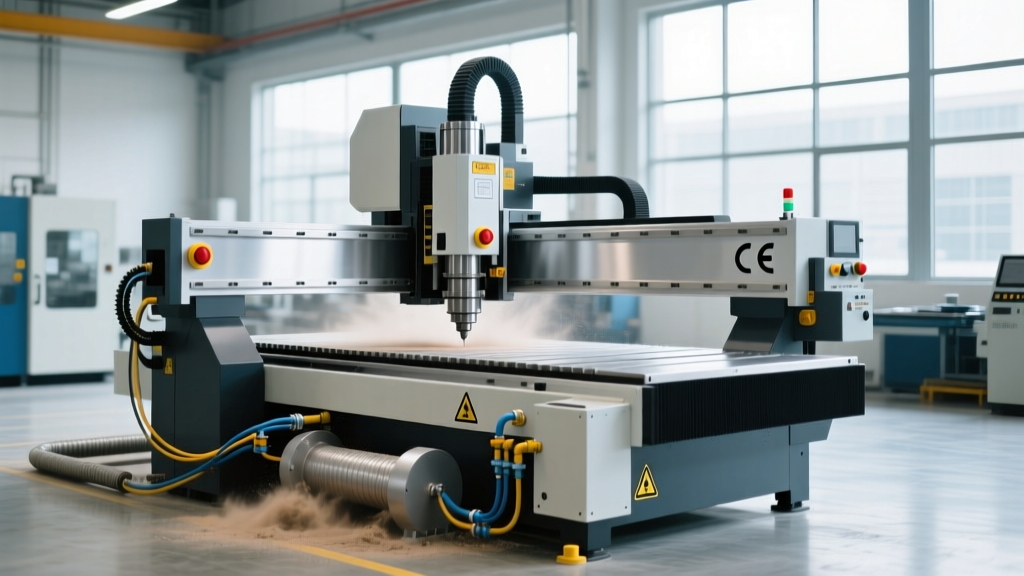
CNC Router Cutting Machine Safety: OSHA and CE Compliance Guide
Ensure your CNC router cutting machine meets OSHA and CE standards. Explore guarding, dust extraction, and electrical compliance requirements.
The True Cost of Bypassing Safety Interlocks
Bypassing a door interlock on a CNC router cutting machine might save three seconds per tool change, but it exposes a fabrication shop to catastrophic amputation risks and severe regulatory penalties. As of 2026, the Occupational Safety and Health Administration (OSHA) imposes maximum penalties exceeding $161,000 for willful machine guarding violations under 29 CFR 1910.212. For shops operating in or exporting to the European Union, non-compliance with the CE Machinery Directive (2006/42/EC) results in immediate market withdrawal and heavy fines.
Compliance is not merely about avoiding fines; it dictates the operational continuity of your manufacturing floor. This guide details the exact hardware, electrical, and environmental standards required to legally and safely operate high-speed CNC routing equipment.
2026 Regulatory Baseline: OSHA categorizes missing or defeated point-of-operation guards on CNC routers as "Willful" or "Repeat" violations if prior warnings were issued, triggering the highest penalty tier. The European EN ISO 13849-1 standard now strictly mandates Performance Level (PL) 'd' or 'e' for safety-related control systems on automated gantry machinery.Core Regulatory Frameworks: OSHA vs. CE Machinery Directive
While OSHA focuses heavily on employer responsibility and point-of-operation guarding, the CE framework requires manufacturers to integrate safety into the machine's fundamental design. Understanding both is critical for North American shops importing European gantry systems (like Biesse or SCM) and domestic shops building custom enclosures.
- OSHA 1910.212 (General Requirements for All Machines): Mandates physical barriers preventing operators from reaching into the cutting zone during spindle rotation. Requires two-hand trip controls or automatic presence-sensing devices.
- CE Machinery Directive (EN ISO 12100 & 13849): Requires risk assessment and validation of safety circuits. A standard software pause is legally insufficient; the machine must utilize hardwired, dual-channel safety relays to achieve a Category 3 or 4 architecture.
Mandatory Hardware Safeguards and Interlock Specifications
Off-the-shelf CNC router cutting machine models often ship with minimal guarding to reduce freight weight and cost. Upgrading these systems requires specific, certified components to pass a third-party safety audit.
1. Polycarbonate Enclosures and Viewing Shields
Standard acrylic sheets shatter under the impact of a fractured carbide endmill or a delaminated piece of plywood ejected at 18,000 RPM. All primary viewing windows must utilize polycarbonate (e.g., Lexan or Makrolon).
- Minimum Thickness: 6mm (0.236 inches) for routers operating under 15,000 RPM; 10mm for high-speed spindles (24,000+ RPM) or machines processing dense composites.
- Mounting: Shields must be secured with anti-vibration nylon lock nuts and sealed with neoprene gaskets to prevent high-frequency acoustic fatigue cracking.
2. Safety Interlocks and Light Curtains
Mechanical limit switches are easily defeated with tape or zip-ties, a common trigger for OSHA citations. Modern compliance requires non-contact, RFID-coded magnetic safety switches (such as the Schmersal RSS26 or Pilz PSENmag series).
- Access Doors: Must utilize RFID-coded actuators with a minimum 25mm sensing range, wired to a dual-channel safety relay.
- Open-Gantry Machines: If full enclosure is impossible due to oversized sheet loading, Type 4 safety light curtains (e.g., Keyence GL-R series) with 14mm finger-detection resolution must be installed at the operator loading zone, calculated via the ISO 13855 safety distance formula to ensure the spindle halts before a hand breaches the cutting plane.
3. Emergency Stop (E-Stop) Architecture
An E-stop button routed through a standard PLC input is a critical failure point. Under ISO 13850, E-stops must trigger a Category 0 (immediate power removal) or Category 1 (controlled stop, then power removal) event via a dedicated, hardwired safety relay (like the Pilz PNOZ X3).
Critical Warning: Never wire an E-stop button solely to the Variable Frequency Drive's (VFD) software logic or the CNC controller's breakout board. The physical contactor cutting 3-phase power to the spindle motor must be actuated by a certified safety relay with positive-break contacts.Combustible Dust Extraction and Fire Safety (NFPA 664)
Routing MDF, particleboard, and solid wood generates fine particulate matter that poses a severe deflagration hazard. The National Fire Protection Association (NFPA) outlines strict parameters for dust collection in woodworking facilities. According to OSHA's combustible dust guidelines, allowing dust to accumulate on overhead surfaces or inside ungrounded PVC ductwork is a citable fire hazard.
| Material Processed | Dust Hazard Classification | Minimum Duct Velocity | Required Filter Media |
|---|---|---|---|
| Solid Oak / Hardwoods | Class ST1 (Moderate Explosion Risk) | 4,000 FPM | Cellulose/Polyester Blend (Anti-static) |
| MDF / Particleboard | Class ST2 (High Explosion Risk) | 4,500 FPM | PTFE Membrane on Anti-static Spunbond |
| Acrylic / Plastics | Static Discharge Hazard | 3,500 FPM | Conductive Carbon-Impregnated Filter |
Ductwork Compliance: PVC piping is strictly prohibited for CNC dust extraction due to static accumulation. All galvanized steel spiral ducting must be bonded and grounded to a common earth ground with a resistance of less than 1 ohm. Furthermore, explosion venting panels must be installed on the dust collector hopper, directed away from pedestrian walkways.
Electrical Grounding and VFD Stray Currents
The high-frequency switching of Variable Frequency Drives (VFDs) used in CNC router spindles generates parasitic capacitance and stray voltages. Without proper mitigation, these currents seek the path of least resistance—often through the spindle bearings, causing electrical discharge machining (EDM) fluting and premature bearing failure, alongside severe shock hazards for operators.
- Symmetrical Shielded Cables: Use VFD-rated symmetrical shielded motor cables (e.g., Belden VFD cables) with three symmetrical ground conductors rather than a single ground wire.
- 360-Degree Shield Termination: The cable shield must be clamped to the machine chassis using a 360-degree EMC gland, not a pigtail wire, to effectively route high-frequency noise to the earth ground.
- Shaft Grounding Rings: Install conductive microfiber shaft grounding rings (such as AEGIS rings) on the spindle motor to divert stray voltages away from the bearings.
For comprehensive machinery electrical standards, reference the UK Health and Safety Executive's guidance on the Machinery Directive, which aligns closely with global IEC 60204-1 requirements for the electrical equipment of machines.
Operator Training and Lockout/Tagout (LOTO) Protocols
Hardware safeguards are rendered useless without documented, verifiable operator training. OSHA requires training on specific machine hazards, not just generic CNC operation.
- Bit Changes and Collet Maintenance: Training must cover the specific Lockout/Tagout (LOTO) procedure for spindle maintenance. Relying on the CNC controller's "tool change" macro is insufficient; the main disconnect switch must be locked out with a physical padlock to prevent accidental pneumatic collet release or software-initiated spindle spins.
- Workholding Failure Modes: Operators must be trained to calculate required vacuum hold-down PSI or mechanical clamp torque based on the specific cutting forces (RPM, feed rate, and depth of cut) of the active toolpath to prevent material ejection.
Achieving full compliance on a CNC router cutting machine requires an integrated approach combining certified physical guarding, hardwired safety logic, and aggressive combustible dust management. Audit your current machine architecture against ISO 13849 and NFPA 664 parameters to identify and rectify critical liabilities before they result in equipment seizure or operator injury.
Related reading

How To Match Troubleshooting With Work: A CNC Router Operator’s Precision Protocol

Best Cranes for Schedules: Precision, Reliability, and On-Time Delivery in Heavy Construction