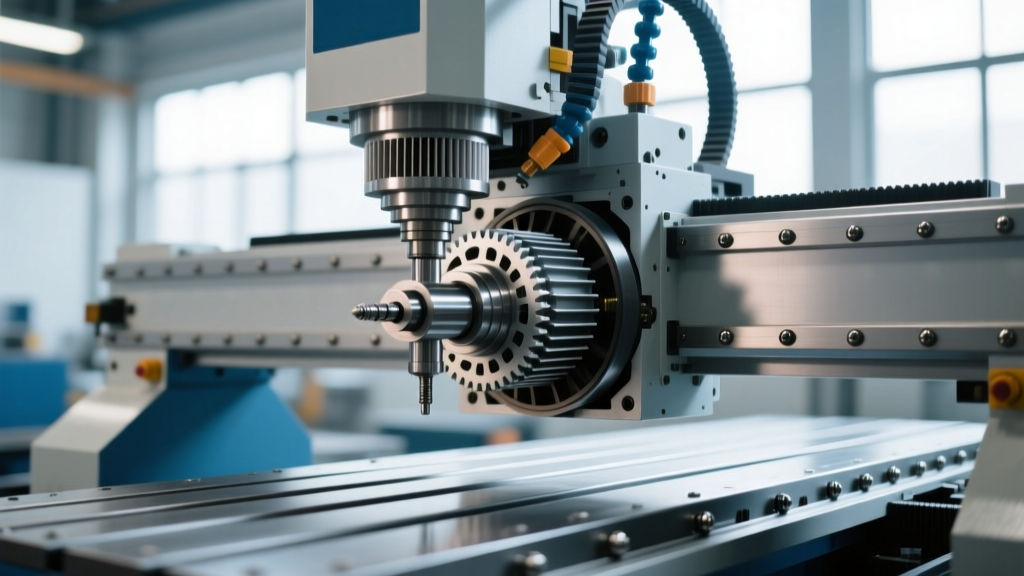
CNC Router Machine Mechanics: Core Technical Specs Explained
Explore the internal mechanics and core technical specifications of a CNC router machine, from spindle torque to axis drive systems and controller logic.
The performance envelope of any CNC router machine is dictated by its underlying mechanical architecture and control logic. While hobbyist forums often focus on software toolpaths, industrial manufacturing relies on the physical realities of gantry deflection, spindle runout, and servo tuning. Understanding these technical specifications is critical for buyers and operators aiming to match machine capabilities with specific material removal rates (MRR) and tolerance requirements.
Kinematics and Axis Drive Systems
The method by which rotational motor force is translated into linear axis movement defines the machine's speed, backlash, and positional accuracy. Modern CNC router machines typically utilize one of three primary drive mechanisms:
1. Helical Rack and Pinion
Standard on large-format industrial machines (e.g., 4x8 ft or 5x10 ft beds), helical rack and pinion systems provide continuous high-speed travel without the whipping issues associated with long ball screws. Premium systems utilize Apex Dynamics or Atlanta Gear helical racks paired with planetary gearboxes. This configuration reduces backlash to less than 0.05mm and allows rapid traverse rates exceeding 25 meters per minute. According to technical documentation from ShopBot Tools Technical Support, proper lubrication of these racks with NLGI Grade 2 lithium-complex grease is mandatory to prevent accelerated wear on the pinion teeth.
2. Precision Ball Screws
For smaller-format, high-precision machines (under 2x3 ft), C7 or C5 ground ball screws (such as those from Hiwin or THK) are the standard. Ball screws offer near-zero backlash and exceptional thrust force, making them ideal for machining non-ferrous metals like aluminum and brass. However, on the X and Y axes of large-format machines, long ball screws are prone to 'whip'—a harmonic vibration that occurs at high RPMs, severely limiting maximum traverse speeds and degrading surface finish.
3. Closed-Loop Stepper vs. AC Servo Motors
By 2026, the industry has largely shifted away from open-loop steppers for mid-tier and industrial machines. Closed-loop steppers (e.g., Leadshine iHSS series) feature integrated encoders that prevent lost steps by monitoring rotor position, offering a cost-effective upgrade. However, true industrial CNC router machines rely on AC Servo Motors (such as the Yaskawa Sigma-7 series). Servos provide continuous torque at high speeds, auto-tuning resonance suppression, and peak torque outputs up to 300% of their rated continuous torque during heavy acceleration and deceleration phases.
Spindle Assembly and Torque Curves
The spindle is the heart of the CNC router machine. Selecting the correct spindle requires analyzing the torque curve, not just the peak kilowatt (kW) rating. A spindle that produces 9kW at 24,000 RPM but lacks low-end torque will stall when routing hardwoods with large-diameter bits.
Industrial standard spindles, such as the HSD ES951 9kW ATC (Automatic Tool Change), utilize liquid cooling loops to maintain thermal stability, preventing the spindle shaft from expanding and altering the Z-axis zero point during long runtimes. Furthermore, the collet system dictates tool holding precision. High-end machines use DIN 6499 standard ER32 collets manufactured from spring steel, guaranteeing a total indicated runout (TIR) of less than 0.008mm at the collet nut face. Cheap, unbranded collets often exhibit 0.05mm+ runout, leading to premature carbide tool wear and poor edge finishes.
Spindle Power vs. Material Application Matrix
| Spindle Power | Cooling Method | Ideal Material Applications | Typical Price Range (Spindle Only) |
|---|---|---|---|
| 1.5 kW - 3.0 kW | Air / Water | Softwoods, acrylics, PCB engraving, light sign-making | $250 - $600 |
| 5.0 kW - 7.5 kW | Air / Liquid | Hardwoods, MDF nesting, solid surface (Corian), plastics | $1,200 - $2,500 |
| 9.0 kW - 12.0 kW | Liquid | High-speed 3D profiling, aluminum plate milling, composite nesting | $3,500 - $6,000+ |
Controller Architecture and Block Look-Ahead
The controller interprets G-code and translates it into electrical pulses for the drive motors. The most critical, yet frequently misunderstood, specification in a CNC router machine controller is Look-Ahead capability.
When executing complex 3D toolpaths generated by CAM software like Mastercam or VCarve Pro, the toolpath consists of thousands of microscopic line segments. A basic DSP controller (like the older RichAuto A11) might only look 50 to 100 blocks ahead. When the machine approaches a sharp directional change, it must decelerate to a near-stop to avoid overshooting, resulting in 'stuttering' dwell marks burned into the material.
Advanced industrial controllers, such as the Syntec 6MB or PC-based Mach4 with high-speed motion control cards (e.g., Warp9 Ethernet SmoothStepper), utilize 1,000 to 2,000 block look-ahead. This allows the controller to calculate the exact deceleration curve required meters before the tool actually reaches the corner, maintaining a constant chip load and flawless surface finish. As noted in advanced machining guides by CNC Cookbook, look-ahead processing is the primary differentiator between a machine that produces rough, stair-stepped 3D carvings and one that produces glass-smooth contours.
Gantry Rigidity and Deflection Metrics
A 15kW spindle is useless if the gantry deflects under cutting forces. Machine beds are generally constructed from either T-slot aluminum extrusions or welded, stress-relieved steel tubes.
- Extruded Aluminum Beds: Common in hobbyist and prosumer machines. While lightweight and easy to assemble, they are prone to harmonic vibration and torsional twisting under heavy lateral cutting loads.
- Welded Steel Tube Beds: Standard for industrial CNC router machines. The steel frame is welded, then subjected to vibratory stress relief or thermal annealing to remove internal welding tensions. This prevents the bed from warping over time.
For the gantry crossbeam, manufacturers utilize heavy-wall rectangular steel tubing or cast iron. A well-engineered industrial gantry should exhibit less than 0.05mm of deflection across a 1,500mm span when subjected to a 50kg lateral cutting force at the Z-axis carriage. This rigidity is what allows industrial routers to aggressively machine 6061-T6 aluminum using single-flute carbide endmills without chatter.
⚠️ Critical Warning: VFD Electromagnetic Interference (EMI)
When integrating a Variable Frequency Drive (VFD) for spindle speed control, unshielded cables act as antennas, broadcasting high-frequency EMI. This interference frequently causes phantom limit-switch triggers, erratic Z-axis zeroing, and controller reboots. Always use double-shielded, armored cables for the VFD-to-spindle connection, ensure the shield is grounded at only one end (the VFD chassis), and route spindle cables at least 150mm away from low-voltage stepper/servo signal wires.
Z-Axis Braking and Homing Precision
The Z-axis carries the heaviest dynamic load (the spindle and carriage) and is most susceptible to gravity-induced failure. Industrial CNC router machines utilize fail-safe electromagnetic brakes on the Z-axis servo or stepper motor. These spring-applied, 24V DC brakes engage instantly when power is cut or an E-stop is pressed, preventing a 40lb spindle carriage from crashing into the workpiece or vacuum table.
For homing, the transition from mechanical micro-switches to inductive proximity sensors (such as the Omron E2B series) has become the 2026 standard. Proximity sensors offer non-contact detection with a repeatability of 0.01mm, ensuring that a machine paused on Friday evening and resumed on Monday morning will pick up the exact same Z-zero datum, eliminating scrapped parts due to homing drift.
'The accuracy of a CNC router is not defined by the software's decimal places, but by the mechanical repeatability of its homing sensors and the torsional rigidity of its crossbeam under maximum lateral load.'
— Industrial Automation Engineering Principles
By evaluating the kinematics, spindle torque curves, controller look-ahead, and structural rigidity, buyers can move beyond marketing brochures and select a CNC router machine that delivers verifiable, precision manufacturing results.