2026 CNC Machine Router Trends: AI, 5-Axis & Automation
Explore 2026 CNC machine router innovations, including AI toolpaths, 5-axis RTCP, IoT spindle telemetry, and hybrid additive manufacturing.
The modern CNC machine router is no longer just a motorized gantry moving along Cartesian coordinates. In 2026, it operates as a cyber-physical node on the shop floor, integrating real-time sensor feedback, artificial intelligence, and hybrid manufacturing capabilities. For fabricators working with advanced composites, dense hardwoods, and aerospace-grade plastics, understanding these technological shifts is critical for maintaining tight tolerances and maximizing spindle uptime.
AI-Driven Adaptive Toolpath Execution
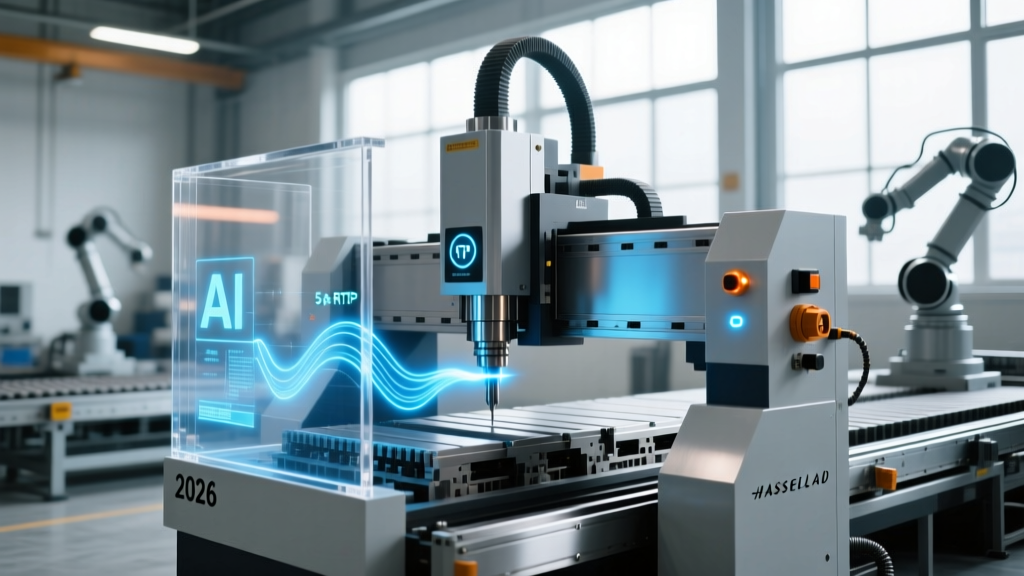
Historically, CAM software generated static G-code based on idealized material models. If a CNC machine router encountered a dense knot in walnut or a resin-rich pocket in carbon-fiber reinforced polymer (CFRP), the tool would either deflect, chatter, or break. The 2026 generation of CNC controllers, led by platforms like the Siemens Sinumerik One and Fanuc 31i-B5, utilize onboard machine learning to execute adaptive toolpaths in real-time.
These systems monitor spindle load and servo motor torque at sampling rates exceeding 10kHz. When the AI detects an anomaly indicating increased material density, it dynamically scales the feed rate—dropping from 200 IPM to 85 IPM in milliseconds—while simultaneously adjusting the spindle speed to maintain optimal chip load. This eliminates the need for conservative, generalized feed rates and reduces cycle times by an average of 18% to 22% on complex 3D contouring jobs.
Expert Insight: To fully leverage AI adaptive control, your CAM post-processor must output specific variable macros (like Fanuc #variables or Siemens R-parameters) that grant the controller permission to override baseline feed rates. Static G-code locks out these AI interventions.IoT Spindle Telemetry and Predictive Maintenance
Spindle replacement on a high-end 5-axis CNC machine router can cost between $12,000 and $28,000, not including the downtime penalty. The integration of IoT telemetry via the MTConnect standard has shifted maintenance from reactive to predictive. Modern routers are now equipped with piezoelectric accelerometers mounted directly on the spindle housing, measuring vibration across the X, Y, and Z axes.
Key Telemetry Metrics Monitored in 2026
- Thermal Growth: Infrared sensors track spindle bearing temperatures, alerting operators if thermal expansion exceeds 3 microns, which compromises Z-axis depth accuracy.
- Vibration Harmonics: Edge gateways analyze frequency spectrums to detect early-stage bearing race degradation long before audible chatter occurs.
- Drawbar Force Decay: Strain gauges monitor the clamping force of the HSK63F or BT30 tool holder, preventing tool pullout during heavy roughing passes.
By routing this data through MQTT protocols to cloud dashboards, shop managers can predict spindle failure within a 45-day window, allowing them to schedule replacements during planned maintenance rather than mid-production.
2026 Controller Ecosystem Comparison
Selecting the right brain for your CNC machine router dictates your shop's ceiling for automation and precision. Below is a technical comparison of the dominant controller ecosystems available for industrial routers this year.
| Controller Model | AI Adaptive Features | Native IoT Protocol | RTCP Calibration | Est. Upgrade Cost |
|---|---|---|---|---|
| Siemens Sinumerik One | Digital Twin integration, collision avoidance AI | OPC UA, MTConnect | Automated 3D probe cycles (0.0002" tol.) | $38,000 - $55,000 |
| Fanuc 31i-B5 | AI Contour Control, Servo Guide AI tuning | FOCAS2, MTConnect | Manual/Auto hybrid (0.0004" tol.) | $32,000 - $45,000 |
| Heidenhain TNC 640 | Dynamic Precision (vibration damping) | DNC interface, custom XML | KinematicsOpt (highly automated) | $41,000 - $60,000 |
5-Axis RTCP and Advanced Composite Routing
The demand for 5-axis simultaneous routing has surged, driven by the aerospace and marine sectors requiring complex CFRP and fiberglass components. The critical innovation here is the refinement of Rotary Tool Center Point (RTCP) algorithms. In older systems, running a 5-axis toolpath along a compound curve introduced micro-stutters as the controller calculated the kinematic chain in real-time, leaving visible dwell marks on the composite surface.
Current 5-axis CNC machine router platforms, such as the Thermwood CS73 and Onsrud 5-axis series, utilize look-ahead processing that calculates up to 10,000 blocks ahead. This ensures the rotary axes (B and C) pre-position smoothly without interrupting the linear feed of the X, Y, and Z axes. When machining abrasive composites, maintaining a constant chip load via flawless RTCP is mandatory; any hesitation glazes the cutting edge of diamond-coated compression bits, leading to catastrophic delamination of the workpiece.
"Routing carbon fiber at 22,000 RPM requires more than just a fast spindle. It requires absolute kinematic stability. If your RTCP calibration is off by even 0.001 inches at the tool tip, the side-load will snap a $400 PCD endmill in seconds." — Lead Manufacturing Engineer, Advanced Composites Lab.
Dust Extraction and NFPA Compliance
Advanced material routing introduces severe safety variables. While wood dust requires standard NFPA 664 compliance for combustible dust mitigation, routing CFRP demands specialized HEPA filtration and static-dissipative ducting. Carbon micro-fibers are highly conductive and can short out unprotected CNC machine router control cabinets if drawn into the electronics enclosure via negative pressure leaks.
Hybrid Additive-Subtractive Router Heads
A major frontier in 2026 is the integration of large-format additive manufacturing directly onto the CNC machine router gantry. Systems are now being outfitted with dual-head configurations: a 12kW HSK63F routing spindle on the left, and a high-temperature pellet extruder (such as the CEAD E30) on the right.
This hybrid approach allows shops to 3D print large structural molds or tooling fixtures using carbon-fiber-filled PEEK or ULTEM pellets, and then immediately switch to the subtractive spindle to machine the critical mating surfaces and trim the flash to exact tolerances. This eliminates the need to move the workpiece between a 3D printer and a CNC mill, reducing cumulative setup errors and cutting total lead time by up to 40% for mold-making operations.
Shop Floor Readiness Audit for 2026 Upgrades
Upgrading to a next-generation CNC machine router requires more than just floor space and capital. The cyber-physical nature of modern routers demands specific infrastructure. Use this framework to audit your facility before signing a purchase order.
- Network Latency & Bandwidth: AI toolpath streaming and real-time IoT telemetry require a dedicated, hardwired Cat6a network drop to the machine. Wi-Fi is unacceptable due to latency spikes that can interrupt DNC drip-feeding. Target network latency must be consistently under 2ms.
- Compressed Air Quality: 5-axis spindle air purges and pneumatic tool changers require ISO 8573-1 Class 1.2.1 air quality. Moisture or oil aerosols in the air lines will destroy the ceramic bearings in a 24,000 RPM spindle within months. Install a refrigerated dryer and coalescing filters.
- Power Conditioning: Advanced servo drives are highly sensitive to voltage sags. Install a dedicated 480V 3-phase line with an active power conditioner to prevent micro-interruptions that corrupt onboard controller memory during long-cycle composite routing.
- Climate Control Stability: For 5-axis RTCP to maintain 0.0004-inch tolerances, the ambient temperature around the CNC machine router must not fluctuate more than ±2°F (±1°C) over a 24-hour period. Thermal expansion of the machine casting will otherwise invalidate the kinematic calibration.
The transition toward intelligent, interconnected routing systems represents a fundamental shift in manufacturing capability. Shops that invest in AI-driven controllers, rigorous IoT telemetry, and hybrid hardware configurations will dictate the pace of production, while those relying on static, open-loop systems will struggle to maintain margins against the escalating demands of modern material science.
Related reading
CNC Router Machine Mechanics: Core Technical Specs Explained

World Alternatives to Specs: CNC Router Tooling, Software, and Workflow Solutions Beyond Standard Industrial Specifications