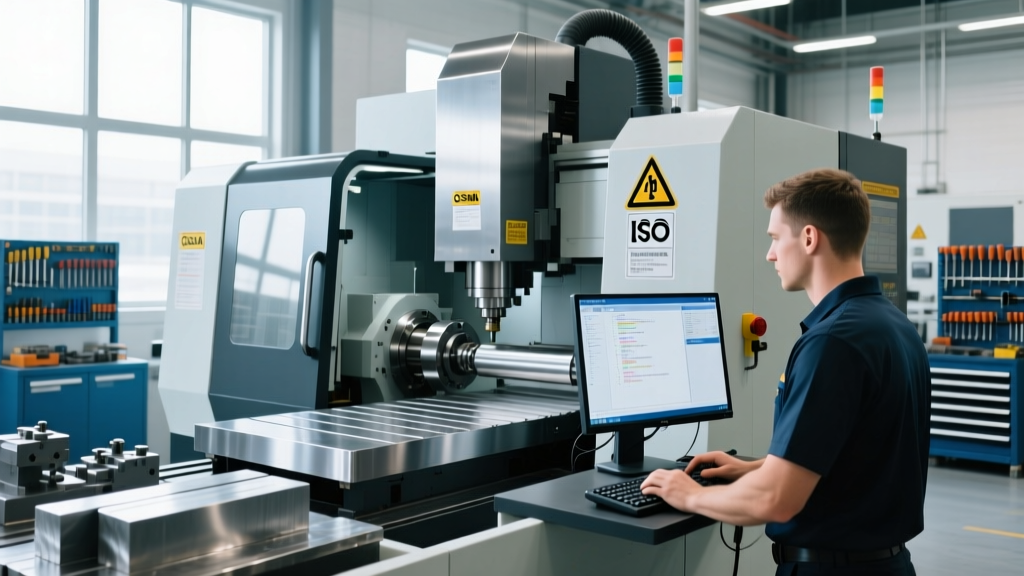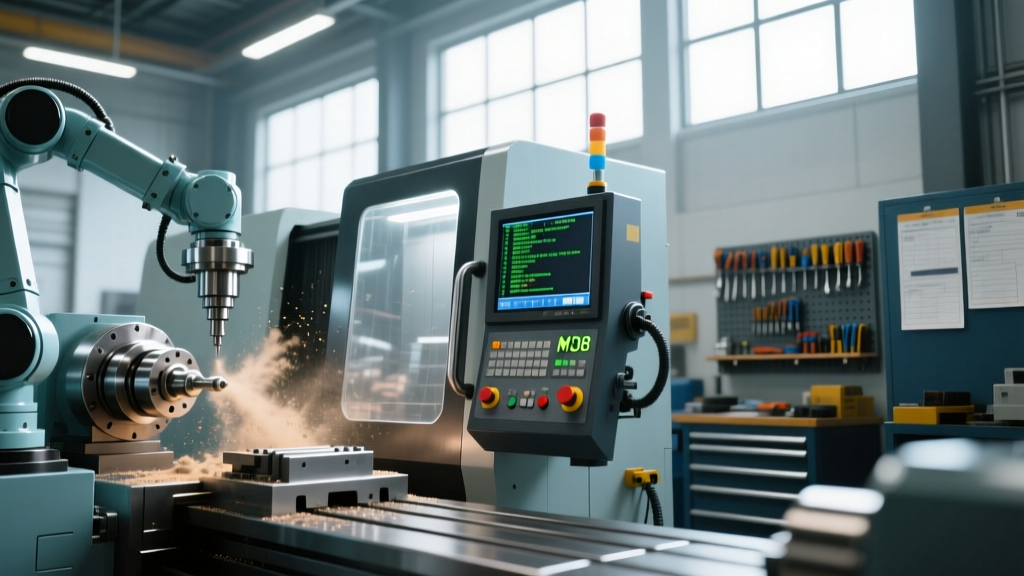
Essential CNC Machine M Code List for Maintenance Schedules
Master preventive maintenance with this essential CNC machine M code list. Automate fluid management, chip removal, and custom macro alarms.
Beyond Basic Spindle Control: M-Codes as Maintenance Triggers
While G-codes dictate the toolpath and geometry of a part, Miscellaneous codes (M-codes) control the physical ecosystem of the CNC machine. In high-volume production environments, relying on operators to manually manage chip conveyors, way lubrication, and coolant flushing leads to catastrophic way-cover damage and premature spindle failure. By integrating a strategic cnc machine m code list directly into your CAM post-processors and main programs, shops can automate preventive maintenance and enforce service schedules without relying on human memory.
In 2026, with the average cost of a replacement spindle cartridge for a standard 40-taper VMC ranging from $12,000 to $18,000, automating machine health functions via M-codes is no longer optional—it is a financial necessity. This guide details the specific M-codes required to manage machine fluids, automate chip evacuation, and program custom maintenance alarms using Fanuc-compatible macro variables.
⚠️ CRITICAL WARNING: Never override OEM factory maintenance M-codes (such as forced way-lube pulses) via parameter adjustments to save cycle time. Bypassing these automated lube cycles will void your machine warranty and accelerate ballscrew wear by up to 40% within the first year.The Core CNC Machine M Code List for Fluid & Chip Management
The foundation of machine health lies in thermal stability and debris removal. The following table outlines the standard M-codes used to automate the systems that protect your machine's castings and guideways.
| M-Code | Function | Maintenance Impact & Best Practice |
|---|---|---|
| M08 / M09 | Flood Coolant On / Off | Prevents thermal growth in the spindle and workpiece. Always program M09 at the end of the cycle to prevent coolant pooling and bacterial growth in the enclosure. |
| M31 / M32 / M33 | Chip Conveyor Fwd / Rev / Stop | Critical for preventing chip bird-nesting. Program M32 (Reverse) for 3 seconds every 15 minutes to break up stringy aluminum chips before switching back to M31. |
| M10 / M11 | Pallet / Fixture Clamp | Automates hydraulic clamping. Ensure hydraulic pressure switches are monitored; a dropped clamp during M10 execution can cause a $50,000 crash. |
| M70 / M71 | Mist Coolant / Air Blast | Use M71 for air blast during graphite or cast iron machining to prevent abrasive dust from infiltrating the way covers and ballscrew wipers. |
| M21 / M22 | Manual Way Lube Pulse (OEM Specific) | Some builders allow manual triggering of the way lube pump. Use sparingly; over-lubrication contaminates coolant and degrades tramp oil skimmers. |
Programming Custom Maintenance Alarms with Macro Variables
Standard M-codes only toggle hardware states. To enforce actual service schedules (e.g., greasing spindle bearings every 500 hours or changing hydraulic fluid every 2,000 hours), you must combine M-codes with Fanuc macro variables. By utilizing the #3000 alarm generation variable alongside M00 (Program Stop), you can force the machine to halt and alert the operator when a maintenance threshold is breached.
Step-by-Step: Automating a 500-Hour Spindle Grease Interval
Most modern VMCs feature grease-lubricated spindles that require manual greasing via a specific grease gun and nozzle. To track this, assign a persistent macro variable (e.g., #500) to accumulate spindle run hours.
- Track Spindle Hours: In your tool-change macro or main program header, add logic to increment
#500based on cycle time. - Set the Threshold: Use an
IF...THENstatement to evaluate#500. - Trigger the Alarm: Assign a custom message to
#3000and executeM00.
(--- MAINTENANCE MACRO SUBPROGRAM O9010 ---)
IF [#500 GT 500.0] THEN #3000 = 1 (SPINDLE GREASE DUE - CALL MAINT)
M00 (FORCED STOP FOR MAINTENANCE)
#500 = 0 (RESET COUNTER AFTER MAINTENANCE)
M99 (RETURN TO MAIN PROGRAM)
According to CNC Cookbook, utilizing persistent variables (typically #500 through #999 on Fanuc controls) ensures that the maintenance counter is retained even if the machine loses power, providing a reliable, un-resettable service log directly on the control screen.
OEM-Specific Maintenance M-Codes: Haas, Mazak, and Okuma
While the ISO standard defines basic M-codes, machine tool builders implement proprietary codes to manage their specific hardware architectures. When building your cnc machine m code list for the shop floor, you must account for these OEM variations.
Haas Automation
Haas controls heavily utilize the M30-series for chip management. As detailed in the Haas Tip of the Month archives, programming M31 (Chip Conveyor Forward) at the start of a roughing cycle and M33 (Stop) during finishing passes prevents the conveyor motor from overheating and extends the lifespan of the hinge belt. Furthermore, Haas Parameter 318 can be configured to automatically trigger an M-code alarm when the way lube reservoir float switch drops below 15% capacity.
Mazak (Mazatrol)
Mazak machines often abstract traditional M-codes behind Mazatrol conversational units. However, in EIA (G-code) mode, Mazak utilizes custom M-codes for their SmoothG control's thermal shield and chiller management. For example, specific M-codes are used to engage the spindle chiller pre-cool cycle 10 minutes before the first M03 (Spindle On) command, ensuring thermal equilibrium.
Okuma (OSP Control)
Okuma’s OSP control relies heavily on subprograms rather than raw M-codes for maintenance routines. Instead of a simple M-code to pulse the way lube, Okuma utilizes the L command subprogram structure to manage axis-specific lubrication distribution, ensuring the Z-axis receives a heavier lube pulse than the X-axis during heavy vertical milling.
Troubleshooting M-Code Maintenance Faults
When automated maintenance M-codes fail, it is rarely a programming error. It is usually a mechanical fault preventing the M-code from completing its circuit. Use this decision tree to diagnose common failures.
Symptom: M31 (Chip Conveyor Forward) Fails to Engage
- Cause 1: Overload relay tripped due to a jammed hinge belt. Fix: Clear the physical jam in the tray, reset the relay in the electrical cabinet, and program an
M32(Reverse) pulse to break future chip wedges. - Cause 2: Proximity sensor misalignment. The control does not register the conveyor is in the 'home' position. Fix: Adjust the sensor gap to exactly 2mm.
Symptom: M08 (Coolant On) Triggers, but Pressure is < 15 PSI
- Cause: The M-code successfully opens the solenoid valve, but the physical filter is clogged with tramp oil and fines. Fix: M-codes cannot monitor analog pressure without a macro-enabled pressure transducer. Install a physical pressure gauge and mandate a 30-day filter change schedule.
Symptom: Custom Macro Alarm (#3000) Triggers Prematurely
- Cause: The persistent variable (e.g.,
#500) was not reset to zero after the last maintenance event. Fix: Ensure the maintenance technician manually types#500 = 0into the MDI panel after completing the physical service.
The Financial ROI of M-Code Automation
Integrating a comprehensive cnc machine m code list into your standard CAM templates yields immediate financial returns. In aerospace and medical machining, where unplanned downtime costs between $10,000 and $25,000 per hour, a single prevented spindle failure pays for hundreds of hours of programming time. Furthermore, automating the chip conveyor via M31/M32 cycles saves approximately 12 minutes of manual labor per shift per machine—time that operators can spend performing value-added deburring or quality inspection. Stop treating M-codes as mere on/off switches; program them as the central nervous system of your shop's preventive maintenance strategy.