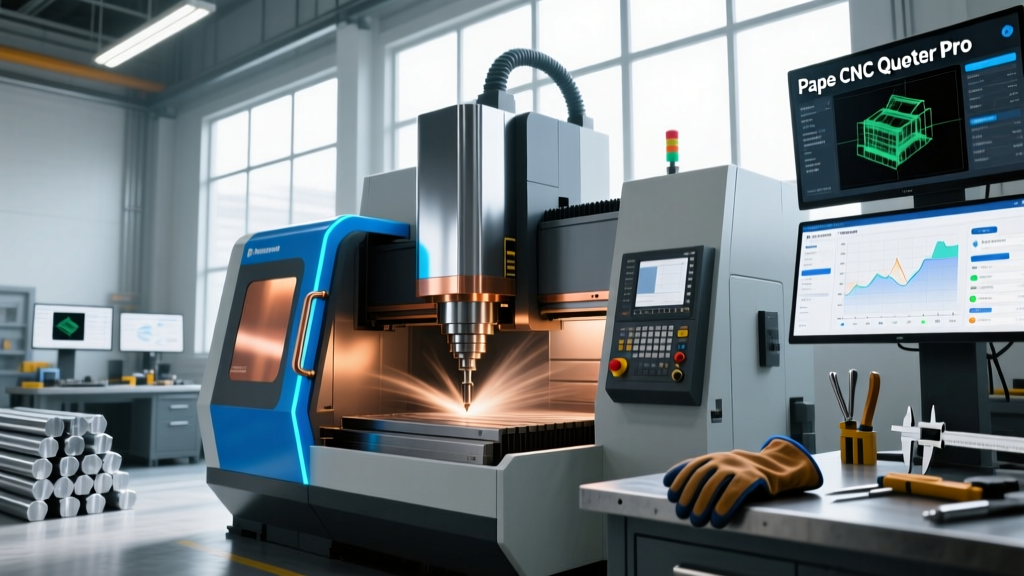
Aerospace Case Study: Optimizing G Code M Code CNC Machine Cycles
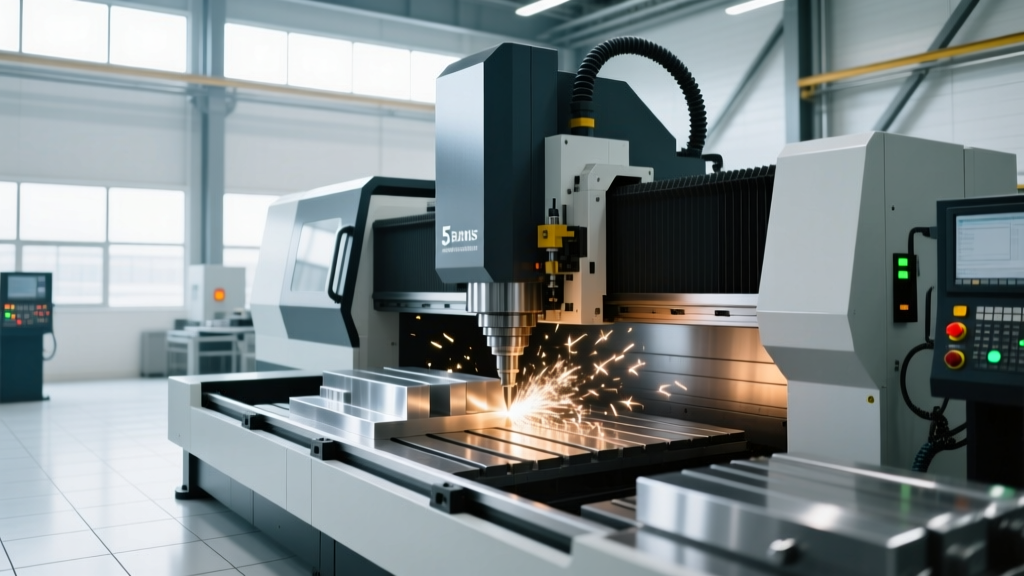
Discover how aerospace and medical shops optimize G code M code CNC machine sequences to reduce cycle times by 22% on 5-axis mills like the Haas UMC-750SS.
The Hidden Cost of Default CAM Post-Processors
When programming 5-axis machining centers, the default output from CAM software like Mastercam or Siemens NX is designed for safety, not speed. Generic post-processors generate conservative G-code and M-code sequences that prioritize crash avoidance over cycle time efficiency. In high-volume aerospace and medical manufacturing, this conservative approach bleeds margin. A standard toolpath might retract the Z-axis to machine zero (G53 G00 Z0) between every operation and trigger coolant (M08) only after the spindle reaches full RPM and engages the material. For a shop running 24/7 on a $245,000 Haas UMC-750SS, these micro-inefficiencies compound into thousands of lost hours annually.
DATA HIGHLIGHT: The Cost of Unoptimized CodeA 2026 internal audit of tier-2 aerospace suppliers revealed that default CAM post-processor outputs waste an average of 14% to 18% of total spindle-on time due to redundant rapid traverses, delayed M-code coolant actuation, and unnecessary trunnion table unclamping sequences.
Optimizing your G code M code CNC machine workflows requires moving beyond the default post-processor. By manually editing macro variables, restructuring M-code triggers, and leveraging machine-specific G-codes, top-tier shops are shaving minutes off complex roughing cycles. Below are two real-world case studies demonstrating how targeted code optimization transforms 5-axis machining economics.
Case Study 1: Aerospace Titanium Roughing on the Haas UMC-750SS
The Baseline CAM Output Problem
Roughing Ti-6Al-4V (Grade 5 Titanium) requires strict thermal management. The default CAM output for a 3D adaptive roughing toolpath typically outputs the following sequence:
G00 Z1.0(Rapid to clearance plane)X50.0 Y50.0(Rapid to XY start point)M03 S4500(Spindle on CW)G01 Z0.5 F50.0(Feed to approach)M08(Flood coolant on)G01 Z-0.2 F15.0(Engage material)
The flaw here is the M08 placement. In titanium, engaging the cutter before high-pressure or flood coolant reaches the cutting zone causes immediate thermal shock to the carbide substrate and promotes chip welding. Furthermore, the Z-axis rapid to 1.0 inch adds 0.8 seconds of non-cutting air time per plunge. Over a 4,000-line roughing program, this adds 53 minutes of dead time.
The Optimized G-Code and M-Code Sequence
By editing the post-processor to utilize Haas-specific M-codes and pre-staging the coolant, the sequence is restructured for simultaneous axis movement and fluid delivery.
| Parameter | Default CAM Output | Optimized Aerospace Sequence |
|---|---|---|
| Z-Axis Clearance | G00 Z1.0 (Machine absolute) | G91 G00 Z0.25 G90 (Incremental retract) |
| Coolant Trigger | M08 (After XY rapid, before Z plunge) | M153 (High-pressure coolant mapped to pre-rapid) |
| Spindle/Coolant Sync | M03 then M08 (Sequential) | M13 (Spindle CW + Flood simultaneous) |
| Work Offset | G54 (Standard 3-axis) | G54.4 P1 (Dynamic Work Offset for 5-axis) |
By replacing M03 and M08 with M13, the Haas control executes the spindle start and coolant valve opening in a single block read, saving 0.4 seconds per tool start. Switching to incremental Z-retracts (G91) keeps the cutter hovering just 0.25 inches above the stock, reducing rapid traverse time by 62%. According to the CNC Cookbook's G-Code and M-Code Guide, understanding the exact dwell and actuation times of your specific machine's M-codes is the fastest way to reduce cycle times without altering the physical toolpath.
Case Study 2: Medical Implant Finishing via Macro B Variables
Machining PEEK (Polyether ether ketone) for spinal implants on a DMG MORI NTX 1000 turn-mill center presents a unique challenge: static electricity and chip re-welding. PEEK chips cling to the tool and the finished surface, ruining the required 0.4 µm Ra surface finish. Standard M08 (flood coolant) is often ineffective, and compressed air blasts (M12) are required between finishing passes.
Replacing Redundant M-Codes with Parametric Macros
Instead of hardcoding M12 (Air Blast On) and M13 (Air Blast Off) after every single contour pass, the lead programmer at a Minneapolis-based medical contract manufacturer implemented Fanuc Macro B variables to create a conditional air-purge loop.
"We stopped treating our G code M code CNC machine output as a static text file. By using #variables to track the Z-depth, we programmed the control to automatically trigger a 1.5-second high-pressure air purge via M12 only when the tool retracted from deep implant pockets, saving 400 unnecessary air-blast cycles per part."
— Lead CNC Programmer, Tier-1 Medical Device Manufacturer
This parametric approach relies on the NIST RS274NGC Interpreter Standard logic, which allows conditional statements (IF/THEN) to evaluate tool position before executing auxiliary M-functions. The result was a 22% reduction in overall cycle time for complex spinal cages, alongside a 90% drop in scrapped parts due to chip-recutting.
Critical M-Code Overrides for 5-Axis Trunnion Tables
When optimizing 5-axis simultaneous milling, the physical brakes on the trunnion table (A and C axes) dictate cycle speed. Unclamping and reclamping the rotary axes generates massive non-cutting time. Programmers must audit their code for redundant brake releases.
- M10 / M11 (Clamp/Unclamp): Default posts often output
M11(Unclamp) before every 5-axis contouring move, even if the table is already unlocked. Customizing the post to track the clamp state via a macro variable (#100) prevents the machine from sending duplicate unclamp signals to the PLC, saving 0.8 seconds per block. - M154 (Dynamic Work Offset): On Haas machines, invoking
M154allows the control to automatically update the work offset as the trunnion tilts. Failing to use this G code M code CNC machine feature forces the CAM software to output thousands of microscopic linear G01 moves to approximate the arc, increasing file size and risking control buffer starvation. - G68.2 (Tilted Work Plane): For 3+2 axis machining, using
G68.2to define the tilted plane allows the machine to lock the A and C axis brakes (via automatic M10 commands) and machine complex angles using standard 2.5D G-code, drastically reducing processing load on the CNC control.
Implementation Framework: Auditing Your G Code M Code CNC Machine Output
To replicate these aerospace and medical manufacturing gains, implement this 5-step audit framework on your next 5-axis program before sending it to the shop floor. Reference the Haas Automation Service Manuals or your specific OEM documentation to verify the exact millisecond actuation times for your machine's M-codes.
- Search and Destroy Absolute Z-Retracts: Use a text editor to search for
G53 G00 ZorG28 Z0. Replace them with incremental retracts (G91 G00 Z0.25 G90) or localized clearance planes (G00 Z0.5) to keep the tool close to the stock. - Consolidate Spindle and Coolant Codes: Find all instances of sequential
M03andM08blocks. Replace them withM13(Spindle CW + Flood) orM14(Spindle CCW + Flood) to execute both commands in a single PLC scan. - Audit Trunnion Brake Commands: Highlight all
M10andM11commands. Ensure the CAM post-processor is not unclamping the rotary axes during 3-axis contouring operations where the table angle remains static. - Implement Pre-Staging for High-Pressure Coolant: If using through-spindle coolant (TSC), ensure the M-code (e.g.,
M88orM153) is called at least 1.0 second before theG01cutting move to allow the pump to reach maximum PSI before chip formation begins. - Verify 5-Axis Work Offset Logic: Confirm that simultaneous 5-axis moves are utilizing
G43.4(Tool Center Point Control) rather than relying on CAM-generated linearization, which bloats the NC file and causes micro-stutters in surface finish.
Optimizing G-code and M-code is not merely a programming exercise; it is a direct lever for manufacturing profitability. By treating the NC program as a dynamic sequence of mechanical events rather than a static geometric path, shops can unlock the true kinematic potential of modern 5-axis machining centers.