High Volume CNC Machined Parts vs. MIM and Die Casting
Compare high volume CNC machined parts with MIM and die casting. Analyze costs, tolerances, and lead times to choose the right manufacturing process.
The Scaling Dilemma: Calculating the Breakeven Point
Transitioning from prototyping to mass production introduces a critical inflection point in unit economics. While CNC machining offers unparalleled precision and material flexibility, the cost-per-part curve flattens significantly after 5,000 units. When procurement targets exceed 50,000 units annually, engineers must evaluate whether high volume CNC machined parts remain viable, or if alternative net-shape processes like High-Pressure Die Casting (HPDC) and Metal Injection Molding (MIM) offer superior total cost of ownership (TCO).
The decision is rarely based on unit cost alone. It requires a synthesis of metallurgical requirements, geometric complexity, and secondary operation overhead. According to manufacturing analysis from the Society of Manufacturing Engineers (SME), nearly 40% of mass-produced metal components undergo at least one secondary CNC operation regardless of the primary forming method, fundamentally altering the perceived cost advantage of casting or molding.
Process Comparison Matrix: CNC vs. HPDC vs. MIM
The following matrix contrasts the baseline capabilities of these three dominant mass-production methods for metal components. Data reflects standard industrial capabilities for parts weighing between 50g and 500g.
| Parameter | Multi-Axis / Swiss CNC | High-Pressure Die Casting (HPDC) | Metal Injection Molding (MIM) |
|---|---|---|---|
| Ideal Volume | 1,000 – 50,000 | 50,000 – 1,000,000+ | 10,000 – 500,000 |
| Tooling Cost | $0 (Fixturing only: $500-$2k) | $15,000 – $45,000 (P20/H13 Steel) | $8,000 – $18,000 (Tool Steel) |
| Standard Tolerances | ±0.005 mm (±0.0002") | ±0.05 mm (±0.002") | ±0.03 mm (±0.001") |
| Surface Finish (Ra) | 0.8 – 1.6 µm | 1.0 – 2.5 µm | 1.5 – 3.0 µm |
| Geometric Limits | Constrained by tool access | Requires draft angles (1-2°) | Complex 3D, no draft required |
| Material State | Wrought (Extruded/Forged) | Cast (Alloys) | Sintered (Powder Metallurgy) |
Deep Dive: Optimizing High Volume CNC Machined Parts
Sticking with CNC machining for volumes exceeding 100,000 units is only economically justifiable if the production cell is highly automated and utilizes specialized equipment. Standard 3-axis vertical mills cannot compete with net-shape processes at this scale. Instead, high-volume CNC relies on Swiss-type lathes and multi-spindle turning centers.
Swiss-Type and Multi-Spindle Economics
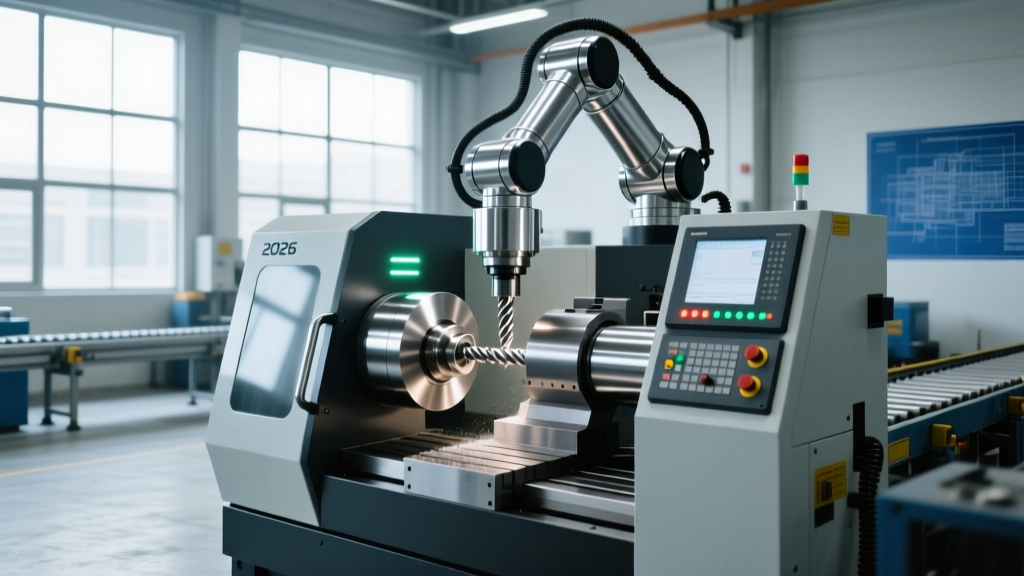
For complex, small-diameter parts (under 32mm), Swiss-type lathes like the Tsugami BO205-II or Tornos MultiAlpha 8x20 are the industry standard. These machines utilize guide bushings to support the material directly adjacent to the cutting tool, eliminating deflection and allowing for aggressive, high-speed turning of difficult alloys like 316L stainless steel or Ti-6Al-4V.
- Bar Feeder Integration: High-volume CNC requires hydrostatic bar feeders capable of handling 12-foot bar stock. This reduces remnant waste to under 2% and enables continuous "lights-out" machining for 14+ hours unattended.
- High-Pressure Coolant (HPC):strong> Running 1,000 to 2,000 PSI coolant through the tool tip is mandatory for high-volume CNC. It breaks stringy chips in ductile materials (like 304 SS) and extends carbide insert life by up to 300%, reducing per-part tooling amortization costs.
- Unit Cost Reality: While a 5-axis milled bracket might cost $14.50 in low volumes, a complex Swiss-turned brass fitting can achieve a unit cost of $0.65 to $1.15 at 100,000 units, rivaling cast alternatives when secondary operations are factored in.
When designing fluidic manifolds or pneumatic valves, HPDC often introduces internal micro-porosity due to trapped air during the shot cycle. Even with vacuum-assisted die casting, high-pressure applications (above 150 PSI) frequently fail leak testing. In these scenarios, high volume CNC machined parts from wrought billet (e.g., 6061-T6 or C36000 brass) remain the only viable option to guarantee zero porosity and absolute structural integrity.
Alternative 1: High-Pressure Die Casting (HPDC)
HPDC dominates the 100,000+ volume tier for aluminum and zinc components. By forcing molten metal into hardened steel molds at pressures up to 10,000 PSI, cycle times are reduced to mere seconds.
Material and Tooling Specifics
The most common alloys are A380 Aluminum and Zamak 3 (Zinc). A380 offers excellent fluidity and a tensile strength of roughly 324 MPa, though it is inherently brittle compared to wrought 6061-T6 (310 MPa yield, but vastly superior elongation). Tooling for HPDC is constructed from H13 tool steel, hardened to 42-46 HRC to withstand the thermal shock of molten aluminum. A multi-cavity mold for a mid-sized automotive bracket will cost between $25,000 and $40,000 and require 12 to 16 weeks for fabrication and T1 sampling.
The Secondary Machining Tax
HPDC cannot hold tight tolerances on critical mating surfaces. As noted in ThomasNet's manufacturing process guides, die cast parts almost universally require secondary CNC milling and tapping. If a cast housing requires face-milling for a gasket seal and tapping four M6 blind holes, the secondary CNC operation adds $0.40 to $0.90 per part. This "secondary tax" must be added to the raw casting cost to determine true TCO.
Alternative 2: Metal Injection Molding (MIM)
MIM bridges the gap between the geometric complexity of plastic injection molding and the mechanical properties of solid metal. It is strictly limited to small parts, typically under 50 grams and 100mm in maximum dimension.
The Sintering Shrinkage Factor
MIM involves mixing fine metal powders (e.g., 17-4 PH stainless or M2 tool steel) with a polymer binder to create a "feedstock." The part is injected into a mold in a "green" state, debinded, and then sintered in a high-temperature furnace. During sintering, the part undergoes a predictable but massive 15% to 18% volumetric shrinkage.
Mold designers must intentionally oversize the tooling cavity to compensate for this shrinkage. If the thermal profile of the sintering furnace fluctuates by even 5°C, the final dimensions of high volume CNC machined parts alternatives like MIM can drift outside the ±0.03 mm tolerance band, resulting in batch rejections. Furthermore, parts must be supported on custom ceramic setters during sintering to prevent gravity-induced warping, adding to the fixture overhead.
Total Cost of Ownership (TCO) Breakdown at 100,000 Units
The following table models the TCO for a complex, 85-gram mechanical linkage with two critical tolerance bores (±0.01 mm) and three tapped holes. The material requirement is high-strength stainless steel.
| Cost Factor | Swiss CNC (316L SS) | HPDC (316L not viable; uses 17-4 PH MIM instead) | MIM (17-4 PH SS) |
|---|---|---|---|
| Tooling & Setup | $1,200 (Collets/Guide Bushings) | N/A (HPDC cannot process 17-4 PH) | $14,500 (Mold + Ceramic Setters) |
| Raw Unit Cost | $1.85 | N/A | $0.95 |
| Secondary CNC Ops | $0.00 (Done in single setup) | N/A | $0.45 (Bore reaming & tapping) |
| Scrap/Rework Rate | 1.5% ($277) | N/A | 4.0% ($560) |
| Total TCO (100k Units) | $186,477 | N/A | $154,560 |
Note: While MIM wins on pure TCO for this specific small, complex geometry, the 4-week lead time for sintering and the inability to easily modify the hard tooling make CNC superior for iterative designs or volatile demand forecasts.
Metallurgical Trade-Offs: Wrought vs. Sintered vs. Cast
Engineers often overlook the microstructural differences between these processes, leading to field failures. According to NIST metrology and material standards, verifying the mechanical properties of the chosen process is as critical as verifying dimensional tolerances.
- Wrought (CNC): The extrusion or forging process aligns the metal's grain structure, providing superior fatigue resistance and impact toughness. Essential for cyclic loading applications like aerospace actuators.
- Sintered (MIM): Contains 2% to 5% residual micro-porosity even after optimal sintering. This reduces ductility and elongation at break. MIM 17-4 PH will exhibit roughly 85% of the yield strength of wrought 17-4 PH.
- Cast (HPDC): Rapid cooling creates a fine-grained skin but a coarser, potentially porous core. Excellent for static structural loads and thermal dissipation (e.g., LED heat sinks), but poor for high-impact or fatigue-critical environments.
Decision Framework: Selecting the Optimal Process
Use the following operational criteria to finalize your manufacturing route for volumes exceeding 50,000 units:
Choose High Volume CNC Machined Parts If:
- The part requires zero porosity for high-pressure fluid or gas containment.
- Material specifications mandate wrought alloys (e.g., 7075-T6 Aluminum, Ti-6Al-4V, or high-nickel superalloys) that cannot be cast or sintered.
- Tolerances tighter than ±0.015 mm are required across multiple datum planes without secondary fixturing.
- Annual volumes are subject to high volatility, making $30,000 hard tooling investments a financial risk.
Choose Die Casting (HPDC) If:
- The part is primarily Aluminum or Zinc, weighs over 100g, and features thin walls (1.5mm - 3.0mm).
- The geometry requires complex external ribbing for stiffness or heat dissipation.
- Critical tolerances are isolated to a single plane that can be quickly face-milled in a secondary operation.
Choose Metal Injection Molding (MIM) If:
- The part weighs less than 50g and features complex 3D contours, undercuts, or internal geometries that would require 5-axis CNC or multi-operation Swiss turning.
- The material is a high-melting-point alloy (like 316L or 17-4 PH) where traditional machining tool wear drives CNC costs prohibitively high.
- Surface finish requirements allow for a slightly granular Ra 2.0 µm texture post-sintering.