CNC Plasma Cutter Machine ROI: 2026 Fabrication Case Studies
Analyze real-world CNC plasma cutter machine ROI through 2026 fabrication case studies, covering consumable costs, THC upgrades, and cut speeds.
The Shift to High-Definition CNC Plasma in Mid-Sized Fabrication
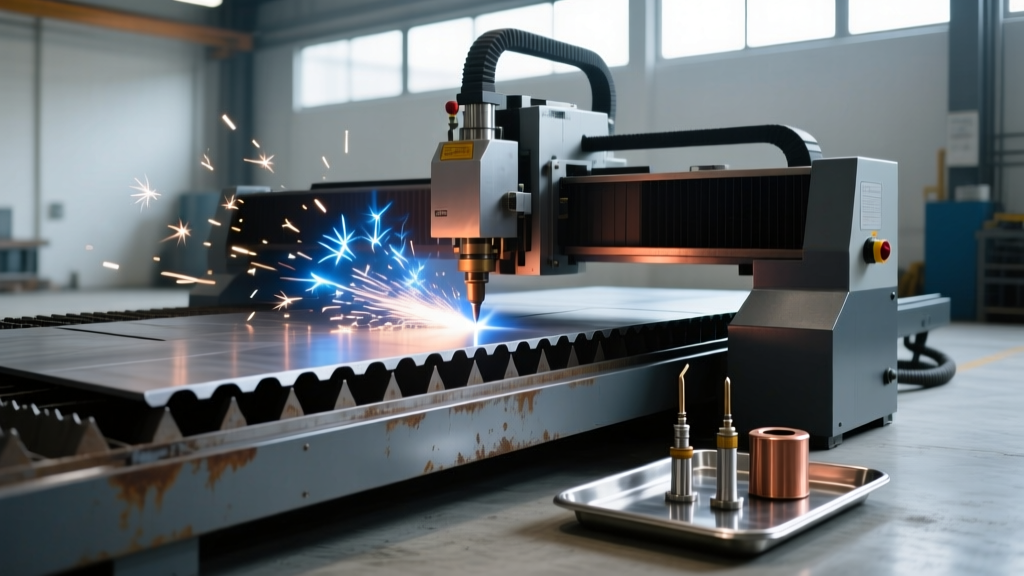
For mid-sized metal fabrication shops in 2026, the capital expenditure gap between fiber lasers and high-definition CNC plasma systems has widened. While fiber lasers dominate the sub-1/2-inch precision market, the modern CNC plasma cutter machine remains the undisputed ROI king for heavy plate processing, beveling, and high-volume structural cutting. However, the profitability of these systems relies entirely on the peripheral accessories, consumable management, and torch height control (THC) calibrations.
This analysis examines two distinct 2026 industry case studies to demonstrate how specific CNC plasma parts, gas accessories, and table configurations dictate the difference between a 14-month and a 4-year return on investment.
Case Study 1: Heavy Equipment Repair & AR Plate Wear Parts
Facility: Midwest Hardox Solutions (Illinois)
Application: Cutting 1/2" to 1.5" AR400 and AR500 wear plates for custom excavator bucket linings.
Equipment: 5x10 CNC plasma table equipped with a Hypertherm XPR300 high-definition power supply.
Production Metrics (Post-Optimization)
- Cut Speed: 115 IPM on 1/2" AR400 (vs. 18 IPM on legacy oxy-fuel)
- Consumable Life: 640 pierces per set (up from 210 prior to air system upgrades)
- Dross Accumulation: Reduced by 85% using True Hole consumable kits
The Bottleneck: Moisture and Double-Arcing
Initially, Midwest Hardox experienced catastrophic consumable failure. Hafnium electrodes were melting down in fewer than 150 pierces, and the nozzle bore was degrading, leading to "double-arcing" (where the pilot arc transfers to the nozzle instead of the workpiece, destroying the copper nozzle instantly).
The root cause was traced to the shop's compressed air accessory setup. Plasma cutting requires exceptionally dry air. The shop was using a standard refrigerated air dryer, which only achieved a dew point of 38°F. At this moisture level, water vapor oxidizes the hafnium emitter prematurely.
The Accessory Solution: Desiccant Dryers and In-Line Filters
The facility invested $4,200 in a desiccant air dryer accessory capable of achieving a -40°F dew point, paired with a coalescing filter rated to 0.01 microns. They also installed an automated torch body drain valve to purge condensation from the torch lead during idle periods. This single accessory upgrade stabilized electrode life to an average of 640 pierces, saving the shop approximately $11,500 annually in replacement consumables and machine downtime.
Case Study 2: High-Volume HVAC Ductwork (Thin-Gauge Stainless)
Facility: Apex Airflow Manufacturing (Texas)
Application: Nesting and cutting 16-gauge and 20-gauge 304 stainless steel for commercial kitchen exhaust systems.
Equipment: Lincoln Electric Torchmate 5x10 with FlexCut consumables.
The Thin-Gauge Warping & Edge Quality Problem
Cutting 16-gauge stainless steel with a standard plasma process generates immense localized heat, leading to severe thermal warping and heavy, tenacious dross on the cut edge. For HVAC applications, edges must be virtually dross-free to allow for immediate press-brake bending without secondary grinding.
Optimizing Gas Consoles and Water Tables
Apex Airflow solved this by overhauling their gas delivery accessories and cutting bed:
- Gas Mix Adjustment: They abandoned compressed air, upgrading to an H35 plasma gas mix (35% Hydrogen, 65% Argon) and an F50 shield gas (50% Nitrogen, 50% CO2). Hydrogen's high thermal conductivity narrows the plasma arc, reducing the heat-affected zone (HAZ) on thin materials.
- Water Table Baffles: Instead of a standard downdraft table, they utilized a water-injection cutting bed. By keeping the water level exactly 1/16" above the slats, the water absorbs the radiant heat, eliminating thermal warping on 20-gauge sheets while simultaneously trapping hexavalent chromium particulates.
- High-Speed THC Calibration: Thin gauge cutting requires rapid pierce heights and immediate drop to cut height. Apex upgraded their Torch Height Control (THC) sensor board to sample arc voltage at 10ms intervals, preventing the torch from diving into the material during high-speed directional changes.
"The most overlooked accessory on a CNC plasma cutter machine isn't the torch; it's the slat cleaning system. If your bed slats accumulate more than 1/4 inch of slag, your material grounding fluctuates, causing the THC to misread arc voltage and crash the torch into the plate."
— Senior Applications Engineer, Industrial Automation Sector
Consumable Economics: Plasma vs. Laser vs. Oxy-Fuel
Understanding the per-part cost requires analyzing the entire consumable ecosystem. Below is a 2026 cost-comparison matrix for cutting a 500-part batch of 1/2" mild steel brackets with 12 holes each (6,000 total pierces).
| Process | Avg. Consumable Life | Cost Per Set | Sets Required (6k Pierces) | Total Consumable Cost | Cut Speed (1/2" MS) |
|---|---|---|---|---|---|
| Oxy-Fuel | N/A (Nozzle only) | $18 | ~15 nozzles | $270 | 18 IPM |
| CNC Plasma (Air) | 400 Pierces | $16 (Electrode, Nozzle, Swirl Ring, Shield) | 15 Sets | $240 | 120 IPM |
| CNC Plasma (O2) | 850 Pierces | $24 (Silver+ electrodes, specialized nozzles) | 7 Sets | $168 | 160 IPM |
| Fiber Laser (4kW) | ~25 Hours | $45 (Protective windows, copper nozzles) | ~6 Sets | $270 | 180 IPM |
Note: While fiber laser and oxy-fuel show comparable consumable costs for this specific batch, the CNC plasma cutter machine utilizing O2 gas delivers the optimal balance of low consumable expense, high cut speed, and superior edge metallurgy for mild steel.
Critical CNC Plasma Accessories for 2026 Production Floors
To maximize machine uptime and edge quality, fabricators must look beyond the base machine and invest in these specific peripheral parts and accessories:
- Pneumatic Slat Cleaners ($450 - $800): Manual chipping of bed slats is a severe bottleneck. Pneumatic chisel accessories attach to standard shop air and shear slag off 1/2" bed slats in seconds, maintaining consistent material grounding for the THC.
- Automatic Gas Consoles ($3,500 - $6,000): Manual gas mixing valves are prone to operator error. CNC-integrated automatic gas consoles read the amperage and material type from the CAD/CAM software and automatically adjust plasma and shield gas flow rates (in SCFH) to the exact specifications required for the pierce and the cut.
- Ohmic Sensing Rings ($120 - $250 per cap): For cutting expanded metal, rusty plate, or uneven surfaces, standard arc-voltage THC fails because the initial electrical circuit is unstable. Upgrading to an ohmic sensing retaining cap accessory allows the torch to physically touch the material to establish Z-axis zero before retracting to pierce height, eliminating misfires and torch crashes.
- Coalescing Air Filters ($150 - $300): Even with a desiccant dryer, compressor oil carryover can ruin plasma swirl rings. A 0.01-micron coalescing filter accessory installed immediately before the plasma power supply is mandatory for air-plasma systems.
Troubleshooting Edge Cases: The Swirl Ring
Many operators replace the electrode and nozzle when cut quality degrades, ignoring the swirl ring. The swirl ring's internal vents dictate the vortex of the plasma gas. If these micro-vents become clogged with metallic dust or moisture residue, the gas flow becomes turbulent. This results in an asymmetrical arc, causing severe bevel on one side of the kerf and heavy dross on the other. Hypertherm's official troubleshooting guides mandate replacing the swirl ring every third electrode change, or immediately if low-pressure warnings trigger on the console.
Summary: The Accessory-Driven ROI
A CNC plasma cutter machine is only as capable as its peripheral systems. In 2026, the shops achieving the highest margins are not necessarily those buying the most expensive base tables, but those investing heavily in gas management accessories, advanced THC sensor caps, and automated bed maintenance tools. By treating consumables and gas delivery as a precision science rather than a commodity expense, fabricators can reliably achieve laser-adjacent edge quality at a fraction of the capital cost.