Tree CNC Milling Machine: Technical Specs & How It Works
Explore the technical specifications, 3D scanning workflows, and cutting strategies of tree CNC milling machines for mass timber and log processing.
The Architecture of Heavy-Duty Tree CNC Mills
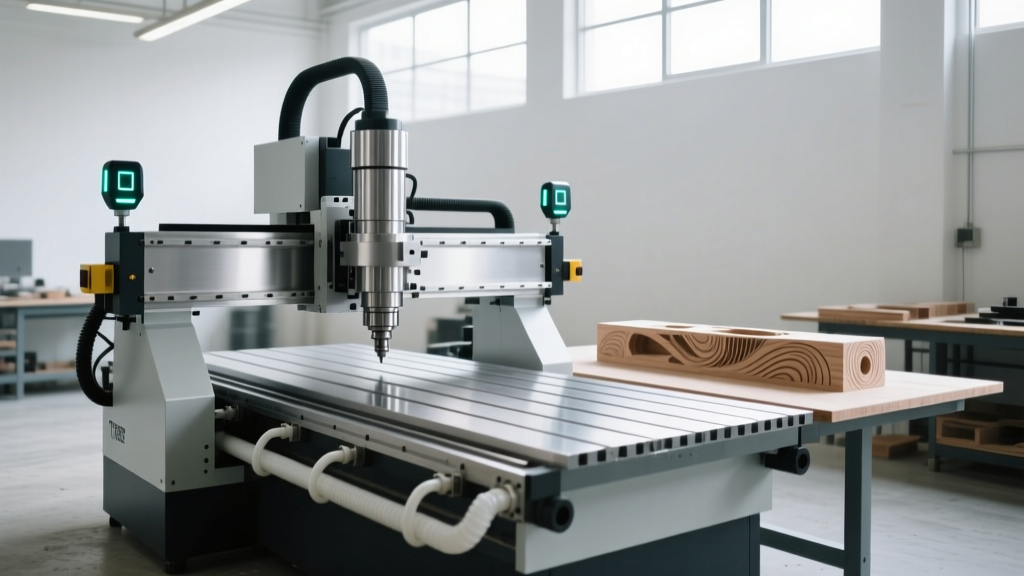
Processing whole tree trunks and massive timber sections requires a fundamentally different machine architecture than standard sheet-goods routing. A tree CNC milling machine—often classified as a log profiler or heavy timber bridge mill—is engineered to handle extreme payload weights, irregular geometries, and the aggressive cutting forces required to remove high volumes of green or kiln-dried wood. Unlike standard 5-axis wood routers that rely on moving gantries, industrial tree CNCs typically utilize a fixed-bridge, moving-table design or a massive dual-drive gantry system supported by helical rack-and-pinion drives to maintain positional accuracy over X-axis travels exceeding 16,000 mm.
Core Engineering Principle: Whole logs possess severe sweep (curvature), taper, and ovality. Tree CNC mills do not assume a perfect cylindrical geometry. Instead, they integrate inline 3D laser scanning to map the exact topography of the bark and cambium layer before a single cutting tool engages the wood.Drive Systems and Rigidity
To handle logs weighing up to 12,000 kg, the machine bed must resist catastrophic torsional deflection. Manufacturers utilize welded steel box-section beds with internal ribbing, stress-relieved and precision-machined. The X-axis (longitudinal log feed) is driven by dual-sided, zero-backlash planetary gearboxes meshing with hardened helical racks. This dual-drive synchronization prevents the skewing that would occur if a single-side drive attempted to push an asymmetrical, multi-ton tree trunk through the cutting envelope.
Operational Workflow: From Raw Trunk to Finished Timber
The operation of a tree CNC milling machine bridges the gap between sawmilling and precision aerospace-style machining. The workflow relies on real-time adaptive toolpath generation.
- Infeed and Log Orientation: The raw tree trunk is loaded onto a heavy-duty chain bed. Hydraulic log turners and V-blocks rotate and center the log. Operators use laser alignment crosshairs to establish the primary grain axis, minimizing cross-grain cutting which reduces structural integrity in mass timber applications.
- 3D Laser Profiling: As the log passes through the scanning portal, multiple laser triangulation sensors (often from Micro-Epsilon or Keyence) capture 10,000+ data points per second. This generates a dense point cloud of the log's exact outer dimensions, including bark thickness, knots, and sweep.
- Adaptive CAM Generation: The machine's proprietary CAM software overlays the desired final profile (e.g., a 400x400mm square beam with specific lap joints) onto the scanned point cloud. The software calculates the optimal rotational orientation to maximize yield and automatically generates the G-code, adjusting Z-axis depths dynamically to account for the irregular bark surface.
- Roughing and Finishing Passes: The log is fed into the milling station. Heavy-duty roughing end mills remove the bulk of the bark and sapwood. The log may be rotated 90 degrees by integrated CNC turners to mill all four faces. Finishing passes with compression spirals ensure a micro-meter level surface finish suitable for exposed architectural timber.
Technical Specification Matrix: Log Mills vs. Standard Routers
Understanding the gap between a standard woodworking CNC and a dedicated tree CNC milling machine is critical for facility planners and mass timber manufacturers. The table below outlines the mechanical and operational deltas.
| Specification | Standard 5-Axis Wood Router | Industrial Tree / Log CNC Mill |
|---|---|---|
| Max Payload Capacity | 500 kg - 1,500 kg | 8,000 kg - 15,000 kg |
| X-Axis Travel | 2,500 mm - 6,000 mm | 12,000 mm - 24,000 mm |
| Spindle Power | 9 kW - 15 kW | 25 kW - 45 kW (often dual-spindle) |
| Tool Holding System | HSK-F63 or ER32 Collets | HSK-A100 or HSK-F80 (high rigidity) |
| Scanning Integration | Rare (assumes flat, uniform stock) | Native 3D Laser Point Cloud Mapping |
| Chip Evacuation | Standard vacuum table / blower | High-volume articulated conveyor belts |
| Estimated Capital Cost | $120,000 - $350,000 | $850,000 - $2,500,000+ |
Tooling and Cutting Strategies for Irregular Grain
Milling a whole tree trunk introduces severe variability in grain direction, moisture content, and material hardness. Standard tooling strategies fail rapidly in this environment.
Tooling Selection: PCD vs. Tungsten Carbide
The outer layer of a tree trunk (the bark and immediate sub-bark region) is heavily contaminated with silica, dirt, and embedded stones. According to machining data published by the US Forest Products Laboratory, silica inclusions in wood act as an extreme abrasive that dulls standard carbide cutters in a matter of minutes. To combat this, tree CNC mills utilize Polycrystalline Diamond (PCD) tipped roughing tools for the initial bark-removal passes. PCD maintains a sharp cutting edge 50 to 100 times longer than tungsten carbide when processing contaminated outer-wood. Once the bark and dirty sapwood are removed, the machine automatically switches to solid tungsten carbide compression spirals for the finishing passes on the clean heartwood, ensuring a tear-out-free surface.
Warning: Resin Pitch BuildupWhen milling softwoods like Pine, Spruce, or Fir, the friction of high-speed milling vaporizes natural resins, which then condense and weld to the cutting tool's flutes. This 'pitch buildup' alters the tool geometry, causes severe burning, and can lead to catastrophic tool shattering. Operators must specify tools with specialized anti-friction coatings (such as TiCN or specialized PTFE-based coatings) and utilize high-pressure mist coolant systems rather than flood coolant, which can negatively impact the moisture content of mass timber components.
Chip Load and Feed Rate Optimization
Because tree trunks contain high moisture gradients (the sapwood can be at 80% moisture content while the heartwood is at 30%), chip load must be dynamically managed. A chip load that is too light will cause the cutter to rub, generating excess heat and boiling the moisture inside the wood fibers, leading to localized checking (cracking). Machinists target heavy chip loads—typically between 0.4mm and 0.8mm per tooth for roughing—using high-torque, low-RPM spindle settings (e.g., 8,000 RPM with a feed rate of 12,000 mm/min) to ensure the tool physically shears the wood fibers and carries heat away in the chips.
Edge Cases: Troubleshooting Timber Milling Defects
Even with advanced 3D scanning, processing biological materials yields unique edge cases that require immediate operational adjustments.
- Post-Cut Warping (Case Hardening): When a tree CNC mill removes massive amounts of material from one side of a log, it releases internal growth stresses. If the log is not supported correctly on the outfeed table, it will bow immediately. Solution: Implement symmetric milling strategies where the CAM software removes equal volumes from opposing faces in alternating passes to balance stress relief.
- Encased Knots and Branch Stubs: Scanners cannot see inside the log. When a cutter hits a dense, encased knot or a hidden branch stub, the sudden spike in cutting force can deflect the spindle. Solution: Utilize spindles equipped with active load-monitoring sensors that detect torque spikes and automatically reduce the feed rate by 40% to prevent tool breakage.
- Bark Delamination: In certain species like Oak or Ash, the bark may delaminate during the milling process, wrapping around the spindle and triggering emergency stops. Solution: Install aggressive, counter-rotating wire brush wheels ahead of the milling spindle to mechanically strip loose bark before the primary cutters engage.
Industry Applications and Structural Integrity
The primary market for tree CNC milling machines is the mass timber and prefabricated log home industry. As noted by APA - The Engineered Wood Association, the precision of CNC-milled timber joints is what allows modern mass timber structures to achieve the tight tolerances required for seismic and wind-load resistance. By utilizing a tree CNC mill to cut complex mortise-and-tenon joints, dovetails, and hidden steel-connector pockets directly into whole logs or glulam beams, manufacturers eliminate the need for on-site manual fitting. The machine's ability to hold tolerances of ±0.2mm over a 12-meter beam length ensures that structural components slot together seamlessly on the construction site, drastically reducing erection time and labor costs.
"The transition from manual timber framing to 5-axis CNC log profiling has shifted the bottleneck in mass timber construction from the fabrication floor to the design phase. The machine will execute exactly what the point-cloud data dictates, making the fidelity of the 3D scan the single most critical variable in yield optimization."
Maintenance and Calibration Protocols
Due to the sheer mass of the moving components and the shock loads generated by interrupted cuts (such as milling lap joints), tree CNC mills require rigorous maintenance. Linear guideways must be purged of micro-fine wood dust weekly using automated central lubrication systems. Furthermore, the geometric calibration of the X-axis rack-and-pinion drives must be verified monthly using laser interferometry to ensure that the dual motors remain perfectly synchronized, preventing the torsional twisting that degrades joint-fit accuracy over long beam lengths.