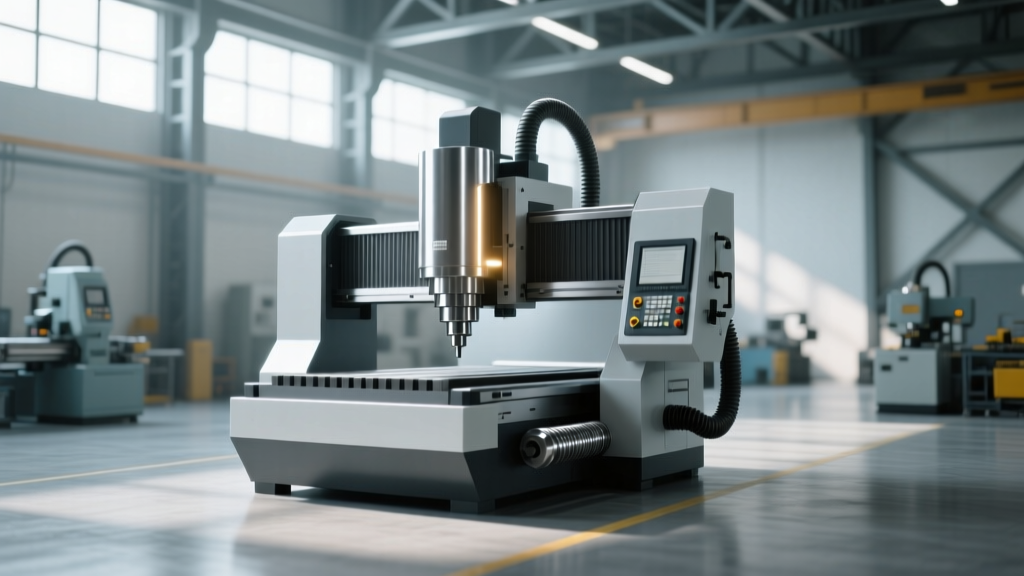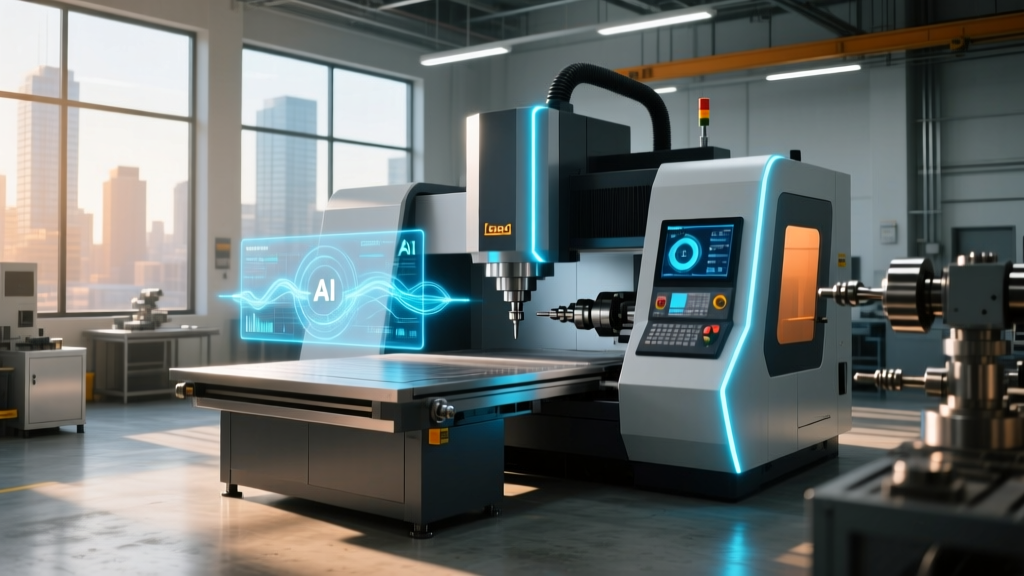
Next-Gen CNC Machine Milling: 2026 AI and Automation Trends
Explore 2026 CNC machine milling trends, including edge AI, digital twins, and adaptive toolpaths that reduce setup times and prevent spindle crashes.
The Shift from Subtractive to Cognitive Machining
Modern CNC machine milling has evolved far beyond rigid kinematics and predetermined G-code trajectories. In 2026, the competitive differentiator on the shop floor is cognitive machining—the integration of closed-loop sensor fusion and edge computing that allows the mill to 'feel' the cut and react in milliseconds. Legacy systems relied on the operator's ear to detect chatter or the post-processor to estimate tool deflection. Today's advanced platforms, such as the Heidenhain TNC 7, utilize piezoelectric spindle load sensors sampling at 10 kHz to dynamically adjust feedrates and spindle speeds mid-cut.
This capability is particularly critical when milling difficult-to-machine alloys like Inconel 718 or Ti-6Al-4V. In these materials, work hardening occurs rapidly if the chip load drops below a specific threshold. By monitoring the torque on the Z-axis ball screw and correlating it with the spindle current draw, the CNC controller can execute a real-time feedrate override to maintain the exact chip thickness required to carry heat away from the cutting edge, extending carbide end mill life by up to 40%.
Controller Architecture Comparison: Legacy vs. Smart Systems
The transition to smart CNC machine milling requires a fundamental shift in controller architecture. Below is a technical comparison of standard legacy controllers versus the current generation of AI-integrated systems dominating 2026 aerospace and medical job shops.
| Feature | Legacy Standard (e.g., Fanuc 0i-F) | Smart Controller (e.g., Siemens Sinumerik ONE) | Advanced Cognitive (e.g., Heidenhain TNC 7) |
|---|---|---|---|
| Digital Twin Native | No (Requires 3rd party CAM) | Yes (Run-on-MyVirtualMachine) | Yes (Integrated Kinematic Simulation) |
| Edge AI Processing | None | Integrated IPC for Edge Analytics | Dedicated Neural Processing Unit (NPU) |
| Sensor Fusion Rate | 100 Hz (Macro variable polling) | 1 kHz (Drive-level torque data) | 10 kHz (Direct piezoelectric integration) |
| Chatter Suppression | Manual RPM adjustment | Automated stability lobe mapping | Sub-millisecond adaptive spindle tuning |
| Average Setup Reduction | Baseline | 35% via virtual prove-out | 55% via AI-assisted workpiece probing |
Digital Twins in CNC Machine Milling Workflows
The concept of the digital twin has moved from a buzzword to a strict requirement for Tier 1 and Tier 2 aerospace suppliers. The Siemens SINUMERIK ONE architecture allows engineers to run the exact PLC and CNC firmware in a virtual environment ('Run-on-MyVirtualMachine') before the physical machine is even powered on.
For complex 5-axis simultaneous milling operations, this means simulating not just the toolpath, but the actual machine kinematics, including acceleration-induced geometric errors and servo lag. If a 12mm diameter ball nose end mill is scheduled to machine a deep, contoured titanium blade root at 15,000 RPM, the digital twin calculates the exact servo following error that will occur during the sharp directional reversals. The CAM system then automatically compensates the toolpath by offsetting the cutter location data (CLDATA) by 14 microns, ensuring the physical part matches the CAD model within a ±5 micron tolerance on the first physical cut.
⚠️ The Hidden Latency Trap in Cloud-Based Toolpath GenerationDo not route real-time chatter suppression or adaptive feedrate data to cloud servers. Cloud round-trip latency typically ranges from 40ms to 150ms. In high-speed CNC machine milling, a chatter vibration cycle at 12,000 RPM occurs every 5 milliseconds. By the time a cloud-based AI analyzes the vibration and sends a corrective speed command back to the VFD, the tool has already experienced 8 to 30 destructive harmonic cycles, resulting in micro-chipping of the carbide coating. Edge computing nodes located physically inside the machine cabinet (<2ms latency) are mandatory for active vibration damping.
Adaptive Toolpath Generation via Edge AI
Edge AI nodes are now being retrofitted onto existing vertical machining centers (VMCs) to bridge the gap between legacy iron and modern smart factories. Devices like the Caron Engineering DTect-IT or proprietary edge gateways tap directly into the machine's spindle drive via analog voltage outputs or high-speed Ethernet (e.g., MTConnect over OPC-UA).
Hardware Requirements for Edge Computing on the Shop Floor
Deploying edge AI for CNC machine milling requires specific hardware tolerances to survive the harsh shop environment. Standard IT servers will fail due to conductive dust and coolant mist. A robust edge node deployment requires:
- Processing: Industrial-grade IPC with an Intel Core i7 or equivalent, featuring a dedicated TPM 2.0 chip for secure MTConnect data transmission.
- Storage: Minimum 1TB NVMe SSD rated for high write endurance (3 DWPD) to handle continuous 10 kHz spindle load logging without throttling.
- Ingress Protection: NEMA 4X or IP66 rated enclosure with positive-pressure purge systems to prevent atomized synthetic coolants (like Trim MicroSol 585XT) from degrading the motherboard traces.
- Cost Baseline: Expect to invest between $4,500 and $7,200 per machine for a fully hardened edge compute node and sensor array in 2026.
Expert Perspectives on Autonomous Tool Changing
The integration of AI into the tool magazine is fundamentally changing how shops manage tool life. Instead of relying on conservative, time-based tool life limits programmed into the CAM software, modern systems use spindle load baselines to predict tool failure.
'We stopped using arbitrary tool life counters in our macro B variables three years ago. Now, our horizontal CNC machine milling cells establish a baseline spindle load signature for the first three parts of a new Inconel run. The edge AI monitors the deviation in the Z-axis load profile. When the cutting force increases by exactly 12%—indicating flank wear has reached 0.2mm—the controller automatically flags the sister tool in the matrix magazine and updates the geometry offset to compensate for the new tool's exact length and diameter variance. We've reduced scrap from tool breakage to virtually zero.'
— Director of Advanced Manufacturing, Tier 1 Aerospace Propulsion Supplier
ROI Framework: Upgrading to Smart Milling Systems
Justifying the capital expenditure for smart CNC machine milling upgrades requires a clear understanding of the hidden costs of legacy operations. Below is a practical ROI framework for retrofitting a standard 3-axis VMC (e.g., Haas VF-2SS) with an advanced tool monitoring and digital twin integration package.
Cost Breakdown (Per Machine)
- Hardware (Spindle Load Sensors & Edge Node): $6,500
- Software Licensing (AI Analytics & Digital Twin Sync): $2,400 / year
- Integration & Calibration Labor: $3,200 (16 hours at $200/hr)
- Total First-Year Investment: $12,100
Financial Returns & Risk Mitigation
- Spindle Crash Prevention: A single catastrophic crash on a 12,000 RPM direct-drive spindle costs between $28,000 and $45,000 in replacement parts, plus 4-6 weeks of downtime. Preventing just one crash yields a 200%+ immediate ROI.
- Tooling Optimization: By pushing carbide tooling to its actual wear limit rather than a conservative time limit, shops typically reduce annual end mill and insert spend by 18-22%. On a $100,000 annual tooling budget, this saves $20,000 annually.
- Cycle Time Reduction: AI-optimized rapid traverses and dynamic feedrate adjustments in non-critical air-cutting zones typically shave 8-12% off total cycle times, effectively adding 2.5 hours of productive spindle time per 24-hour shift.
The transition to cognitive, AI-driven CNC machine milling is no longer an experimental luxury; it is the baseline requirement for maintaining margins in a landscape defined by tight tolerances, expensive materials, and zero-defect mandates. Shops that treat their machine tools as isolated, blind subtractive devices will inevitably lose ground to those leveraging real-time data to turn every cut into a measurable, optimizable event.