Precision CNC Milling Machine Comparison: Haas vs DMG Mori 2026
Compare the Haas UMC-500 and DMG MORI DMU 50 precision CNC milling machines. Analyze pricing, thermal stability, and sub-micron alternatives for 2026.
The Procurement Dilemma: Value vs. Absolute Metrology
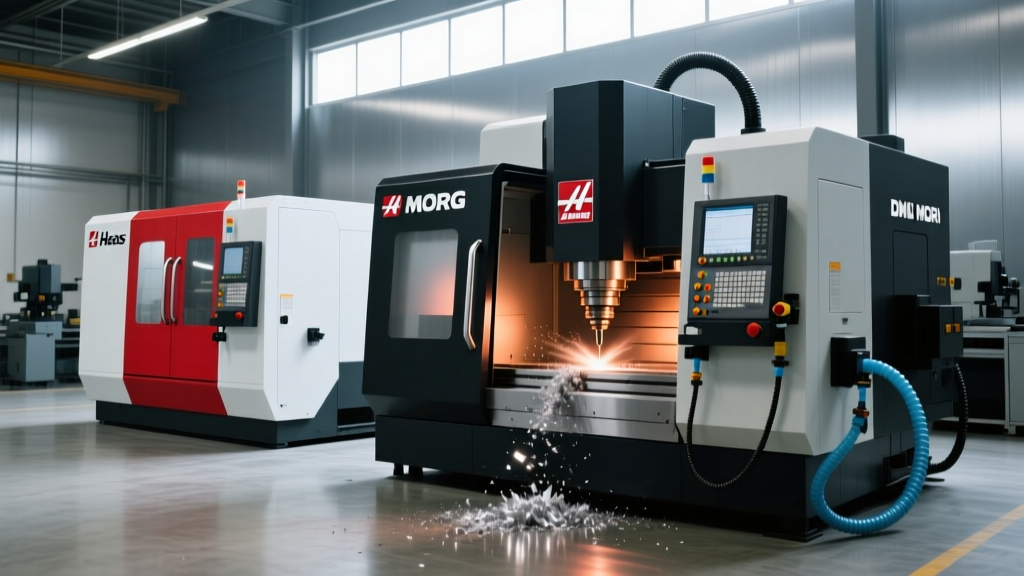
Selecting a precision CNC milling machine for sub-10-micron tolerance work requires looking past marketing brochures and analyzing thermal displacement, servo lag, and long-term geometric stability. In 2026, the mid-market 5-axis segment is dominated by two distinct engineering philosophies: the value-driven, software-compensated approach of the Haas UMC-500, and the hardware-mitigated, premium European architecture of the DMG MORI DMU 50 3rd Generation. This analysis dissects the mechanical realities, total cost of ownership (TCO), and specific use cases to determine which platform actually holds tolerance on the shop floor.
Quick Decision Matrix
- Procure the Haas UMC-500 if: Your budget is capped at $250,000, your primary materials are aluminum (6061/7075) and engineering plastics, and your CMM verification allows for a ±5µm tolerance band.
- Procure the DMG MORI DMU 50 if: You are machining aerospace superalloys (Inconel 718, Ti-6Al-4V) or medical implants, require sub-3µm positional accuracy over 8-hour cycles, and have a capital budget exceeding $320,000.
Head-to-Head Specifications & 2026 Pricing
The base price of a machine rarely reflects the final invoice. Below is a realistic breakdown of the configured costs required to achieve actual precision machining, including necessary encoders, chillers, and probing systems.
| Specification | Haas UMC-500 | DMG MORI DMU 50 3rd Gen |
|---|---|---|
| XYZ Travel | 20 x 16 x 16 in. (508 x 406 x 406 mm) | 25.6 x 20.5 x 18.5 in. (650 x 520 x 475 mm) |
| Spindle Interface / RPM | CAT 40 / 12,000 RPM | HSK-A63 / 15,000 RPM (Option: 20k) |
| Positioning Accuracy (VDI/DGQ) | ±0.0002 in. (5µm) | ±0.00012 in. (3µm) with Glass Scales |
| Control System | Haas NGC | Siemens Sinumerik One / Heidenhain TNC7 |
| Estimated Loaded Price (2026) | $215,000 - $245,000 | $340,000 - $395,000 |
The Thermal Stability Reality: Software vs. Hardware
The primary enemy of precision CNC milling is thermal growth. As spindles rotate and axes accelerate, friction generates heat, causing the casting and ball screws to expand. How each manufacturer handles this expansion dictates the machine's ability to hold tight tolerances during long, unattended shifts.
Haas: Algorithmic Thermal Compensation
Haas relies heavily on software-based thermal compensation. The NGC control monitors ambient temperature sensors and spindle load data, applying algorithmic offsets to the Z-axis and rotary tables. While highly effective for standard job-shop environments and 3-axis work, this predictive model can struggle during aggressive 5-axis simultaneous contouring in hardened steels, where localized heat generation outpaces the sensor polling rate. To maintain 5µm tolerances on a Haas, operators must run warm-up cycles for exactly 45 minutes and avoid stopping the spindle for more than 10 minutes during a shift.
DMG MORI: Physical Heat Extraction
DMG MORI approaches thermal stability through physical hardware mitigation. The DMU 50 features coolant-chilled ball screws and a temperature-controlled spindle housing. By actively pumping chilled fluid through the center of the X, Y, and Z axis screws, the machine physically extracts heat before it can cause mechanical expansion. According to DMG MORI's engineering documentation, this closed-loop cooling system reduces thermal displacement by up to 80% compared to conventional air-cooled screws, making it vastly superior for aerospace structural components where a 3µm deviation can scrap a $15,000 titanium forging.
Hidden HVAC Requirement: Neither machine will achieve its published accuracy specs if your shop floor fluctuates by more than ±3°C. For sub-5µm work, investing in a dedicated, climate-controlled metrology and machining cell (maintained at 20°C ±1°C) is mandatory. The machine's internal compensation cannot overcome a draft from a loading dock door.Real-World Cutting Scenarios: Where the Machines Diverge
Specifications on paper do not always translate to chip-making reality. Here is how these platforms perform in specific 2026 manufacturing scenarios.
Scenario A: Medical PEEK and Titanium Implant Milling
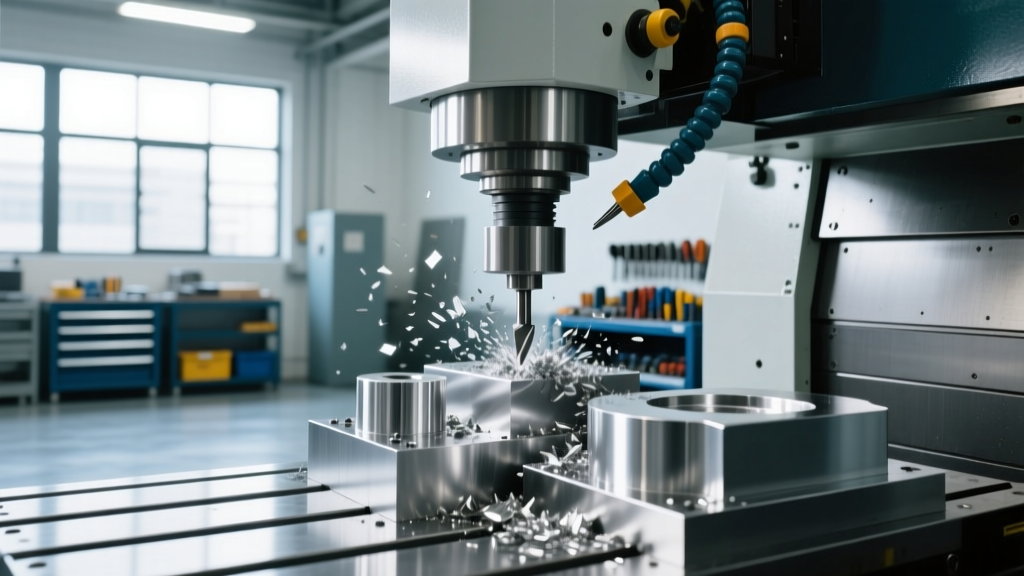
Machining spinal implants requires alternating between high-speed finishing of PEEK polymers and heavy roughing of Ti-6Al-4V. The DMG MORI's HSK-A63 interface provides superior radial clamping force and repeatability (under 1µm runout) compared to the Haas CAT 40 taper. When performing a 0.2mm depth-of-cut finishing pass on a titanium bone screw thread, the DMG's direct-drive torque table maintains absolute C-axis lock, eliminating the micro-chatter marks often seen on lesser rotary tables.
Scenario B: High-Volume Aluminum Aerospace Brackets
If your primary workload involves 6061-T6 aluminum aerospace brackets with true-position hole tolerances of ±0.0005 in., the Haas UMC-500 is the undisputed ROI champion. The 12,000 RPM spindle, combined with Haas's high-flow coolant through-spindle (1000 PSI option), evacuates chips efficiently. The NGC control's dynamic work offsets (G54.1) allow for rapid tombstone setups, and the lower initial capital cost means the machine pays for itself within 14 months of two-shift operation.
'When verifying 5-axis simultaneous milled surfaces on a CMM, the difference in surface finish and geometric truth between a machine with physical thermal extraction and one relying purely on software offsets becomes glaringly obvious after hour four of a continuous cycle.'
— Lead Metrologist, Tier 1 Aerospace Supplier
Premium Alternatives for Sub-Micron Requirements
If the DMG MORI DMU 50 does not meet your extreme precision requirements, the next tier of precision CNC milling machines utilizes fundamentally different kinematic architectures.
- Makino D200Z: Engineered specifically for complex aerospace impellers and blisks. Makino utilizes a unique tilting table design that keeps the center of gravity low, minimizing vibration during heavy interrupted cuts. Base pricing starts around $450,000.
- Kern Micro HD: The absolute pinnacle of milling accuracy. Kern replaces traditional linear guideways with hydrostatic guideways, eliminating stick-slip friction entirely. This allows for nano-level surface finishes (Ra < 0.1µm) directly from the cutter, eliminating the need for EDM or polishing in optical mold manufacturing. Expect pricing to exceed $850,000.
For deeper insights into advanced metrology and verification standards for these ultra-precision platforms, refer to the NIST Advanced Manufacturing Portal, which publishes critical guidelines on dimensional tolerancing and machine tool calibration.
The 2026 Total Cost of Ownership (TCO) Framework
Procurement teams often fail to account for the peripheral costs of maintaining precision. Use this framework to calculate your true 5-year TCO:
- Foundation & Installation ($10k - $25k): Precision machines require isolated foundations. A 12-inch thick, steel-reinforced concrete pad with vibration-dampening epoxy grout is required to prevent floor-transmitted vibrations from ruining surface finishes.
- Chiller Maintenance ($4,500/year): The spindle and ball-screw chillers require bi-annual coolant flushes and filter replacements. Neglecting this leads to catastrophic spindle bearing failure, costing upwards of $28,000 to rebuild.
- Glass Scale Degradation: Machines equipped with Heidenhain linear glass scales (like the DMG) offer unmatched accuracy but are vulnerable to way-lube contamination. Budget $2,000 annually for specialized scale cleaning kits and positive-pressure air purge system maintenance.
- Calibration & Ballbar Testing ($6,000/year): To maintain ISO 10791 compliance for aerospace contracts, you must hire third-party metrologists to perform annual Renishaw ballbar and laser interferometry calibrations.
Final Procurement Recommendation
The choice between these precision CNC milling machines hinges entirely on your contract portfolio. If your shop operates as a high-mix, fast-turnaround facility producing parts where a 5µm variance is acceptable, the Haas UMC-500 offers unbeatable agility and ROI. However, if you are bidding on next-generation turbine components, medical implants, or optical molds where thermal displacement directly correlates to scrap rates, the hardware-level thermal management and Siemens/Heidenhain control ecosystem of the DMG MORI DMU 50 3rd Generation is a non-negotiable capital investment.