2026 CNC Mill Turn Machine Trends: AI & Hybrid Machining
Explore 2026 CNC mill turn machine innovations, including AI chatter suppression, hybrid additive integration, and edge computing for autonomous machining.
The Evolution of Done-in-One Manufacturing
The fundamental value proposition of a CNC mill turn machine has shifted dramatically over the last five years. Historically, shops invested in these platforms strictly for 'done-in-one' part completion—combining lathe turning and multi-axis milling to eliminate secondary setups. In 2026, however, the baseline expectation has moved beyond mechanical consolidation. Modern mill-turn centers are now autonomous, self-correcting manufacturing cells driven by edge computing, AI sensor fusion, and hybrid additive capabilities.
For manufacturing engineers and shop owners evaluating capital equipment this year, understanding these technological leaps is critical. The gap between a standard 2020-era mill-turn and a 2026 smart cell is not just in cycle time; it is in the machine's ability to autonomously manage thermal drift, suppress chatter in real-time, and deposit material before cutting it.
2026 Market Reality: The global market for advanced mill-turn centers is increasingly dominated by shops machining high-value, low-volume components for aerospace, medical, and energy sectors. If your primary output is high-volume, simple rotational parts, the ROI on a $1.2M+ smart mill-turn cell will likely underperform compared to dedicated Swiss-type lathes or automated VMCs.AI-Driven Sensor Fusion and Chatter Suppression
Chatter remains the primary enemy of surface finish and tool life in heavy milling operations, particularly when utilizing the B-axis milling head on large, eccentric workpieces. The latest generation of CNC mill turn machine controllers—such as the Mazatrol SmoothAi and Fanuc 31i-B5—have moved past simple threshold-based load monitoring.
Sub-10ms Latency and 10kHz Sampling
Modern spindle load and vibration sensors now sample data at 10kHz or higher. More importantly, the AI models running on the machine's local edge-computing node are trained on specific toolpath signatures. When the system detects the harmonic frequency of regenerative chatter, it does not merely trigger an alarm; it dynamically adjusts the spindle speed and feed rate in under 10 milliseconds to shift the cutting frequency out of the chatter zone.
- Okuma's Thermo-Friendly Concept: Now integrates AI to predict thermal displacement based on ambient shop temperature, coolant temperature, and specific spindle load histories, achieving accuracies of ±2µm over 24-hour unmanned shifts.
- DMG MORI's CELOS X: Utilizes acoustic emission (AE) sensors paired with neural networks to detect tool micro-chipping on carbide inserts before it causes catastrophic workpiece scrap.
Hybrid Additive-Subtractive Integration
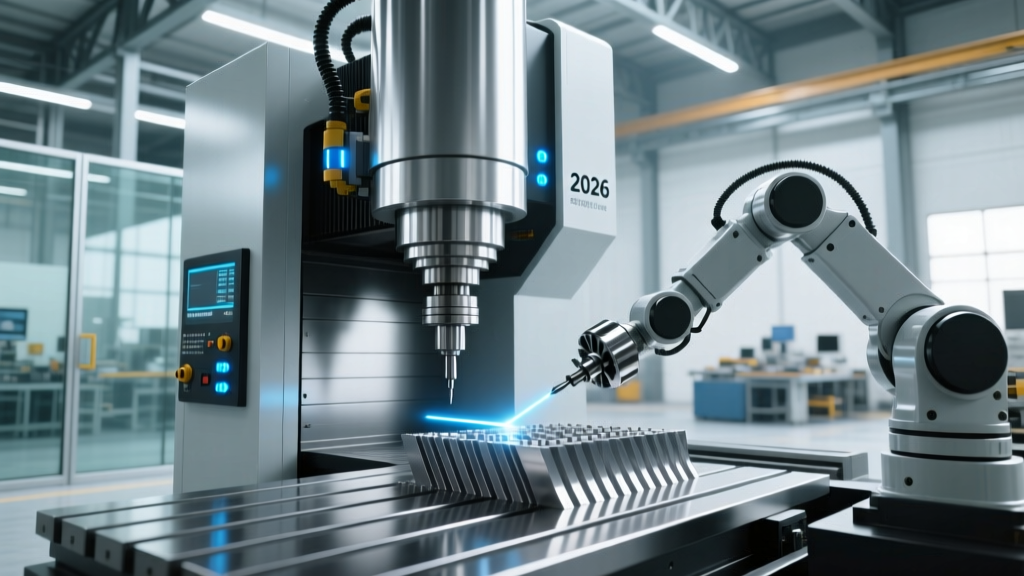
The integration of Directed Energy Deposition (DED) into mill-turn platforms has matured from an experimental novelty into a production-ready reality. A hybrid CNC mill turn machine utilizes a laser-cladding head mounted in the tool magazine or on the B-axis to deposit metal powder, which is subsequently machined to net shape by the milling spindle.
This is particularly transformative for the oil and gas sector, where components require wear-resistant Inconel or Stellite cladding on specific sealing surfaces. Instead of forging a solid Inconel part and machining away 80% of the material, shops can machine a steel substrate, laser-deposit the Inconel only where needed (at powder feed rates of 2-10 g/min), and finish-mill the surface in a single chucking.
| Feature | Standard Mill-Turn | Hybrid Mill-Turn (DED) |
|---|---|---|
| Average Capital Cost (2026) | $650,000 - $950,000 | $1.1M - $1.6M |
| Material Buy-to-Fly Ratio | 10:1 to 20:1 (Solid Billet) | 1.2:1 to 2:1 (Near Net Shape) |
| Setup Complexity | Moderate (Standard Fixturing) | High (Requires Gas Purging & Laser Calibration) |
| Ideal Application | Complex geometries from standard alloys | Bimetallic parts, localized hardfacing, repair |
Edge Computing and the Digital Twin Standard
Cloud-based monitoring is being rapidly superseded by edge computing for critical machine control functions. The latency inherent in sending spindle telemetry to a remote server and waiting for a corrective command is unacceptable for high-speed milling operations. In 2026, controllers like the Siemens Sinumerik ONE process digital twin simulations locally on the machine's edge node.
According to the ISO 23247 Digital Twin framework for manufacturing, local processing allows the machine to run a virtual collision check and thermal deformation simulation of the exact G-code program in the background while the current part is being cut. This ensures that the next part in the automated pallet pool is verified for clearance and thermal stability before the spindle even stops.
For data interoperability across the shop floor, adherence to the MTConnect standard is no longer optional. Advanced CNC mill turn machines now ship with native MTConnect adapters that translate proprietary controller variables (like B-axis torque and Y-axis servo load) into standardized XML/JSON streams for integration with ERP and MES systems.
2026 Capital Expenditure and ROI Framework
Purchasing a high-end CNC mill turn machine requires a rigorous financial analysis that looks beyond the base machine price. A fully loaded Mazak Integrex i-400S or Okuma MULTUS U5000, equipped with a 12-station pallet pool, high-pressure coolant (1000 PSI), and edge-computing nodes, will command between $1.1M and $1.4M in 2026.
'The true ROI of a modern mill-turn center isn't found in faster cutting speeds; it is found in the elimination of non-value-added fixturing. By consolidating three distinct setups into one, we routinely save $15,000 to $22,000 in custom fixture tooling per complex aerospace valve family, while simultaneously reducing cumulative stack-up tolerances by 40%.'
— Director of Manufacturing Engineering, Tier 2 Aerospace Supplier.
Calculating the Break-Even Point
To justify the premium of a smart mill-turn cell over separate CNC lathes and 5-axis VMCs, calculate the cost of your current work-in-progress (WIP) movement. If a part requires turning, moving to a CMM for inspection, moving to a VMC for milling, and returning to the lathe for final threading, the labor, crane time, and fixturing costs typically add 18-24 hours of lead time. At a fully burdened shop rate of $150/hour, that is $2,700 to $3,600 in hidden costs per part. Running 500 parts a year yields over $1.3M in saved overhead, paying for the machine in under 12 months.
Buyer Decision Matrix: Selecting the Right Platform
Not every shop requires a hybrid additive system or AI chatter suppression. Use this decision framework to align your 2026 capital expenditure with your actual production needs:
- Aerospace (Blisks & Structural Titanium): Prioritize high-torque B-axis milling and rigid tapping. Look for machines with direct-drive torque motors on the B-axis (eliminating worm-gear backlash) and high-pressure coolant through the spindle at 1000+ PSI to break stringy titanium chips. Top Contenders: DMG MORI NTX series, Mazak Integrex i-800.
- Medical (Orthopedic Implants & Bone Screws): Prioritize extreme precision, thermal stability, and bar-fed automation. A hybrid system is unnecessary; instead, invest in advanced automated tool setters and robotic part washing integrated into the sub-spindle unload cycle. Top Contenders: Okuma MULTUS U3000, WFL M35.
- Oil & Gas (Valves & Downhole Tooling): This is the prime use case for hybrid CNC mill turn machines. The ability to machine a 4140 steel valve body and laser-clad the seating surfaces with Stellite 6 without unchucking the part provides an insurmountable competitive advantage in lead time and material cost. Top Contenders: DMG MORI LASERTEC integration, Mazak Integrex i-400 AM.
As the National Institute of Standards and Technology (NIST) continues to refine smart manufacturing protocols, the integration of these advanced mill-turn platforms into fully autonomous, lights-out manufacturing cells will only deepen. The shops that master the programming and tooling nuances of these systems in 2026 will dictate the margins in complex machining for the next decade.
For further reading on integrating additive processes into subtractive workflows, the Society of Manufacturing Engineers (SME) provides extensive technical papers on DED powder metallurgy and post-machining surface integrity standards.