Safety Compliance for 5-Axis CNC Milling Machines: 2026 Guide
Ensure shop floor safety with our 2026 compliance guide for 5-axis CNC milling machines, covering ISO 13849-1, kinematic hazards, and enclosure specs.
The Hidden Kinematic Hazards of 5-Axis Machining
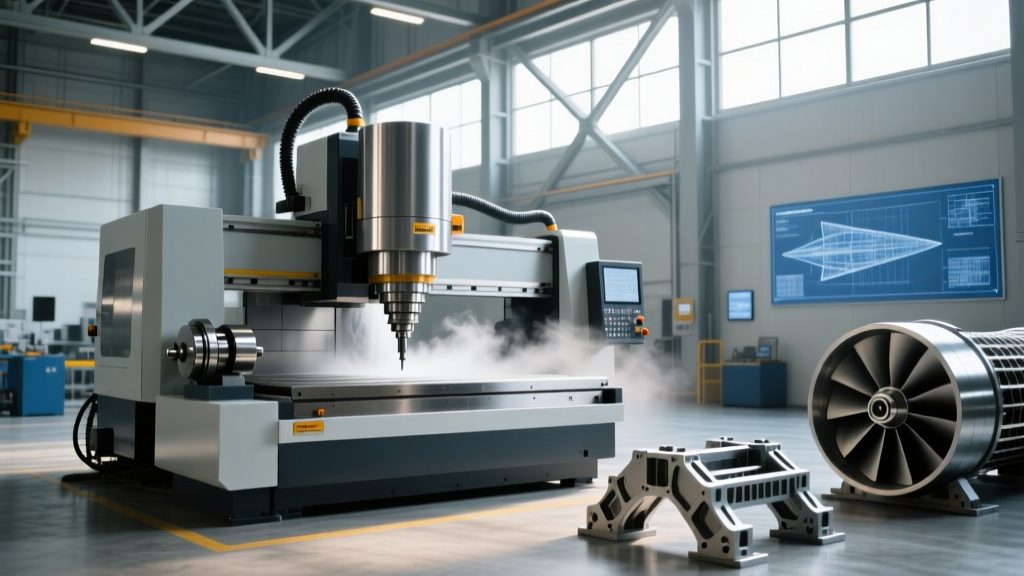
Integrating 5-axis CNC milling machines into a production environment introduces complex kinematic hazards that standard 3-axis safety protocols fail to address. Unlike traditional vertical machining centers (VMCs) where the spindle moves linearly along the Z-axis and the table moves in X and Y, 5-axis platforms utilize simultaneous rotational interpolation. Whether your shop utilizes a trunnion table (A/C axes) or a swivel-head spindle (B/C axes), the resulting dynamic crush zones and high-velocity ejection paths require specialized engineering controls.
As of 2026, regulatory bodies and insurance underwriters are heavily scrutinizing 5-axis installations. Compliance is no longer just about slapping an E-stop on the front panel; it requires a systematic approach to enclosure integrity, control system architecture, and operator safeguarding per ISO 13849-1:2023 Safety of Machinery and OSHA Machine Safeguarding Guidelines.
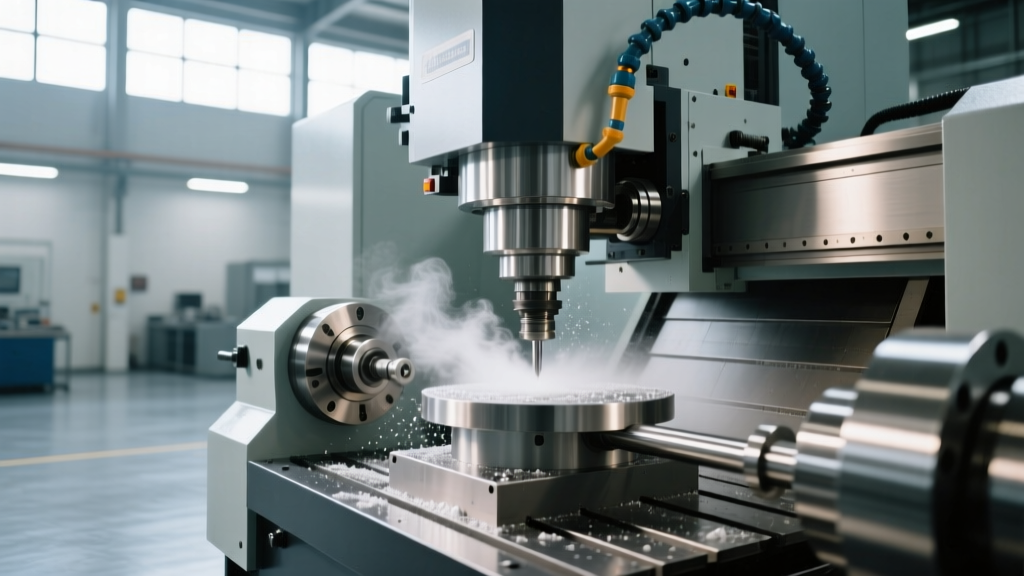
⚠️ Critical Warning: Trunnion Table Pinch PointsOn A/C axis trunnion machines (e.g., Haas UMC-750), the rotational center of the C-axis constantly shifts relative to the machine column during A-axis tilting. Standard light curtains calibrated for 3-axis X/Y travel will fail to detect an operator reaching into a shifting rotary envelope. Physical interlocked guarding is mandatory.
ISO 13849-1 Performance Levels for 5-Axis Functions
Under ISO 13849-1, every safety-related part of a control system (SRP/CS) must be assigned a required Performance Level (PLr) based on the severity, frequency, and avoidability of the hazard. Because 5-axis machines carry higher kinetic energy and unpredictable tool vectors, the baseline PLr requirements are elevated.
| Safety Function | Hazard Scenario | Required PLr (ISO 13849-1) | Category / Architecture |
|---|---|---|---|
| Emergency Stop (E-Stop) | Operator caught in rotary table sweep | PL d | Cat. 3 (Dual-channel with diagnostics) |
| Spindle Safe Torque Off (STO) | Tool shatter at 24,000 RPM | PL d | Cat. 3 (IEC 61800-5-2 compliant drive) |
| Z-Axis Brake Engagement | Gravity-induced head drop on B-axis tilt | PL e | Cat. 4 (Redundant mechanical braking) |
| Enclosure Door Interlock | High-velocity coolant/chip ejection | PL c | Cat. 2 or 3 (RFID coded, non-defeatable) |
Control System Architecture: STO vs. SS1 in Multi-Axis Drives
A common compliance failure in retrofitted or older 5-axis machines is the misuse of Safe Torque Off (STO) during emergency stops. STO immediately removes electrical power from the servo motor. On a 3-axis VMC, engaging STO stops the machine. On a 5-axis machine with a tilted spindle head or an off-center loaded trunnion table, immediate STO results in a gravity-induced axis crash, potentially shattering the spindle or damaging the rotary table bearings.
Implementing Safe Stop 1 (SS1)
Modern 5-axis drives (such as Siemens SINAMICS or Fanck Alpha-Di series) must be configured for Safe Stop 1 (SS1). SS1 initiates a controlled, rapid deceleration ramp along all interpolated axes while maintaining servo torque, and only engages the mechanical holding brakes and triggers STO once the axes reach a complete standstill.
Engineering Note: When commissioning a DMG MORI DMU 50 or Mazak VARIAXIS, verify the drive parameters for SS1 deceleration ramps. If the ramp is set too aggressively, the servo drive will fault with an 'Overvoltage' or 'Following Error' alarm before the mechanical brakes engage, defeating the safety function.
Enclosure Integrity: Polycarbonate Degradation and Glass Upgrades
5-axis CNC milling machines frequently utilize high-speed spindles (15,000 to 30,000 RPM) with HSK-A63 or HSK-E50 tool interfaces. At these speeds, a catastrophic tool failure releases kinetic energy that standard 10mm polycarbonate (Lexan) enclosures cannot reliably contain over the machine's lifespan.
The Coolant Crazing Phenomenon
Polycarbonate is highly susceptible to chemical degradation from synthetic and semi-synthetic metalworking fluids. Exposure to alkaline coolants (pH > 9.0) causes micro-cracking, known as 'crazing,' which reduces the impact resistance of the polycarbonate by up to 70% within 18 to 24 months. During a 2026 safety audit, yellowed or crazed polycarbonate windows are an immediate red-tag violation.
💡 Actionable Upgrade: Laminated Safety GlassFor any 5-axis machine operating above 15,000 RPM, replace polycarbonate viewing panes with 12mm to 15mm laminated PET/PC composite safety glass. The inner PET layer resists chemical coolant attack, while the outer PC layer provides ballistic impact resistance. Expect to budget between $8,500 and $14,000 per machine enclosure for this upgrade, including custom seals and heavy-duty gas strut replacements to handle the increased door weight.
Defeatable Interlocks and RFID Coding
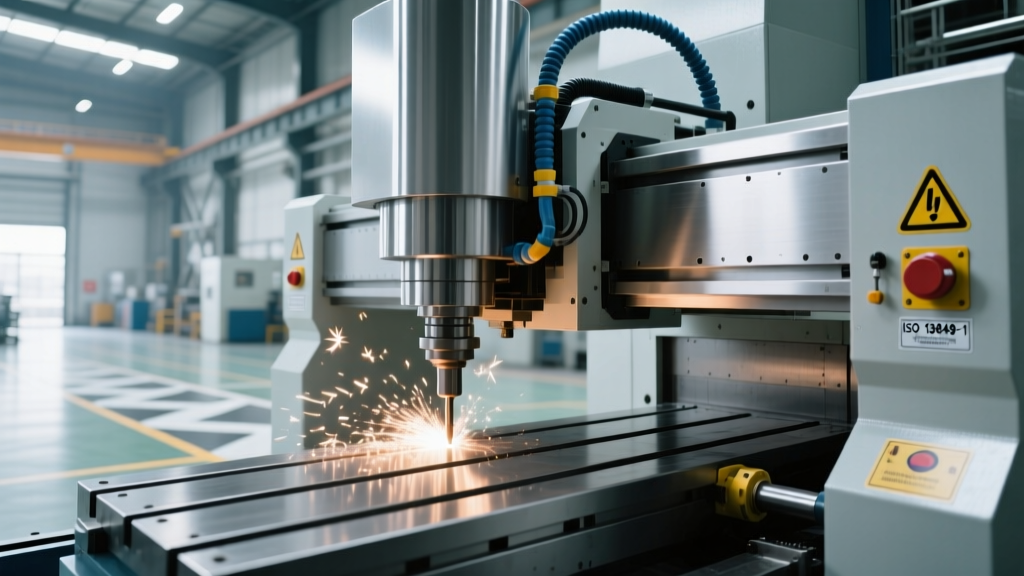
Operators defeating door interlocks with tape or spare magnets remains a leading cause of CNC amputations and fatalities. Mechanical plunger switches and basic reed switches are entirely obsolete for 5-axis compliance. Current standards mandate RFID-coded, non-contact safety switches.
Devices like the Euchner CTM-BT or Schmersal AZM400 utilize coded RFID transponders. They are completely immune to magnetic defeat and feature a 'high coding' level that prevents an operator from using a spare actuator from another machine to bypass the interlock. Furthermore, these units support series connection without signal masking, meaning a fault in one door switch will not be hidden by the rest of the circuit.
Retrofit Economics: Budgeting for 2026 Compliance
Bringing a legacy 5-axis machine (manufactured prior to 2020) up to current safety standards requires capital expenditure. Shop managers must account for the following baseline costs when acquiring used 5-axis equipment:
- RFID Interlock Retrofit: $2,500 - $4,500 per door (includes wiring, safety relay expansion, and PLC ladder logic updates).
- Axis Brake Verification & Upgrade: $3,000 - $6,000 per axis (testing mechanical brake holding torque and replacing worn friction discs on the A/C rotary drives).
- Enclosure Laminated Glass Swap: $8,500 - $14,000 per primary viewing door.
- Safety PLC Migration: $12,000 - $18,000 if the existing controller lacks dedicated safety I/O channels required for dual-channel Cat. 3 architectures.
Pre-Commissioning Safety Audit Checklist
Before signing off on a new or relocated 5-axis CNC milling machine, the safety engineering team must execute the following physical verifications:
- Kinematic Sweep Test: Run a dry-cycle of the most extreme 5-axis toolpath at 10% rapid override. Verify that no part of the spindle, tool holder, or coolant manifold comes within 150mm of the enclosure door seals or internal cable carriers.
- Gravity Drop Verification: With the spindle head tilted at maximum B-axis angle (e.g., 90 degrees) and the Z-axis fully extended, trigger the E-stop. Measure Z-axis deflection. Any drop greater than 0.05mm indicates failing mechanical brake pads.
- Interlock Defeat Attempt: Attempt to bypass the primary door interlock using a standard neodymium magnet and a piece of raw stock. If the machine maintains servo torque, the RFID coding level is insufficient.
- Coolant Compatibility Check: Cross-reference the machine builder's specified enclosure materials with the exact pH and chemical composition of the shop's active coolant concentrate.
Adhering to these rigorous standards ensures that the immense productivity gains of 5-axis simultaneous milling are not overshadowed by catastrophic safety liabilities.