2026 CNC Milling Machine Innovations: AI & IoT Trends
Explore 2026 CNC milling machine innovations, including AI toolpath optimization, digital twins, and IoT adaptive control for modern manufacturing.
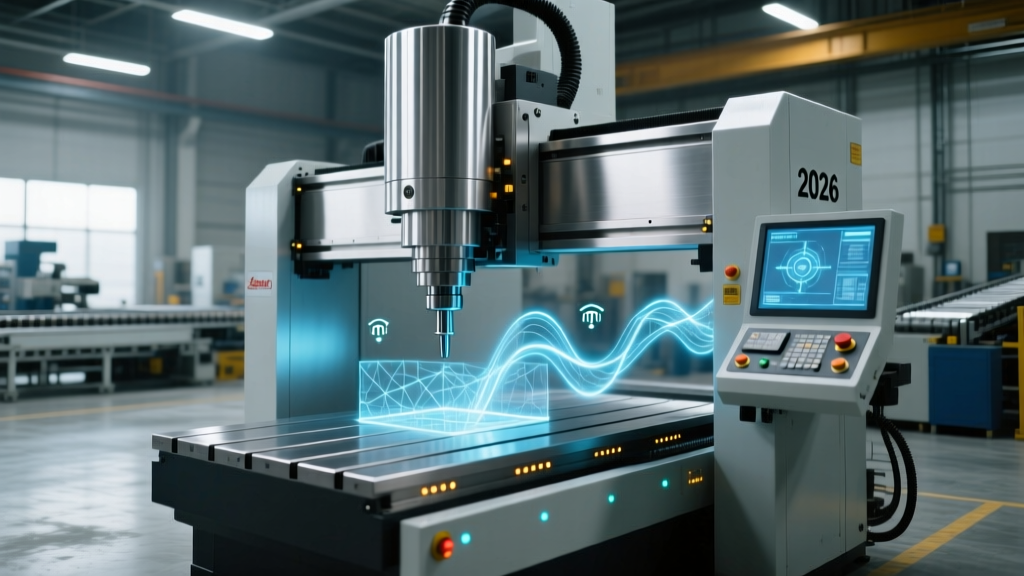
The 2026 manufacturing landscape has transitioned the CNC milling machine from a purely mechanical cutting tool into a cognitive, data-generating node. With the integration of edge computing, artificial intelligence, and high-fidelity digital twins, modern machining centers now self-optimize toolpaths, predict spindle failures before they occur, and compensate for thermal drift in real time. For manufacturing engineers and shop floor managers, understanding these hardware and software innovations is no longer optional—it is the baseline for maintaining competitive cycle times and holding tight tolerances on complex aerospace and medical components.
2026 Market Data Highlight: According to recent industry analyses, CNC milling machines equipped with native AI adaptive control reduce average tool wear by 22% and decrease cycle times on 3D contoured parts by up to 15% compared to standard CAM-generated G-code without real-time override.AI-Driven Adaptive Control and Toolpath Optimization
Traditional CAM software generates static toolpaths based on theoretical stock models. In 2026, the paradigm has shifted to dynamic, closed-loop adaptive control. Systems like the Siemens Sinumerik ONE utilize onboard AI algorithms to analyze spindle load, axis torque, and vibration data at sampling rates exceeding 1000 Hz.
When the machine detects an unexpected increase in material hardness or a variation in casting stock allowance, the AI instantly overrides the programmed feed rate to maintain a constant chip thickness. This prevents tool deflection and catastrophic insert chipping, particularly when roughing difficult-to-machine alloys like Inconel 718 or Titanium Ti-6Al-4V.
Real-World Application: Aerospace Structural Rib Roughing
- Legacy Approach: Programmed at a conservative 400 mm/min to account for air cuts and hard spots, resulting in a 4-hour roughing cycle.
- 2026 AI Approach: The controller accelerates through air cuts to 2000 mm/min and dynamically scales back to 350 mm/min only when engaging hard material, reducing the cycle to 2.8 hours while extending end mill life by 30%.
The Digital Twin Ecosystem in 5-Axis Machining
The concept of the digital twin has matured from a 3D visual representation into a mathematically exact, physics-based replica of the CNC milling machine. Governed by frameworks such as the ISO 23247 Digital Twin standard, modern 5-axis machining centers now operate with virtual models that account for kinematic chain deviations, axis backlash, and servo lag.
Before a single drop of coolant is applied, engineers simulate the entire machining process in a virtual environment that mirrors the exact controller logic (NCK) of the physical machine. This eliminates the risk of $50,000 spindle crashes caused by post-processor errors or singularity points in simultaneous 5-axis contouring. Machines like the DMG MORI NVX 5100 and Mazak VARIAXIS i-800 NEO now ship with factory-calibrated digital twins that map geometric errors down to 2 microns across the entire working envelope.
2026 Procurement Matrix: Standard vs. AI-Integrated CNC Mills
When specifying a new CNC milling machine, the capital expenditure must be weighed against the operational savings generated by smart technologies. The following matrix compares a standard 3-axis vertical machining center (VMC) against a 2026-spec smart 5-axis mill.
| Feature / Specification | Standard 3-Axis VMC | 2026 Smart 5-Axis Mill | ROI & Operational Impact |
|---|---|---|---|
| Base Price Range | $85,000 - $120,000 | $280,000 - $450,000+ | Higher CapEx offset by 50% reduction in secondary operations. |
| Controller Architecture | Standard G-Code execution, basic look-ahead | Edge-computing enabled, AI NURBS interpolation | Superior surface finishes (Ra < 0.4 µm) without manual polishing. |
| Probing & Metrology | Basic touch probe for WCS setup | Renishaw OMP600 with strain-gauge logic | Sub-micron part alignment; eliminates manual indicator setup. |
| Thermal Compensation | None (requires warm-up cycles) | Real-time volumetric error mapping via 12+ sensors | Holds ±5 µm tolerances from cold start to 8-hour continuous run. |
| IoT Protocol Support | Proprietary or none | Native MTConnect and OPC UA | Seamless integration with ERP/MES systems for OEE tracking. |
IoT Sensor Integration and Predictive Maintenance
The integration of Industrial Internet of Things (IIoT) sensors directly into the castings and ball screws of the CNC milling machine allows for continuous health monitoring. In 2026, machines are equipped with triaxial accelerometers and acoustic emission sensors embedded near the spindle bearings.
By analyzing the high-frequency vibration signatures, machine learning models can detect the early stages of bearing spalling or lubrication starvation weeks before a catastrophic failure occurs. This data is transmitted via OPC UA to centralized dashboards, allowing maintenance teams to schedule spindle replacements during planned weekend downtimes rather than suffering unplanned outages during critical production runs.
Implementation Warning: Retrofitting Legacy EquipmentIf you are attempting to retrofit a pre-2020 CNC milling machine with IoT sensors, do not rely solely on the machine's legacy RS-232 or early Ethernet ports for high-frequency data extraction. You must install external hardware gateways (such as the MTConnect adapter or external vibration nodes) to bypass the controller's processing bottlenecks. Attempting to poll spindle load data via standard macro variables at high frequencies will overload older PLCs and cause motion control stuttering.
Thermal Stability and Precision Cooling Technologies
As shops push for tighter tolerances in the 3-to-5 micron range, thermal expansion of the machine structure becomes the primary enemy of accuracy. The latest generation of CNC milling machines addresses this through active thermal management systems.
Core-Cooled Ball Screws and Spindle Chillers
High-end 2026 machining centers feature hollow ball screws with chilled oil circulating directly through the core. This maintains the screw at a constant 20°C (68°F), neutralizing the heat generated by rapid traverse rates of 50 m/min. Combined with spindle chillers that regulate temperature to within ±0.1°C, these machines eliminate the traditional 45-minute morning warm-up cycle, allowing shops to start cutting aerospace structural components to final tolerances the moment the spindle engages.
Actionable Procurement Framework for 2026
When evaluating a new CNC milling machine investment this year, utilize the following decision framework to ensure your capital equipment aligns with modern smart-manufacturing requirements:
- Audit Your Data Infrastructure: Before purchasing an AI-enabled machine, ensure your shop floor network supports CAT6 cabling and has dedicated VLANs for machine data traffic. A smart machine is useless if it cannot communicate with your MES.
- Demand Open Standards: Refuse proprietary data-lock ecosystems. Require the OEM to guarantee native support for NIST-backed smart manufacturing protocols like MTConnect and OPC UA without requiring expensive annual software licenses to access your own machine data.
- Verify Kinematic Calibration Tools: For 5-axis machines, ensure the OEM includes automated calibration cycles (using tools like the Renishaw AxiSet Check-Up) that can be run by operators on the shop floor in under 10 minutes, rather than requiring a laser interferometer specialist for every minor crash.
- Calculate True Cost Per Part: Factor in the reduction of scrap rates and tooling costs provided by adaptive control. A $350,000 smart machine that saves $4,000 a month in broken carbide end mills and scrapped titanium forgings pays for its premium over a base-model machine in under three years.