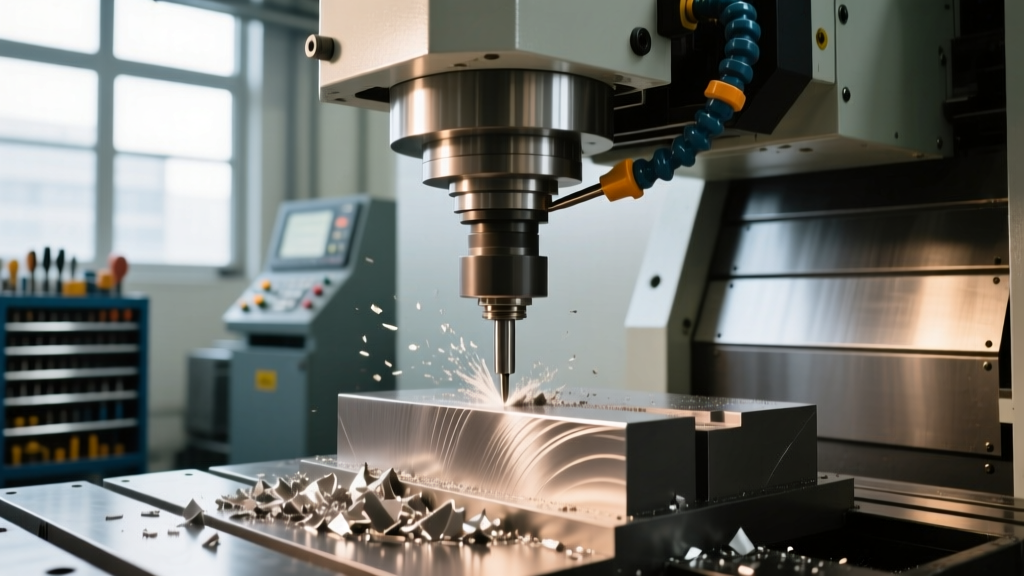
Troubleshooting Tool Chatter on a CNC Machine That Cuts Metal
Fix harmonic chatter, spindle runout, and surface defects on your CNC machine that cuts metal. Expert troubleshooting steps, TIR specs, and rebuild costs.
Diagnosing Harmonic Chatter vs. Mechanical Vibration
When a CNC machine that cuts metal begins to produce a high-pitched squeal or leaves visible, periodic witness marks on the workpiece, operators often misdiagnose the issue as simple tool wear or incorrect feeds and speeds. In reality, you are likely dealing with regenerative chatter or forced mechanical vibration. Distinguishing between the two is the critical first step in any troubleshooting protocol.
Regenerative chatter is a self-excited vibration. It occurs when the tool vibrates against the workpiece, leaving a wavy surface. On the next revolution or tooth pass, the tool cuts into this wavy surface, amplifying the vibration. According to Modern Machine Shop, regenerative chatter is highly dependent on the dynamic stiffness of the machine-tool-workpiece system and the spindle speed.
Forced vibration, conversely, is driven by an external periodic force. This is typically caused by an unbalanced toolholder, a damaged spindle bearing, or a worn drive belt. The frequency of forced vibration will exactly match the rotational frequency of the spindle (RPM / 60) or its harmonics.
Pro-Tip: The Audio TestRecord the sound of the cut using a smartphone app equipped with a spectrogram or FFT (Fast Fourier Transform) analyzer. If the dominant frequency shifts when you change the spindle RPM, you are dealing with regenerative chatter. If the dominant frequency scales perfectly and linearly with your RPM changes, you have a mechanical imbalance or forced vibration issue.
Decision Tree for Vibration Diagnosis
- Symptom: Chatter only occurs at specific RPMs and depths of cut. Action: Generate a stability lobe diagram and adjust RPM to a 'sweet spot'.
- Symptom: Vibration is present even during air-cutting (no workpiece engagement). Action: Check toolholder balance (G2.5 at 25,000 RPM minimum) and spindle runout.
- Symptom: Surface finish shows a pattern matching the number of spindle drive gears or belt teeth. Action: Inspect spindle transmission and motor coupling.
Spindle Runout: Measuring and Correcting TIR
Total Indicator Runout (TIR) is the silent killer of surface finish and tool life on any CNC machine that cuts metal. Even a high-quality carbide end mill will fail prematurely if the spindle introduces excessive radial deviation. For roughing operations, a TIR of up to 0.0005 inches (12.7 microns) might be acceptable, but finishing operations demand a TIR below 0.0002 inches (5 microns) measured at the tool tip.
To measure TIR accurately, avoid using cheap dial indicators with 0.001-inch resolutions. Invest in a Mitutoyo 2046S dial indicator (0.0001-inch resolution) or, preferably, a non-contact capacitive sensor or a Haimer 3D Sensor mounted in the spindle taper.
| Toolholder Type | Max Acceptable TIR (Tool Tip) | Best Application | Average Cost (2026) |
|---|---|---|---|
| ER32 Collet Chuck | 0.0004' (10 µm) | General roughing, drilling | $180 - $250 |
| Hydraulic Chuck | 0.0002' (5 µm) | Finishing, reaming, high-speed | $450 - $700 |
| Shrink-Fit Holder | 0.0001' (2.5 µm) | 5-axis contouring, micro-milling | $250 - $400 |
| Milling Chuck (e.g., TG) | 0.0003' (7.5 µm) | Heavy duty slotting, high torque | $300 - $500 |
If your TIR exceeds these thresholds, the issue is rarely the spindle itself initially. MSC Direct's Better MRO notes that up to 70% of runout issues stem from contaminated tapers or degraded collets rather than internal spindle bearing failure.
The Collet and Nut Maintenance Protocol
Microscopic chips and coolant residue trapped between the toolholder taper and the spindle nose will induce severe runout. A 0.0005-inch particle of swarf on a CAT40 taper can translate to over 0.002 inches of runout at the tip of a 6-inch long end mill.
Step-by-Step Taper and Collet Cleaning
- Spindle Wipe: Use a lint-free shop towel dampened with 99% isopropyl alcohol. Never use WD-40 or standard machine oil, as these leave a viscous film that attracts abrasive dust.
- Collet Inspection: Remove the collet from the nut. Inspect the internal slots for embedded micro-chips. Use a brass bristle brush (never steel, which will score the collet surfaces) to clear the slots.
- Nut Thread Cleaning: The internal threads of the ER nut collect hardened coolant. Use a dedicated thread-cleaning pick or a nylon brush to clear the flutes.
- Torque Verification: Hand-tighten the nut, then use a calibrated torque wrench. An ER32 nut requires exactly 100 Nm to 120 Nm of torque. Under-torquing allows the tool to slip; over-torquing distorts the collet, creating an hourglass grip that ruins TIR.
Spring steel collets suffer from metal fatigue. Even if visually pristine, an ER collet used in daily production loses its elastic memory after 6 to 8 months. Mandate a hard replacement schedule for collets every 2,000 machining hours to prevent sudden tool pullout during heavy radial engagements.
Tool Geometry and Radial Depth of Cut (RDOC)
If mechanical runout is within spec and chatter persists, the fault lies in the cutting dynamics. Traditional slotting (100% RDOC) maximizes radial cutting forces, pushing the tool laterally and triggering harmonic deflection. To stabilize a CNC machine that cuts metal, you must alter the toolpath and tool geometry.
Transitioning to Adaptive Clearing or Trochoidal milling reduces the RDOC to 5% - 10% of the tool diameter while allowing you to increase the Axial Depth of Cut (ADOC) to 1.5x or 2x the diameter. This shifts the cutting forces axially into the spindle bearings (which are vastly stiffer in the Z-axis) rather than radially.
Furthermore, verify your tooling. Standard 3-flute or 4-flute end mills with uniform helix angles and equal pitch spacing are highly susceptible to harmonic resonance. Upgrade to variable helix, variable pitch end mills (such as those from Helical Solutions or Harvey Tool). The irregular spacing of the cutting edges disrupts the harmonic frequency, effectively canceling out regenerative chatter before it amplifies.
Spindle Bearing Failure: When to Rebuild
If you have verified the toolholders, cleaned the tapers, optimized the toolpaths, and chatter remains—particularly accompanied by a high-frequency squeal or elevated spindle housing temperatures—you are likely facing internal spindle bearing degradation.
CNC milling spindles utilize precision angular contact bearings, typically graded ABEC-7 or ABEC-9. Over time, the grease inside these sealed bearings breaks down, or microscopic pitting occurs on the races due to radial shock loads. According to Sandvik Coromant's machining guidelines, a temperature spike exceeding 65°C (149°F) at the spindle nose during standard operation is a primary indicator of bearing preload loss or lubrication failure.
Rebuild Costs and Considerations
Do not attempt to replace spindle bearings in-house unless you operate an ISO Class 5 cleanroom and possess specialized bearing preload gauges. A professional OEM or certified third-party spindle rebuild for a standard HSK63A or CAT40 interface typically costs between $4,500 and $8,500 in 2026. If your machine requires hybrid ceramic bearings (silicon nitride balls with steel races) for high-speed applications (20,000+ RPM), expect the cost to push toward $12,000.
Edge Case: Before authorizing a $6,000 spindle rebuild, check the drawbar retention force. A weak drawbar (e.g., pulling at 1,500 lbs instead of the required 2,500 lbs) allows the toolholder to vibrate microscopically inside the taper, perfectly mimicking the symptoms of a bad spindle bearing. Use a calibrated drawbar force gauge (like a Tool-Holder retention force tester) to rule this out first.
Troubleshooting FAQ
Why does my machine only chatter during the first few passes of a new tool?
This is often caused by a lack of edge preparation or 'honing' on brand new carbide tools. Microscopically sharp edges can dig into the workpiece and cause high-frequency vibration. Many premium tool manufacturers apply a light edge hone (T-land or K-land) to stabilize the cutting edge. If using unbranded tooling, manually stoning the cutting edges with a fine Arkansas stone for 2-3 seconds per flute can eliminate initial-pass chatter.
Can I use WD-40 to clean my spindle taper?
No. WD-40 leaves a sticky, viscous residue that attracts microscopic abrasive dust and swarf. This residue acts as a lapping compound, accelerating wear on the spindle taper. Always use 99% isopropyl alcohol or a dedicated, fast-evaporating electronic contact cleaner that leaves zero residue.
Does climb milling reduce chatter compared to conventional milling?
Yes, in most rigid setups. Climb milling directs the primary cutting force downward into the table and workholding, utilizing the machine's vertical stiffness. Conventional milling tends to lift the workpiece and push the tool away from the cut, increasing the likelihood of radial deflection and chatter. However, if your machine has significant ball-screw backlash, climb milling will cause sudden grabbing and severe chatter; in that specific case, conventional milling is required until the gibs and screws are adjusted.