CNC Plastic Machining for Texas Railroads: Custom Pipe Fittings
Master operator training for CNC plastic machining of custom railroad pipe fittings in Texas. Learn tooling, workholding, and thermal management.
The Engineering Shift in Railroad Fluid Systems
The intersection of railroads, custom pipe fittings, and CNC plastic machining in Texas creates a highly specialized manufacturing niche. Historically, rail car pneumatic and fluid handling systems relied heavily on brass, bronze, and stainless steel. However, the modern push for lightweighting and the elimination of galvanic corrosion in harsh rail environments has driven a massive shift toward advanced engineering polymers. Texas, serving as a critical logistics hub for BNSF and Union Pacific, has seen a corresponding surge in demand from local machine shops tasked with producing these non-metallic components.
Machining polymers for high-vibration, high-pressure rail applications is fundamentally different from milling aluminum or steel. Plastics possess low thermal conductivity, high coefficients of thermal expansion, and viscoelastic memory. Operators trained exclusively on metals often scrap expensive polymer stock by applying excessive clamping force, using incorrect tool geometries, or failing to account for ambient shop temperatures. This guide outlines the precise operator training protocols required to successfully manufacture custom plastic pipe fittings for the railroad industry.
Material Selection Matrix for Rail Fittings
Selecting the correct polymer is the first critical step. Railroad fittings must withstand extreme temperature cycling (from freezing Midwest winters to scorching Texas summers) and resist degradation from compressed air moisture and hydraulic fluids. Below is a comparative matrix of the most common engineering plastics used in this sector.
| Material | Common Trade Name | Approx. Cost (2026) | Max Continuous Temp | Machinability | Primary Railroad Application |
|---|---|---|---|---|---|
| Acetal (POM) | Delrin 150 | $18 - $24 / lb | 180°F (82°C) | Excellent (machines like brass) | Pneumatic push-to-connect fittings, brake line manifolds |
| PEEK | TECAPEEK | $95 - $130 / lb | 480°F (250°C) | Good (requires rigid setup) | High-pressure hydraulic couplings, locomotive engine bay fittings |
| UHMW-PE | Tivar 1000 | $22 - $30 / lb | 180°F (82°C) | Poor (gummy, low stiffness) | Non-threaded wear pads, low-friction slip couplings |
| PTFE | Teflon | $40 - $55 / lb | 500°F (260°C) | Difficult (highly viscoelastic) | Chemical-resistant tank car liners, specialized seal glands |
Operator Training: Tooling Geometry and Selection
Standard carbide endmills designed for aluminum will tear, melt, or fuzz the edges of engineering plastics. Operator training must emphasize the use of geometry specifically engineered for polymers. According to the Harvey Tool Machining Plastics Guide, the primary goal is to shear the material cleanly while evacuating chips rapidly to prevent heat buildup.
Required Tool Specifications
- Flute Design: Use single or double O-flute (up-cut) endmills. The large gullet of an O-flute is mandatory for clearing the stringy, voluminous chips produced by Acetal and UHMW-PE.
- Rake Angle: A high positive rake angle (25° to 30°) is required to slice through the polymer rather than pushing and deforming it.
- Clearance Angle: Increase the primary clearance angle to 12°–15° to prevent the heel of the tool from rubbing against the plastic, which generates friction and melts the bore.
- Coatings: Avoid standard TiAlN or AlTiN coatings. Uncoated, highly polished carbide or diamond-coated tools provide the best surface finish and prevent material adhesion.
Workholding: Preventing the 'Triangle Effect'
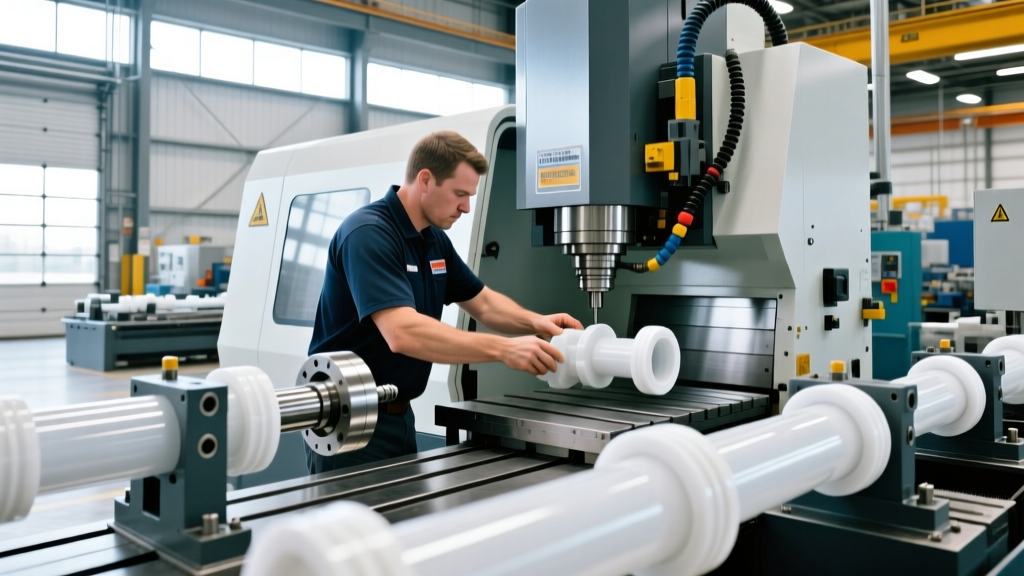
The most common failure mode for junior operators machining cylindrical plastic fittings is over-clamping. Plastics have a low modulus of elasticity. When a standard 3-jaw chuck clamps a hollow Acetal pipe fitting, the part deforms into a triangle. The operator machines the OD to a perfect circle while it is under clamping stress. Once the part is removed from the chuck, the viscoelastic memory of the plastic causes it to spring back into a triangle, ruining the concentricity and sealing surfaces.
CRITICAL WARNING: Never use standard hard steel chuck jaws on engineering plastics. The point loading will permanently indent the material and cause out-of-tolerance rebound.Best Practice Workholding Solutions
- Custom Soft Jaws: Machine aluminum or Delrin soft jaws bored to the exact nominal OD of the plastic part. This distributes the clamping force evenly across 360 degrees.
- Pneumatic Collet Chucks: For high-volume production of pneumatic fittings, use 5C collet chucks with custom-molded polyurethane or Delrin collet pads. Pneumatic actuation allows the operator to dial in the exact clamping pressure (typically 15-25 PSI for thin-walled plastics), eliminating hydraulic over-clamping.
- Internal Mandrels: When machining the OD of a hollow fitting, support the ID with an expanding internal mandrel to resist cutting forces without crushing the part walls.
Thermal Management in Texas Machine Shops
Texas machine shops frequently experience ambient temperatures exceeding 95°F in the summer, particularly in facilities without comprehensive climate control. This presents a severe metrology challenge. The Coefficient of Linear Thermal Expansion (CLTE) for Acetal is approximately 6.7 x 10⁻⁵ in/in/°F—nearly ten times higher than that of steel.
If an operator machines a critical NPT thread on an Acetal fitting when the part temperature is 105°F (due to ambient heat and cutting friction), and the quality control inspector measures it in a 70°F CMM room, the part will have shrunk significantly, resulting in a failed inspection. Furthermore, the Ensinger Plastics Machining Guide emphasizes that localized heat from dull tools can cause surface smearing, which compromises the pressure rating of the fitting.
Coolant and Chip Evacuation Strategies
- Avoid Water-Soluble Coolants: Many engineering plastics (especially Nylon and certain Acetals) are hygroscopic. Flood coolant can cause the material to absorb moisture, swell, and alter its dimensional stability. It also washes away the dry lubricity of the polymer.
- Compressed Air Blasts: Use high-volume, dry compressed air aimed directly at the cutting zone to clear chips and cool the tool.
- MQL (Minimum Quantity Lubrication): If lubrication is necessary for heavy roughing, use a plant-based MQL system applied in microscopic droplets. This provides lubricity without soaking the part.
- Ionized Air Nozzles: Machining dry plastics generates massive static electricity, causing chips to cling to the part and get re-cut, ruining the surface finish. Install static-eliminating ionized air nozzles on the CNC enclosure to blow chips clear.
Threading Protocol: NPT and JIC Fittings
Railroad pipe fittings frequently require NPT (National Pipe Taper) or JIC (Joint Industry Council) 37-degree flare threads. Machining threads in plastics requires a complete departure from standard metalworking practices.
'Attempting to use standard spiral-flute taps in Acetal or PEEK is a primary cause of scrapped railroad fittings. The polymer matrix tears rather than cuts, and chip evacuation inside a blind or deep hole fails, leading to catastrophic tool breakage and part destruction.' — Advanced Polymer Machining Standards, 2025 Industry Report.
The Thread Milling Mandate
Operators must be trained to abandon tapping in favor of single-point thread milling. Thread milling offers distinct advantages for plastic fittings:
- Chip Control: The interrupted cut of a thread mill allows chips to break and clear easily.
- Thread Quality: It produces a smooth, burnished thread flank that seals significantly better than the torn surface left by a tap.
- Adjustability: Plastics shrink and expand. A thread mill allows the operator to adjust the toolpath diameter by 0.001 inches to compensate for thermal variations, ensuring a perfect gauge fit every time.
Quality Control and AAR Compliance
Custom fittings destined for rail cars must comply with rigorous standards set by the Association of American Railroads (AAR). Quality control for CNC-machined plastic fittings extends beyond dimensional checks with calipers and CMMs.
Mandatory Testing Protocols
- Thread Gauging: Use calibrated L1 and L2 ring/plug gauges. Because plastics are softer, operators must use a 'feel' gauge rather than forcing the gauge, which can strip the polymer threads.
- Burst Pressure Testing: Sample parts from every batch must be subjected to hydrostatic burst testing at 3x to 4x the maximum operating pressure (typically 300-450 PSI for rail pneumatic systems) to ensure the machining process did not introduce micro-fractures or stress concentrators.
- Vibration Fatigue Simulation: For critical manifold fittings, batch samples are mounted on multi-axis shaker tables to simulate the high-frequency, low-amplitude vibrations characteristic of freight rail transport, ensuring the polymer threads do not back out or fatigue-crack over time.
By mastering these specific tooling, workholding, and thermal management techniques, Texas CNC shops can reliably capture the high-margin, high-volume demand for advanced polymer railroad fittings, delivering components that outperform traditional metals in the harshest transit environments.