2026 CNC Stone Cutting Machine Innovations: 5-Axis & AI Trends
Discover 2026 innovations in CNC stone cutting machines, including 5-axis waterjet hybrids, AI slab scanning, and IoT diamond blade monitoring for fabricators.
The Convergence of 5-Axis Kinematics and High-Pressure Waterjets
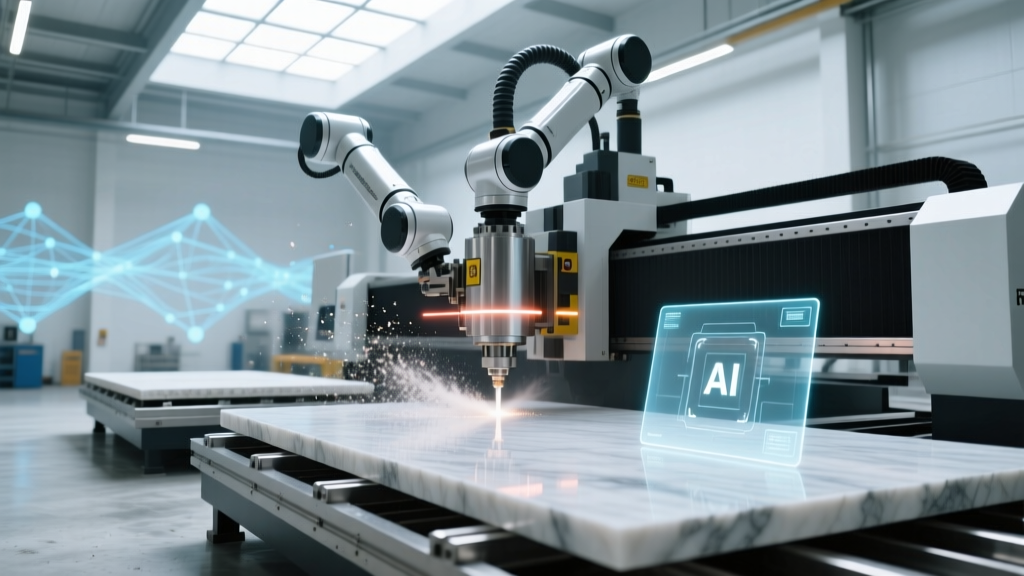
The stone fabrication industry in 2026 is defined by the rapid obsolescence of traditional 3-axis bridge saws. Modern fabricators processing high-density quartzite, large-format porcelain, and sintered stone demand zero-chip bevels, intricate cutouts, and automated nesting. The modern cnc stone cutting machine has evolved into a 5-axis saw-jet hybrid, combining a 22HP diamond saw blade with a 50,000 PSI abrasive waterjet on a single monolithic gantry.
Machines like the Breton Smartcut and Park Industries Fusion 4125 dominate the premium tier. These systems utilize the diamond blade for high-speed straight relief cuts (up to 45 m/min in 2cm granite) and seamlessly switch to the waterjet for complex sink bowls, faucet holes, and 45-degree mitered edges for waterfall islands. The 5-axis head allows the waterjet nozzle to tilt dynamically, compensating for the natural kerf taper inherent in abrasive waterjet cutting, resulting in perfectly square edges on 3cm materials without secondary CNC routing.
Fabricator Insight: The Mitering Advantage
Cutting a 45-degree miter on a Dekton or Neolith slab using a standard bridge saw requires multiple passes, specialized mitring blades, and extensive manual polishing. A 2026 5-axis saw-jet hybrid executes the miter in a single continuous pass with a specialized diamond mitring wheel, followed immediately by the waterjet trimming the apex to within 0.1mm tolerance, reducing edge-prep labor by up to 70%.
AI-Driven Photogrammetry and Dynamic Nesting
Material yield is the primary driver of profitability in natural stone fabrication. In 2026, AI-powered photogrammetry tables are fully integrated into the CNC workflow. Systems utilizing polarized LED lighting and 12MP overhead cameras map not just the visual veins of a slab, but also resin fills, micro-fissures, and structural weak points.
This topographical and visual data is exported as an XML file directly into nesting software like Slabsmith or AlphaCAM Stone. The AI algorithm calculates the optimal cut path, ensuring that high-stress areas—such as the narrow bridge between a sink cutout and the slab edge—are never placed over a natural fissure. According to industry data published by Stone World fabrication reports, shops utilizing AI-assisted digital slab imaging and dynamic nesting have reduced their overall material waste from an industry average of 18% down to 9.2%, effectively adding thousands of dollars to the bottom line per month.
LiDAR Thickness Mapping
Natural stone is rarely perfectly calibrated. A slab of Taj Mahal quartzite might vary from 19mm to 23mm across its surface. 2026 CNC stone cutting machines now feature integrated LiDAR sensors that scan the slab's Z-axis topography before cutting. The machine's controller dynamically adjusts the Z-height of the cutting head in real-time, maintaining a constant blade depth engagement. This prevents the blade from plunging too deep into the sacrificial grid, which drastically extends the life of the diamond segments and prevents catastrophic blade binding.
IoT Acoustic Monitoring for Sintered Stone
Sintered stone and ultra-compact surfaces are notoriously abrasive and unforgiving. Pushing a diamond blade too hard causes the metal matrix to glaze over; feeding too slowly causes the blade to warp and shatter the slab. To combat this, modern CNC controllers are equipped with IoT acoustic emission sensors mounted directly on the spindle housing.
These sensors monitor the high-frequency acoustic signature of the diamond segments engaging the stone. If the blade begins to glaze, the acoustic pitch shifts. If a diamond segment fractures, the sensor detects a micro-impact spike. When the acoustic signature deviates by more than 12% from the baseline profile for that specific material (e.g., 2cm porcelain), the IoT dashboard automatically throttles the feed rate by 15% and alerts the operator to dress the blade with an abrasive brick. This predictive maintenance prevents a $400 diamond blade from destroying a $2,500 slab of premium sintered stone.
Machine Class Comparison Matrix
| Machine Architecture | Estimated 2026 Price Range | Bevel & Miter Capability | Sintered Stone Viability | Footprint & Requirements |
|---|---|---|---|---|
| 3-Axis CNC Bridge Saw | $75,000 - $110,000 | Manual tilt only; requires secondary edge router | Poor (high risk of edge chipping) | 20x12 ft; Standard 3-phase power |
| 5-Axis Saw-Jet Hybrid | $195,000 - $310,000 | Automated 45° miters; zero-chip bevels | Excellent (waterjet relieves tension) | 25x15 ft; Requires 50HP+ & water filtration |
| 6-Axis Robotic Waterjet Cell | $240,000 - $380,000 | Full 3D contouring; undercut capabilities | Excellent (no mechanical blade stress) | 15x15 ft enclosed cell; Heavy water recycling |
Environmental Compliance and Water Filtration
Operating a CNC stone cutting machine in 2026 requires strict adherence to environmental and occupational health standards. The introduction of high-pressure waterjets means shops are processing thousands of gallons of abrasive-laden slurry daily. Furthermore, the OSHA Respirable Crystalline Silica standard mandates strict Permissible Exposure Limits (PEL) of 50 µg/m³ for general industry.
Dry cutting engineered quartz or natural stone is entirely unviable. Modern setups mandate closed-loop water filtration systems. A 5-axis saw-jet requires a minimum of a 5-micron filtration system paired with a multi-stage settling tank to remove garnet abrasive and stone particulate before the water is recirculated to the 50,000 PSI intensifier pump. Failure to maintain water purity below 1 ppm of suspended solids will destroy the high-pressure pump seals and the jewel orifice in the cutting head within weeks.
Warning: Silica Dust in CNC EnclosuresEven with flood cooling, CNC stone routers and saws generate aerosolized silica mist. According to guidelines from the Natural Stone Institute, fabrication shops must utilize localized exhaust ventilation (LEV) systems integrated directly into the CNC enclosure, paired with HEPA filtration units, to ensure ambient air quality remains compliant during high-speed dry-routing operations for edge profiling.
Decision Framework: Upgrading Your Fabrication Cell
Choosing the right CNC stone cutting machine depends entirely on your shop's monthly volume and material mix. Use this framework to determine your capital expenditure strategy:
- Tier 1: Under 15 Kitchens/Month (Focus on Granite/Quartz)
A high-quality 3-axis CNC bridge saw with an automated tool changer (ATC) for edge profiling is sufficient. Invest heavily in digital templating (laser or LiDAR) rather than a 5-axis gantry. Budget allocation: $90k for the saw, $30k for templating. - Tier 2: 15 to 35 Kitchens/Month (Mixed Materials including Porcelain)
The 5-axis saw-jet hybrid is mandatory. The ability to cut sink holes in porcelain without mechanical stress prevents micro-fractures that lead to warranty claims. The ROI on a $250,000 hybrid machine is typically realized in 14 months through reduced secondary CNC routing time and lower labor costs. - Tier 3: 40+ Kitchens/Month & Commercial Millwork
Consider a dual-table setup: one 5-axis saw-jet for rough cutting and cutouts, paired with a dedicated multi-spindle CNC edge profiler. This decouples the cutting bottleneck from the edge-finishing bottleneck, allowing continuous material flow.
"The fabricators who are winning in 2026 aren't just buying faster machines; they are buying data. The integration of slab scanning, IoT spindle monitoring, and automated nesting turns a CNC stone cutting machine from a mere saw into an intelligent manufacturing node."
Investing in a modern CNC stone cutting system is no longer just about cutting speed; it is about precision, material preservation, and data-driven workflow integration. By prioritizing 5-axis kinematics, AI nesting, and predictive IoT maintenance, fabrication shops can drastically reduce waste, ensure compliance, and dominate the high-end custom surfacing market.