Smart CNC Machine for Wood: 2026 Automation & AI Trends
Discover how AI, 5-axis robotics, and smart sensors are transforming the modern CNC machine for wood in 2026. Compare top automated woodworking systems.
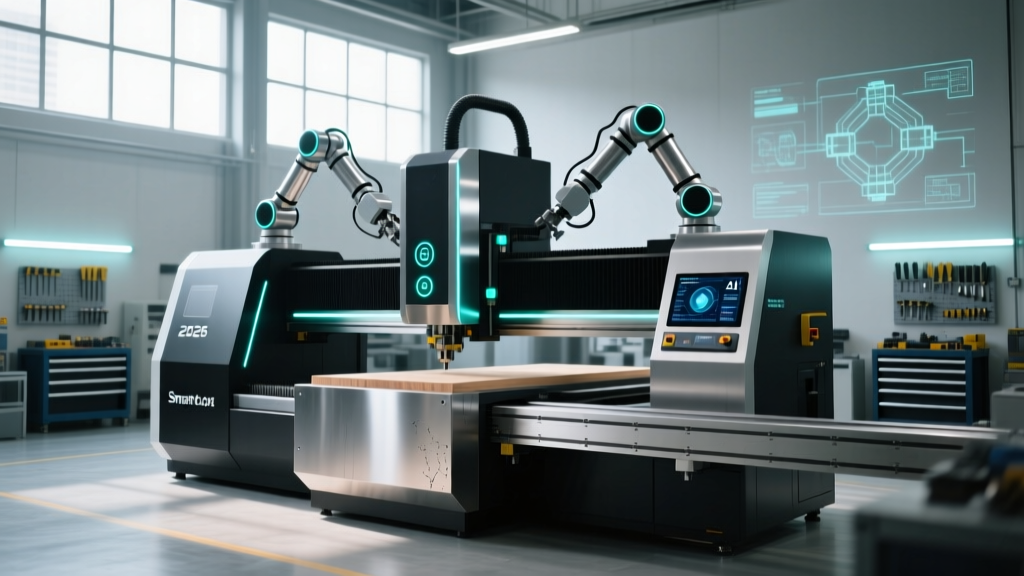
Wood is an inherently unpredictable material. Unlike aluminum or steel, solid timber features variable density, hidden knots, and internal stresses that cause warping. Historically, operating a CNC machine for wood meant relying on rigid G-code that assumed a perfectly flat, uniform blank. As of 2026, that paradigm has completely shifted. The integration of adaptive vision systems, AI-driven toolpath generation, and robotic material handling has transformed woodworking routers from blind cutting tools into cyber-physical manufacturing cells.
For shop owners and production managers, understanding these technological leaps is no longer optional; it is the primary driver of margin protection and yield optimization. This guide breaks down the specific hardware and software innovations defining the modern woodworking CNC landscape, providing actionable data for equipment upgrades.
2026 Woodworking CNC Industry Snapshot
- Adaptive Vision Adoption: 42% of mid-to-large cabinet manufacturers now utilize inline LiDAR or structured-light scanning for warp compensation.
- Material Yield Improvement: AI-nesting software combined with 5-axis trimming has increased usable yield from rough-sawn lumber by an average of 14%.
- Setup Time Reduction: Automated pod-and-rail vacuum systems have reduced average job changeover times from 25 minutes to under 4 minutes.
Adaptive Vision and Dynamic Toolpath Generation
The most significant innovation in the modern CNC machine for wood is the move away from static CAD/CAM assumptions. When machining solid hardwoods like White Oak or Walnut, a board that was perfectly flat in the CAD file may have bowed 3mm by the time it reaches the machine bed due to moisture equalization.
Leading 2026 systems, such as those utilizing Siemens Sinumerik ONE controllers paired with structured-light overhead cameras, scan the actual blank in 12 to 15 seconds before cutting begins. The software maps the Z-axis deviations and dynamically adjusts the toolpath. If a board is bowed upward by 2mm in the center, the controller automatically adds 2mm to the Z-depth in that specific zone, ensuring consistent profile depths and eliminating the need for manual shimming or double-sided tape.
Edge Case Management: Knots and Grain Reversal
Advanced vision systems now incorporate multispectral imaging to detect subsurface knots and grain direction changes. When the AI identifies a dense knot, it automatically reduces the spindle feed rate by 30% and adjusts the ramp-in angle to prevent carbide micro-chipping. This level of dynamic intervention extends the lifespan of compression bits by up to 40% compared to static feed rate programming.
Spindle Interfaces: The HSK-F63 Standard
While ER32 and ER40 collets remain standard for 3-axis hobbyist and light-production machines, the industrial 5-axis CNC machine for wood has overwhelmingly adopted the HSK-F63 tool holder interface. The reason is strictly mechanical: runout and clamping force.
When performing 3D contouring or undercutting with long-reach end mills, lateral forces on the tool are immense. ER collets rely on friction and nut torque, which can slip under heavy side-loading, causing chatter and ruining the surface finish. The HSK-F63 system utilizes a dual-contact clamping mechanism that grips both the taper and the flange face simultaneously. According to research on wood machining dynamics from the USDA Forest Products Laboratory, maintaining strict tool concentricity is critical when machining abrasive composite woods like MDF or Melamine-faced particleboard, where even 0.02mm of runout accelerates flank wear exponentially.
Comparison Matrix: 2026 Wood CNC Architectures
Choosing the right machine architecture depends entirely on your production volume and part geometry. Below is a direct comparison of the three dominant CNC configurations available in 2026.
| Feature | 3-Axis Gantry (Flat Table) | Pod & Rail (5-Axis) | Robotic Arm Cell (6-Axis) |
|---|---|---|---|
| Primary Use Case | Nested-based cabinet parts, sign making, 2.5D carving. | Chair components, curved stair parts, complex joinery. | Sculptural elements, large-scale 3D architectural millwork. |
| Hold-Down Method | Universal MDF spoilboard, vacuum grid. | Automated pneumatic pods, mechanical clamps. | Custom fixtures, robotic part-handling. |
| Typical Spindle | 9kW - 12kW Air-Cooled | 15kW HSK-F63 Liquid-Cooled | 10kW+ Inline Spindle End-Effector |
| 2026 Price Range | $45,000 - $85,000 | $120,000 - $280,000 | $250,000 - $450,000+ |
| Footprint | Compact (e.g., 4x8 or 5x10 bed) | Large (requires 20ft+ clearance) | Massive (requires safety caging) |
The Automation of Material Handling and Hold-Downs
The actual cutting time of a CNC router is often dwarfed by the time spent loading, aligning, and securing the material. The 2026 standard for high-volume shops is the automated pod-and-rail system. Machines like the Homag BHX series or Biesse Rover platforms now feature robotic gantries that automatically position vacuum pods based on the imported CAD file.
When a new job is loaded, the machine's controller reads the part geometry, calculates the optimal center of gravity and clamping zones, and physically moves the vacuum pods into position. The operator simply places the rough blank against the physical stops. This eliminates the manual layout of pods, prevents accidental cutting into vacuum lines, and ensures maximum holding force exactly where the cutting forces will be highest.
Critical Warning: Sensor Blindness in Woodworking
As shops integrate more LiDAR and optical cameras for adaptive toolpaths, dust management becomes a machine-vision problem, not just a health hazard. Fine MDF dust and resin-heavy pine pitch will quickly coat camera lenses, rendering adaptive scanning useless. Solution: Ensure any vision-equipped CNC machine for wood specifies IP67-rated camera housings with integrated positive-pressure air purges. Do not rely on standard shop dust collection to keep optical sensors clean.
Software Ecosystem: The End of Manual CAM
The software bridging the gap between design and machine execution has seen massive consolidation and AI integration. Parametric design software now communicates directly with the CNC controller. If a designer changes the thickness of a cabinet side panel from 18mm to 19mm in the ERP system, the CNC machine automatically updates the toolpath, adjusts the depth of the dado cuts, and recalculates the vacuum pod placement without a human programmer ever opening a CAM interface.
Furthermore, AI-driven nesting algorithms in 2026 do not just minimize waste; they account for tool entry and exit points to prevent tear-out on visible melamine edges, and they sequence cuts to manage heat buildup in the spoilboard, preventing premature MDF degradation.
Implementation Checklist for Shop Upgrades
If you are evaluating a new CNC machine for wood, use this technical checklist to ensure you are purchasing a future-proofed system:
- Verify Controller Capabilities: Ensure the controller supports NURBS (Non-Uniform Rational B-Splines) interpolation natively. This is mandatory for smooth 3D contouring in hardwoods without facetting.
- Audit the Vacuum Pump: For pod-and-rail systems, a standard rotary vane pump is insufficient. Specify a liquid-ring or dry claw vacuum pump capable of sustaining at least 6-bar (87 PSI) negative pressure with a flow rate matched to your pod count.
- Check Tool Management: Look for an HSK-F63 automatic tool changer (ATC) with a minimum of 12 positions, and ensure the carousel is enclosed to prevent dust ingress into the tool tapers.
- Network Security: Modern CNCs are IoT devices. Ensure the machine's controller can be isolated on a VLAN to protect proprietary CAD files and prevent ransomware attacks on the production floor.
The transition to smart, sensor-driven CNC routing requires a higher initial capital expenditure, but the reduction in manual sanding, elimination of setup errors, and maximized material yield typically deliver a complete ROI within 18 to 24 months for mid-volume production facilities.