Railroads Seals CNC Plastic Machining Houston: 2026 Innovations
Explore 2026 innovations in railroads seals CNC plastic machining in Houston. Discover advanced polymer tooling, cryogenic cooling, and AAR compliance.
The North American freight rail network is undergoing a massive structural shift. With heavy-haul axle loads now routinely exceeding 315,000 pounds, traditional elastomeric seals in journal bearings and suspension systems are experiencing premature catastrophic failure. This has triggered a rapid migration toward advanced engineered polymers. At the epicenter of this supply chain evolution is the Gulf Coast logistics corridor, where the sector encompassing railroads seals CNC plastic machining in Houston has become a critical hub for North American rail operators like Union Pacific and BNSF.
Houston’s proximity to the Port of Houston intermodal yards and the Katy Freeway logistics corridor has fostered a specialized ecosystem of CNC machine shops. These facilities are moving beyond basic turning and milling, adopting 2026-era manufacturing technologies to machine ultra-high molecular weight polyethylene (UHMWPE), polyether ether ketone (PEEK), and filled PTFE composites to the stringent tolerances required by the Association of American Railroads (AAR).
Why Rail Operators are Abandoning Elastomers for Machined Polymers
Historically, nitrile butadiene rubber (NBR) and polyurethane were the default materials for rail car bearing seals and center plate wear pads. However, the thermal degradation of these materials under continuous high-speed freight operations has forced a material rethink. Advanced polymers offer superior dimensional stability, chemical resistance to track-side lubricants, and vastly extended service lifecycles.
Material Performance Matrix: Rail Seal Applications
| Material | Max Continuous Temp | Wear Resistance (ASTM D4060) | Moisture Absorption | Primary Rail Application |
|---|---|---|---|---|
| NBR Elastomer (Legacy) | 100°C (212°F) | Poor (High abrasion) | Low | Light-duty passenger seals |
| UHMWPE (Virgin) | 80°C (176°F) | Exceptional (Lowest coefficient of friction) | Zero | Journal bearing seals, wear pads |
| PEEK (Unfilled) | 250°C (482°F) | Excellent | Very Low (0.1%) | High-speed passenger rail braking seals |
| PTFE (15% Glass Filled) | 260°C (500°F) | Good (Improved via fillers) | Zero | Suspension system rotary seals |
2026 CNC Innovations Specific to Houston's Rail Supply Chain
Machining advanced plastics for rail seals is fundamentally different from machining aluminum or steel. Plastics have high thermal expansion coefficients, low melting points, and a tendency to 'spring back' or retain memory after cutting forces are removed. Houston-based machine shops are deploying specific innovations to overcome these hurdles.
Cryogenic Flood Cooling and Thermal Management
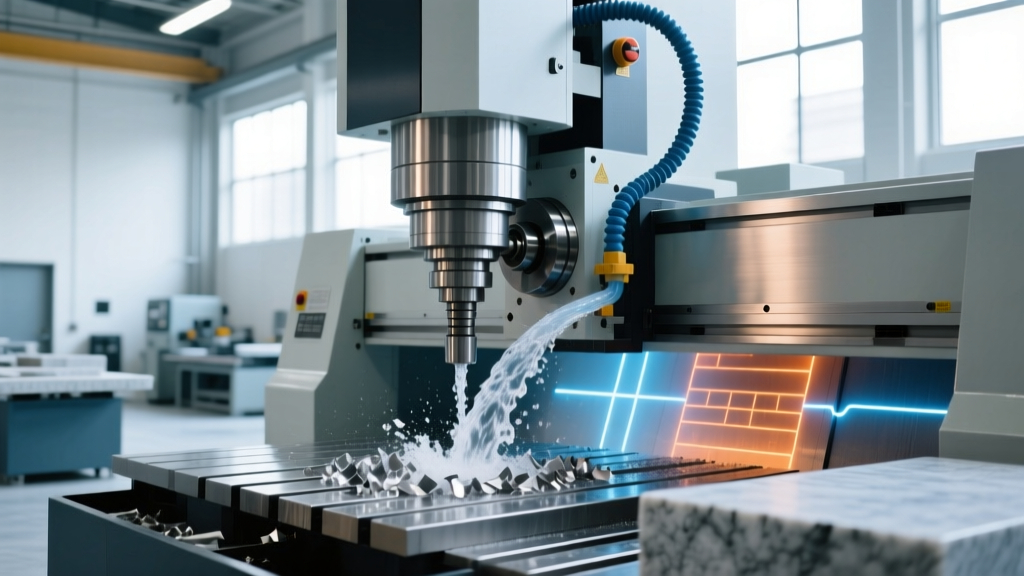
When machining UHMWPE for heavy-haul bearing seals, friction at the cutting edge can easily exceed the material's melting point of 135°C, causing localized smearing and ruining the sealing surface finish. In 2026, top-tier Houston shops have integrated cryogenic flood cooling systems using liquid CO2 or specialized low-temperature synthetic emulsions. This maintains the workpiece at a stable 18°C (65°F), preventing thermal expansion and allowing for tight holding tolerances of ±0.0005 inches on seal outer diameters.
Ultrasonic-Assisted Machining (UAM) for PTFE Composites
Glass-filled PTFE is notoriously abrasive and difficult to finish without tearing the glass fibers from the polymer matrix. Ultrasonic-assisted machining, now widely adopted in precision facilities near the Houston Ship Channel, superimposes high-frequency, low-amplitude vibrations onto the cutting tool. This reduces cutting forces by up to 40%, eliminates built-up edge (BUE) on the carbide inserts, and yields a mirror-like surface finish (Ra 0.2 µm) essential for dynamic rotary seals.
Expert Insight: The Houston Supply Chain AdvantageRail operators sourcing from Houston benefit from localized polymer stockists (such as regional distributors for Ensinger and Mitsubishi Chemical). This localized inventory reduces raw material lead times from 6 weeks to under 72 hours, allowing Houston CNC shops to run just-in-time (JIT) production for emergency railcar maintenance depots across Texas and the Midwest.
Precision Machining Parameters for Rail Seal Polymers
Success in CNC plastic machining relies entirely on tool geometry and feed/speed optimization. Standard metal-cutting inserts will destroy engineered polymers. Below are the baseline parameters utilized for 3-axis and 5-axis CNC turning centers processing high-volume rail seal orders.
| Polymer Grade | Tool Material & Geometry | Surface Speed (SFM) | Feed Rate (IPR) | Coolant Strategy |
|---|---|---|---|---|
| UHMWPE | Polycrystalline Diamond (PCD), 0° rake, sharp edge | 800 - 1200 | 0.008 - 0.015 | High-pressure mist or cryogenic |
| PEEK | Carbide (TiN coated), positive rake (10°-15°) | 400 - 600 | 0.004 - 0.008 | Flood soluble oil (avoid water-based) |
| PTFE (15% Glass) | CVD Diamond coated carbide, large clearance angle | 300 - 500 | 0.005 - 0.010 | Dry compressed air blast |
Managing Thermal Expansion and 'Memory' in CNC Plastics
The most common failure mode in CNC-machined plastic seals is not dimensional inaccuracy during the cut, but dimensional drift after the part is unclamped. Polymers possess viscoelastic memory; the clamping pressure from a standard 3-jaw chuck or milling vise introduces internal stresses that release hours later, warping the seal out of roundness.
Stress-Relief Annealing Protocols
To meet railway industry compliance standards, Houston machine shops implement strict multi-stage annealing protocols. Extruded UHMWPE rods are stress-relieved in convection ovens at 85°C for 2 hours per inch of thickness prior to roughing. After roughing, parts are annealed again before the final finishing pass. This guarantees that the final CNC cut is made on a completely relaxed molecular structure.
Advanced Workholding Solutions
Mechanical clamping is being phased out for thin-walled rail seals (wall thicknesses under 0.125 inches). Instead, shops utilize custom-machined vacuum chucks with porous sintered aluminum faces, or freeze-chucking technology. Freeze-chucking uses a water-soluble freezing agent to bond the plastic workpiece to a sub-plate at -20°C, allowing 5-sided machining with zero clamping distortion. Once the part thaws, it is washed, leaving a perfectly round, undistorted seal ready for assembly.
Vendor Selection Framework for AAR-Compliant Seals
For procurement managers and rail fleet engineers evaluating CNC machining partners in the Houston area for plastic rail seals, use this technical decision framework to separate generalist machine shops from specialized polymer experts.
- Verify Material Traceability: Demand Mill Test Reports (MTRs) or Certificates of Analysis (CoA) for every batch of UHMWPE or PEEK. The polymer must be virgin or specifically certified for recycled content limits (usually <5% for critical bearing seals).
- Audit Metrology Equipment: Plastic seals cannot be measured accurately with standard mechanical micrometers, which deform the material. Ensure the shop uses non-contact laser scanning CMMs (Coordinate Measuring Machines) or optical comparators for final QA.
- Evaluate Packaging Protocols: Machined PTFE and UHMWPE seals are highly susceptible to scratching and UV degradation. Vendors must ship parts in custom vacuum-formed trays, individually wrapped in UV-blocking VCI (Volatile Corrosion Inhibitor) poly-bags.
- Request First Article Inspection (FAI) Data: Before authorizing full production runs, require an AS9102-style FAI report that specifically documents the thermal stability testing of the machined batch.
As heavy-haul rail networks continue to push the boundaries of axle loads and transit speeds, the reliance on precision-machined engineered polymers will only accelerate. By leveraging advanced CNC cooling, ultrasonic tooling, and rigorous stress-relief protocols, Houston’s machining sector is securing its position as the vital link in North America's modernized rail supply chain.