CNC Router Machine for Wood: ShopBot vs. CAMaster in 2026
Compare the top CNC router machine for wood in 2026. We analyze ShopBot Desktop MAX vs. CAMaster Stinger II specs, pricing, and woodcutting performance.
The Mid-Tier Production Dilemma: Steppers vs. Servos
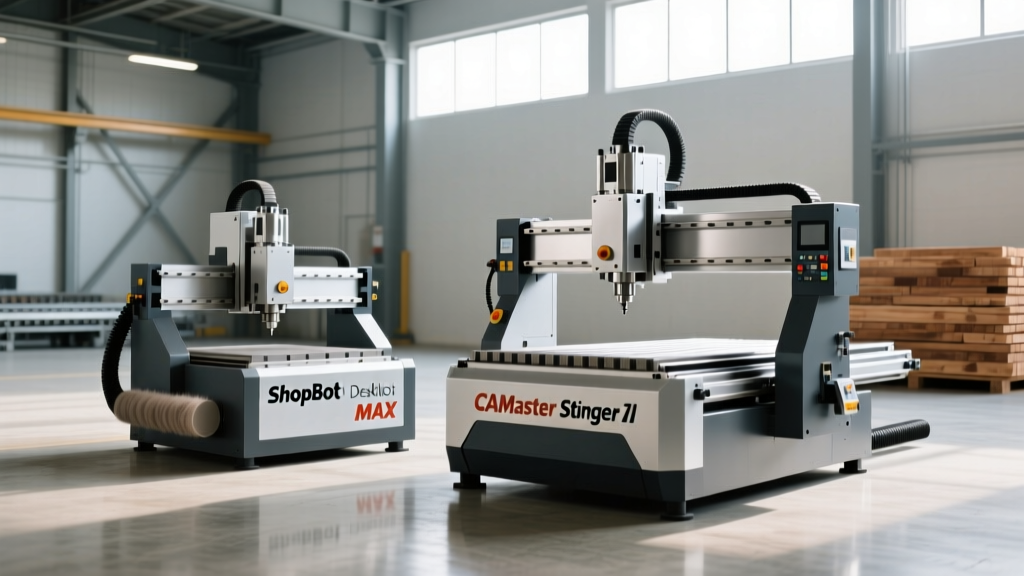
Selecting the right CNC router machine for wood dictates your shop's throughput, edge finish quality, and tooling lifespan. In the $30,000 to $40,000 mid-production tier, two platforms dominate the 2026 market: the ShopBot Desktop MAX (4x8) and the CAMaster Stinger II (SR-44/SR-48). While both machines can process Baltic birch plywood, MDF, and dense hard maple, their underlying mechanical architectures serve fundamentally different production methodologies.
The core divergence lies in the drive systems. ShopBot utilizes advanced closed-loop stepper motors, which excel at high holding torque during low-RPM, intricate 3D wood carving. CAMaster employs Yaskawa AC servo motors paired with helical rack-and-pinion drives, optimized for high-speed, high-volume nesting of cabinet components. Understanding this distinction is the first step in aligning your machinery investment with your actual shop output.
Decision Framework: Which Architecture Fits Your Shop?
- Choose ShopBot if: Your primary workload involves detailed 3D relief carving, sign making, custom millwork with slow feed rates, and you operate in a space-constrained environment where software ease-of-use is paramount.
- Choose CAMaster if: Your shop runs high-volume panel processing, cabinet nesting, rapid roughing of thick hardwoods, and you require the aggressive acceleration/deceleration profiles that only AC servos can provide.
Head-to-Head Specifications & Pricing (2026 Baseline)
| Feature | ShopBot Desktop MAX (4x8) | CAMaster Stinger II (SR-48) |
|---|---|---|
| Work Area | 49" x 97" x 6" | 49" x 97" x 6" (Optional 8" Z) |
| Spindle | 3.0 HP HSD (Italian, ER20) | 3.0 HP HSD or Colombo (ER20/ER25) |
| Drive System | Closed-Loop Steppers | Yaskawa AC Servos |
| Transmission | Precision Rack and Pinion | Helical Rack and Pinion |
| Controller | ShopBot CNC (Proprietary) | WinCNC (Industry Standard) |
| Base Price (Approx.) | $37,500 | $36,900 |
Deep Dive: ShopBot Desktop MAX
The ShopBot Desktop MAX remains the benchmark for educational institutions and boutique custom woodshops. Its proprietary controller software abstracts away complex G-code parameters, offering a highly visual interface that reduces operator error. The 3.0 HP HSD spindle provides ample torque for hogging out waste in softwoods and plywoods, though it can bog down if pushed too aggressively into end-grain hard maple or hickory without proper chipload management.
Woodcutting Edge Cases & Limitations
Because the Desktop MAX relies on stepper motors, it is susceptible to lost steps if the cutting tool catches on a dense wood knot or hidden defect in reclaimed lumber. While the closed-loop encoders mitigate this by shutting down the machine rather than silently ruining the part, it interrupts production. Furthermore, the standard 6-inch Z-axis clearance limits the thickness of 3D blanks you can mount, making it less ideal for deep-block sculptural work.
Deep Dive: CAMaster Stinger II
The Stinger II is engineered for violence and speed. The helical rack-and-pinion drive system ensures constant tooth engagement, eliminating the micro-backlash that can cause visible chatter marks on the edge profiles of MDF and melamine. The Yaskawa servos allow the gantry to accelerate to 500 inches per minute (IPM) rapidly, drastically reducing non-cutting transit times during complex nesting jobs.
Controller Quirks and Shop Integration
WinCNC is a powerhouse but demands a skilled operator. Unlike ShopBot's plug-and-play ecosystem, WinCNC requires the user to manually verify feed rates, spindle ramp-up times, and safety zones. However, for shops utilizing advanced CAM software like VCarve Pro or Cabinet Vision, WinCNC's native tool library and automatic tool changer (ATC) integration are vastly superior. If your shop processes 20+ sheets of plywood daily, the Stinger II's ATC option (an $8,500 upgrade) pays for itself in under three months by eliminating manual bit changes.
Warning: Dust Collection Static in Woodshops
When routing MDF or particleboard, fine particulate generates massive static electricity. If you are using PVC piping for your dust collection network, the static buildup can arc and ignite wood dust inside the cyclone. Always use grounded metal spiral ductwork (minimum 8-inch main trunk) and ensure your dust collector delivers at least 1,500 CFM at the machine hood to capture silica-heavy MDF dust before it settles on the linear guide rails.
Real-World Wood Machining Realities
Buying the machine is only 40% of the equation. The remaining 60% involves tooling, hold-down methodology, and material preparation. According to The Wood Database's machinability guidelines, varying wood densities require drastically different approaches to chip evacuation and heat management.
Tooling Selection Matrix
- Solid Carbide Upcut (2-Flute): Best for deep mortising and roughing out hardwoods. Pulls chips up and out of the cut, but leaves a fuzzy, splintered top edge. Never use on finished veneers.
- Downcut (2-Flute): Pushes chips downward. Essential for cutting laminated plywood or veneered MDF where the top surface must remain pristine. Requires shallower depth-of-cut (DOC) passes to prevent chip packing and bit fires.
- Compression Bits (3-Flute, 1/2" Shank): The industry standard for double-sided melamine and cabinet nesting. The lower flutes cut upward while the upper flutes cut downward, shearing the material perfectly on both the top and bottom faces. Requires a minimum feed rate of 300 IPM to maintain the correct chipload and prevent heat buildup.
The Hold-Down Conundrum: Vacuum vs. Mechanical
A CNC router machine for wood is useless if the workpiece shifts mid-cut. Vacuum hold-down is the gold standard for panel processing, but it requires a 25 HP regenerative blower (adding $12,000 to $18,000 to your capital expenditure) and a dedicated 3-phase power supply. For small-to-medium shops operating on single-phase 220V power, mechanical clamping remains the only viable option.
When using mechanical clamps on a 1/2-inch MDF sacrificial spoilboard, you must employ "tabs" in your CAM software to prevent the cut part from flying into the spinning bit during the final pass. Alternatively, utilize a dual-stage vacuum system with a porous MDF spoilboard and a smaller 5 HP rotary vane pump, which can hold down full 4x8 sheets of plywood for lighter engraving and V-carving operations without the massive electrical draw of a regenerative blower.
Alternative Market Contenders
If neither the ShopBot nor the CAMaster aligns with your specific production needs, consider these alternatives:
- Laguna SmartShop III (4x8): Priced around $24,500, this is the premier budget alternative. It features a steel frame and DSP controller, but lacks the helical rack rigidity of the CAMaster. Best for hobbyists transitioning to light commercial sign-making, not heavy daily nesting.
- MultiCam 3000 Series: Starting above $55,000, this machine bridges the gap into industrial automation. It offers superior gantry mass, making it the definitive choice for shops that alternate between routing dense hardwoods and milling soft aluminum composite materials (ACM).
Final Procurement Advice
When requesting quotes in 2026, do not just compare the base machine price. Mandate that the dealer includes the cost of the required collets, a 1/2-inch precision-machined aluminum spoilboard (which outlasts MDF by a factor of ten and improves flatness), and the specific voltage drop requirements for your facility. A $37,000 CNC router machine for wood quickly becomes a $55,000 facility upgrade once electrical drops, dust collection, and CAD/CAM software licenses are factored into the operational reality.