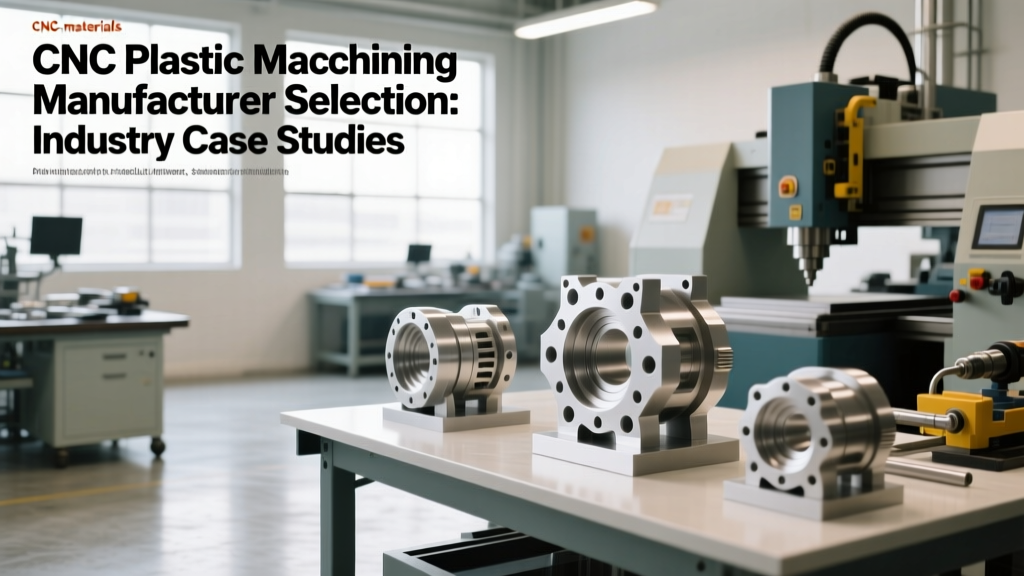
CNC Plastic Machining Manufacturer Selection: Industry Case Studies
Evaluate a CNC plastic machining manufacturer using real-world aerospace, medical, and semiconductor case studies, tolerance data, and sourcing frameworks.
The Physics of Polymer Milling: Why Metal Shops Fail at Plastics
Sourcing a specialized CNC plastic machining manufacturer requires discarding the metal-centric playbook. Polymers possess high coefficients of thermal expansion (CTE), low elastic moduli, and viscoelastic memory. A machine shop that excels at holding tight tolerances on 6061-T6 aluminum will often destroy a $400-per-kilogram block of aerospace-grade PEEK through improper clamping, excessive heat generation, or incorrect tool geometry.
Unlike metals, which dissipate cutting heat into the chips and coolant, plastics act as thermal insulators. Heat concentrates at the cutting edge, causing localized melting, tool welding, and severe dimensional instability. Furthermore, the CTE of engineering plastics dwarfs that of metals. Aluminum expands at roughly 23 µm/m-°C, while PTFE (Teflon) expands at 130 µm/m-°C, and Acetal (Delrin) at 122 µm/m-°C. If a shop floor is 75°F and the metrology lab is 68°F, a 10-inch PTFE component will shrink by approximately 0.003 inches after inspection—a catastrophic failure for semiconductor or aerospace assemblies.
Warning: The 'Bait and Switch' Material TrapWhen vetting a CNC plastic machining manufacturer, explicitly specify the exact polymer grade and filler on your purchase order. Substituting generic 'PTFE' for virgin, low-outgassing PCTFE (Kel-F), or using industrial-grade PEEK instead of Victrex 450G, will result in catastrophic outgassing in vacuum environments or biocompatibility failures in medical implants.
Case Study 1: Semiconductor Wafer Handlers (PCTFE & PTFE)
The Application
In 2026, the semiconductor industry demands ultra-low particulate and low-outgassing materials for 300mm silicon wafer handling. End-effectors and vacuum chucks are frequently machined from PCTFE (Kel-F) due to its superior stiffness compared to PTFE, combined with virtually zero moisture absorption.
The Machining Challenge
PCTFE is highly susceptible to 'cold flow' (creep) under clamping pressure. If a manufacturer uses standard hydraulic vises, the material compresses during machining and springs back when unclamped, ruining flatness tolerances. Additionally, PCTFE is brittle; standard negative-rake carbide end mills will cause micro-chipping along the edges.
The Manufacturer Solution
A qualified manufacturer utilizes custom-machined soft jaws or vacuum workholding to distribute clamping forces evenly. Tooling is restricted to razor-sharp, uncoated micro-grain carbide with high positive rake angles (30° or higher) and large relief angles to shear the material cleanly rather than plowing it. Spindle speeds are kept high (12,000–15,000 RPM) with light radial depth of cut, utilizing compressed air blast—never flood coolant, which can introduce moisture contamination into the vacuum chamber later.
Case Study 2: Aerospace Interior Brackets (Ultem 9085 & PEEK)
The Application
Commercial aerospace manufacturers are aggressively replacing aluminum interior brackets with SABIC Ultem 9085 (PEI) and glass-filled PEEK to reduce airframe weight while maintaining flame, smoke, and toxicity (FST) compliance.
The Machining Challenge: Residual Stress and Warping
Extruded and injection-molded plastic stock contains locked-in residual stresses from the manufacturing process. When a CNC plastic machining manufacturer removes the outer 'skin' of the billet during the roughing pass, the internal stresses are unbalanced. If the shop proceeds immediately to the finishing pass, the part will warp as much as 0.015 inches off the table within hours.
The Manufacturer Solution: Multi-Stage Annealing
Top-tier aerospace manufacturers implement a strict stress-relief protocol. The part is roughed to +0.020 inches over final dimensions, removed from the machine, and placed in a programmable convection oven. For Ultem 9085, this involves a soak at 350°F for two hours, followed by a controlled cooling ramp of no more than 50°F per hour. Only after the part returns to room temperature is it fixtured for the semi-finishing and final finishing passes. This guarantees flatness and true position tolerances within ±0.001 inches.
Evaluating Capabilities: Metal Shop vs. Specialized Plastic Manufacturer
Use this comparison matrix during your supplier audit to separate generalists from true polymer specialists.
| Capability Metric | General Metal Machine Shop | Specialized CNC Plastic Machining Manufacturer |
|---|---|---|
| Coolant Strategy | Flood coolant (causes moisture absorption and swelling in Nylon, PEI, and POM) | Compressed air, mist, or specialized water-soluble synthetic coolants |
| Tooling Selection | Standard TiAlN or AlCrN coated carbide (coatings increase friction and heat) | Uncoated micro-grain carbide, HSS, or CVD diamond-coated for abrasive filled-polymers |
| Inspection Environment | Shop-floor CMM (subject to ambient HVAC fluctuations) | Climate-controlled metrology lab maintained at 20°C ±1°C (68°F) |
| Stress Relief | Rarely performed; parts machined straight from billet | Documented multi-stage annealing SOPs between roughing and finishing |
| Machine Cleanliness | Mixed material runs; metal swarf contamination risk | Dedicated plastic-machining centers with rigorous purging protocols |
Case Study 3: Medical Spinal Implants (PEEK-OPTIMA)
The Application
Interbody spinal fusion cages are increasingly machined from implant-grade PEEK, such as Victrex PEEK-OPTIMA, due to its radiolucency and elastic modulus that closely mimics human cortical bone. As of 2026, raw implant-grade PEEK stock commands premium pricing, often exceeding $850 per kilogram, making scrap reduction a critical economic factor.
The Machining Challenge: Bioburden and Surface Finish
Medical implants cannot harbor bacteria in microscopic tool marks. The CNC plastic machining manufacturer must achieve surface finishes of Ra < 0.4 µm directly off the machine or through validated secondary polishing. Furthermore, the facility must adhere strictly to ISO 13485:2016 quality management standards for medical devices, ensuring full material traceability from the resin pellet to the final sterilized part.
The Manufacturer Solution
Specialists utilize single-flute, mirror-polished O-flute end mills to evacuate chips efficiently and prevent re-welding of the PEEK swarf to the part surface. For complex internal geometries, 5-axis simultaneous milling is employed to maintain optimal tool engagement angles, eliminating the need for secondary bench polishing which can alter critical dimensional tolerances. Cross-contamination is prevented by dedic specific 5-axis mills exclusively to clean-room certified medical polymers.
The 4-Point Audit Framework for Sourcing Plastic Machining Partners
When issuing an RFQ for high-performance polymers, do not rely solely on the manufacturer's ISO 9001 certification. Demand answers to these four technical questions:
- Request their Annealing SOP: Ask for a copy of their standard operating procedure for stress-relieving PEEK and Ultem. If they do not have a documented thermal profile (ramp rates, soak times, cooling rates), disqualify them immediately.
- Audit Swarf Management: Ask how they prevent cross-contamination. A shop machining carbon-fiber-reinforced PEEK on the same Haas VF-2 used for aluminum, without a complete teardown and washdown, will embed metallic and abrasive particles into your virgin PTFE parts.
- Verify Metrology Controls: Ask for the calibration and environmental control logs of their CMM room. High-CTE plastics require inspection at exactly 20°C (68°F). If their CMM sits next to a loading dock door, their inspection data is invalid.
- Run a 'First Article' Stress Test: Before awarding a production contract for $50,000 worth of aerospace components, order a first-article run using a high-CTE, high-stress material like Acetal (Delrin 150). Design a part with aggressive pocketing and thin walls. If they can hold ±0.001 inches on Acetal without warping, they possess the workholding and toolpath expertise to handle your advanced polymers.
'Machining plastic is not about removing material; it is about managing thermal energy and mechanical stress. The moment your cutting edge generates enough heat to soften the polymer matrix, you are no longer machining—you are deforming.'
— Senior Manufacturing Engineer, Aerospace Polymers Division
Navigating Certifications and Industry Standards
For aerospace applications, your chosen CNC plastic machining manufacturer must hold AS9100D certification, which mandates rigorous configuration management and risk-based thinking essential for flight-critical polymer components. In the medical sector, ISO 13485 is non-negotiable. Always verify these certifications directly through the issuing registrar's database, as expired or 'in-process' certifications are common red flags in the supply chain.
Furthermore, when sourcing materials, ensure the manufacturer sources directly from authorized distributors of Victrex PEEK or SABIC Ultem, complete with lot-specific certificates of analysis (CoA). The secondary plastics market is flooded with off-spec, regrind, or improperly cured billets that will pass visual inspection but fail catastrophically under thermal or mechanical load in the field.
Related reading
2026 Technology Trends in Precision CNC Metal Machining