Sourcing CNC Machines in China for Small Workshop Upgrades
Discover how small workshops source CNC machines in China. We analyze real costs, VMC850 specs, hidden import fees, and failure modes for job shops.
Small job shops and prototype manufacturing environments face a brutal capital expenditure reality: domestic and Japanese vertical machining centers (VMCs) routinely exceed $75,000 for a standard 3-axis configuration. To maintain margins without sacrificing work envelope capacity, an increasing number of small workshops are bypassing local dealers and sourcing CNC machines in China directly. This strategy is not without risk, but when executed with rigorous technical vetting, it can reduce initial capital outlay by 50% to 60%. According to industry data tracked by AMT - The Association For Manufacturing Technology, import volumes of mid-range Asian machine tools have steadily shifted from massive production floors to agile, high-mix job shops looking to expand capacity on a budget.
The Economics of Importing: Real Cost Breakdown
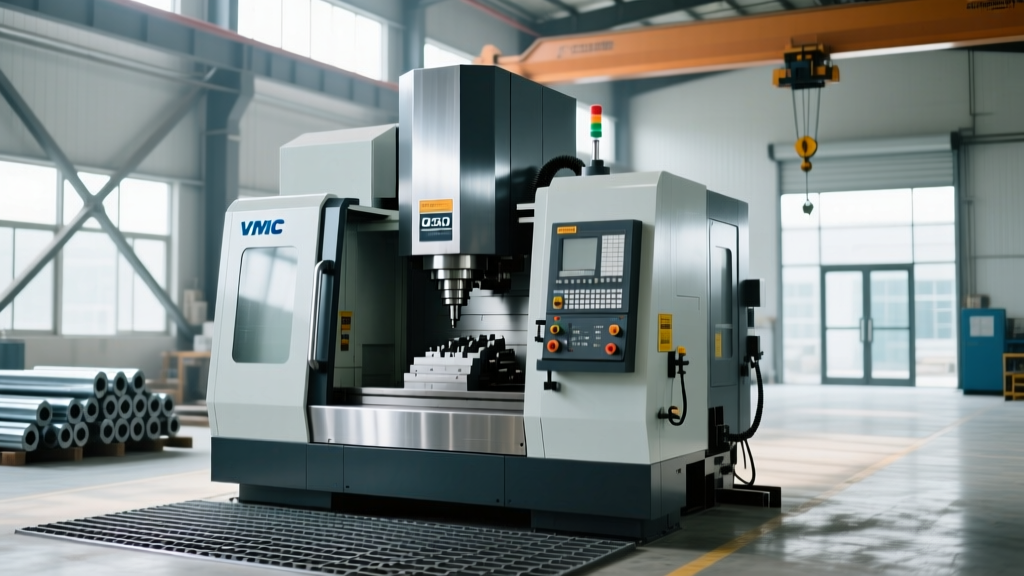
The most common export model from Chinese manufacturing hubs like Shandong and Liaoning provinces is the VMC850. This machine offers an 800x500x500mm work envelope, roughly comparable to a domestic 30x20x20 inch travel machine. However, the sticker price on Alibaba or Made-in-China is merely the starting line. Small workshop owners must calculate the true landed cost to understand the actual ROI.
Warning: Hidden Landed CostsA VMC850 quoted at $19,500 FOB (Free on Board) Qingdao will not arrive at your shop for $19,500. You must factor in ocean freight (FCL/LCL rates), marine insurance, US Customs duties (including active Section 301 tariffs on machine tools, typically 25%), harbor maintenance fees, customs broker fees, and final drayage and rigging to your shop floor. Expect the final landed cost to be 45% to 60% higher than the FOB factory price.
For a standard VMC850 equipped with a Fanuc 0i-MF Plus control, the financial breakdown looks like this in the current market:
- FOB Factory Price: $19,500 - $22,000
- Ocean Freight & Insurance: $2,500 - $3,500
- Tariffs & Customs Duties (25%+): $5,500 - $6,500
- Port Fees, Brokerage & Drayage: $2,000 - $3,000
- Total Landed Cost: $29,500 - $35,000
Compared to a base-model domestic equivalent starting at $65,000 before tooling or chip conveyors, the imported machine still offers a massive capital advantage, provided the shop has the technical acumen to manage the integration.
Case Study: Precision Prototyping Shop Integration
Consider a composite case study of a 12-person precision prototyping shop in the Midwest that integrated two Chinese VMC850s to handle secondary roughing operations, freeing up their high-end 5-axis machines for complex finishing. The shop specifically requested a BT40 spindle taper, linear guideways from Hiwin (Taiwan), and an arm-type 24-tool magazine rather than the standard 16-tool umbrella changer.
The Tooling Taper Gotcha: BT40 vs. CAT40
One of the most critical edge cases when importing Asian machinery is the spindle taper standard. Chinese factories default to BT40 (MAS 403), while North American shops are heavily invested in CAT40 (V-flange). Pull studs and toolholder geometries differ. If a small workshop imports a BT40 machine without realizing it, they must purchase an entirely new inventory of toolholders. Savvy buyers either negotiate a custom CAT40 spindle build with the factory (adding roughly $1,500 and three weeks to lead time) or commit to the BT40 ecosystem, which actually offers slightly better high-speed balancing characteristics for aluminum prototyping.
| Feature | Generic VMC850 (China Import) | Domestic VF-2 Equivalent |
|---|---|---|
| Work Envelope (X-Y-Z) | 800 x 500 x 500 mm | 762 x 406 x 508 mm (30x16x20 in) |
| Spindle Taper & Speed | BT40 / 8,000 RPM (Belt) | CAT40 / 8,100 RPM (Direct Drive) |
| Control System | Fanuc 0i-MF Plus | Proprietary Next Gen Control |
| Rapid Traverse Rates | 24 m/min | 25.4 m/min (1,000 ipm) |
| Tool Changer | 24-Tool Arm Type (Upgraded) | 20+1 Side Mount |
| Estimated Landed Cost | $32,000 - $36,000 | $65,000 - $75,000+ |
| Warranty & Support | 1-Year (Parts only, self-repair) | 1-Year (Full onsite service) |
Navigating the Supply Chain: Direct Sourcing Protocols
Procuring heavy industrial equipment requires a fundamentally different approach than buying consumer goods. The International Trade Administration emphasizes the necessity of rigorous compliance and verification when importing capital equipment. Small workshops must implement a strict pre-shipment protocol to avoid receiving a machine with compromised geometric accuracy.
- Control System Verification: Never accept proprietary or cloned Chinese CNC controls for a professional shop. Mandate genuine Fanuc, Siemens, or Mitsubishi controls. Counterfeit or 'gray market' controls cannot receive firmware updates or local dealer support in North America.
- Third-Party Pre-Shipment Inspection: Hire an independent inspection firm like SGS or Bureau Veritas ($300-$500) to visit the factory before the machine is crated. They must perform a laser interferometer test on the ball screws to verify pitch error compensation and use a dial indicator to check spindle runout under load.
- Electrical Cabinet Audit: Ensure all internal wiring uses standard color codes and that components (contactors, relays, breakers) are from globally recognized brands like Schneider, ABB, or Omron. Obscure domestic Chinese electrical components are impossible to replace locally if they fail.
- Rust Prevention & Crating: Mandate vacuum-sealed foil bagging with heavy-duty desiccants inside the crate. Ocean freight humidity will destroy exposed cast iron and linear rails within three weeks if properly sealed.
Real-World Failure Modes in Budget VMCs
Imported machines do not typically fail catastrophically in the spindle or castings; they fail in the peripherals and sheet metal. Understanding these edge cases allows small workshops to perform proactive maintenance or demand upgrades at the point of sale.
- Way Cover Degradation: Many budget factories use cheap PVC bellows for the X and Y axis way covers instead of polyurethane or steel. PVC becomes brittle when exposed to synthetic coolants and UV light, tearing within 18 months and allowing abrasive swarf to destroy the linear guideway blocks. Always specify steel telescopic covers or high-grade polyurethane.
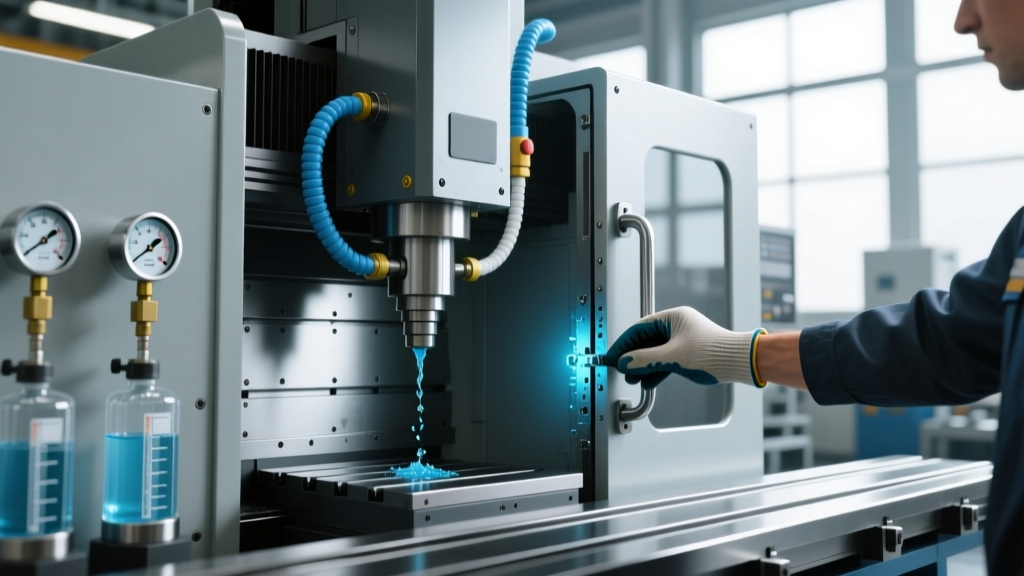
- Coolant Pump Cavitation: Standard Chinese coolant pumps often lack adequate filtration at the suction point. Fine aluminum or cast iron chips bypass the tray, enter the pump, and destroy the impeller. Install an aftermarket paper band filter or a magnetic separator immediately upon commissioning.
- Electrical Cabinet Thermal Failure: The AC cooling units mounted to electrical cabinets are frequently undersized for the heat generated by Fanuc servo drives in warm shop environments. When the cabinet exceeds 45°C, the drives trigger thermal alarms. Upgrading to a higher BTU cooling unit or adding a secondary exhaust fan is a mandatory $400 day-one fix.
- Lubrication System Airlocks: The centralized one-shot lubrication pumps often suffer from poor bleeding at the factory. If the Y-axis ball screw does not receive oil, it will overheat and lose preload within 500 hours. Manually cycle the lube pump and verify oil weeping at every axis wick pad before cutting the first chip.
Decision Framework: Should Your Shop Import?
Sourcing CNC machines in China is not a universal solution. It requires a specific operational profile to be financially and technically viable. Use this framework to determine if an import strategy aligns with your workshop's reality.
'The decision to import a VMC shouldn't be based solely on the purchase price delta. It must be based on your shop's internal mechanical aptitude and your tolerance for downtime. If a machine going down for 48 hours while you source a replacement proximity sensor will cause you to miss a critical aerospace delivery, buy domestic. If you have an in-house maintenance tech who can swap a relay and bleed a lube line, the import route yields massive ROI.' — Senior Manufacturing Analyst, Modern Machine Shop
The 'If/Then' Import Matrix
IF your shop runs 24/7 lights-out manufacturing with strict aerospace or medical ISO tolerances...
THEN avoid imports. The lack of immediate local OEM service support will destroy your uptime metrics. Invest in domestic or Japanese machinery with guaranteed 24-hour service SLAs.
IF your shop operates 8-to-10 hour shifts, handles high-mix/low-volume job shop work, and has personnel capable of basic electromechanical troubleshooting...
THEN importing a VMC850 is a highly strategic move. The machine will easily hold ±0.0005-inch tolerances for standard milling and turning operations, and the capital saved can be reinvested into premium CAM software, high-quality tooling, and advanced workholding, which ultimately dictate part quality more than the machine's cast iron origin.
By treating the sourcing process as a rigorous engineering project rather than a simple e-commerce transaction, small workshops can successfully leverage global supply chains to punch well above their weight class in competitive bidding environments.