Sharp CNC Machine Costs for Stainless Steel in 2026
Analyze 2026 CapEx and OpEx for Sharp CNC machines in stainless steel. Includes pricing, tooling costs, and hidden expenses for 304/316 grades.
The Metallurgical Reality of Machining Stainless Steel
Austenitic stainless steels (300-series) and precipitation-hardening grades (17-4 PH) present a unique thermal and mechanical challenge on the shop floor. Unlike aluminum or mild steel, stainless alloys exhibit low thermal conductivity, high tensile strength, and a severe tendency to work-harden. Heat generated during the cutting process does not dissipate into the chip; instead, it concentrates directly at the cutting edge and the workpiece surface.
When shops evaluate a Sharp CNC machine for a dedicated stainless steel cell, the initial price tag often looks highly attractive compared to premium Japanese or top-tier American brands. However, a rigorous 2026 budget analysis reveals that the base MSRP is only the starting line. Successfully machining 316L or 17-4 PH requires specific machine options, high-pressure coolant delivery, and specialized tooling that fundamentally alter both Capital Expenditure (CapEx) and Operational Expenditure (OpEx).
Capital Expenditure (CapEx): Base Machine vs. Stainless-Ready Configuration
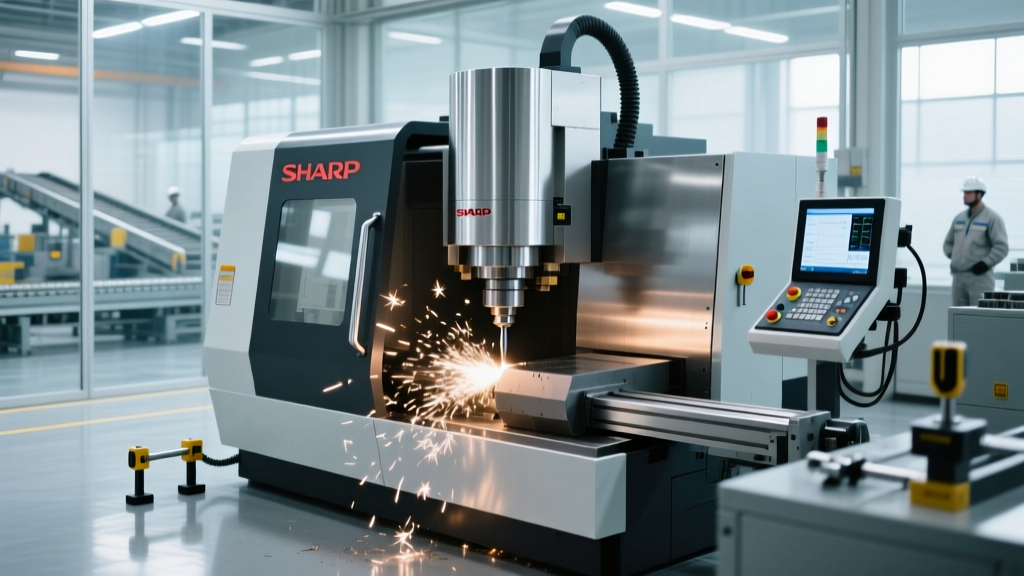
The Sharp SV-510 Vertical Machining Center (VMC) remains a popular mid-tier choice for job shops in 2026. Featuring a 40-taper spindle and a robust cast-iron frame, it provides the necessary mass to dampen the vibrations inherent in heavy stainless milling. However, ordering a 'bare-bones' configuration for stainless steel is a critical budgeting error.
Stringy, abrasive chips and extreme cutting zone temperatures mandate specific factory-installed options. Below is the realistic 2026 CapEx breakdown for a stainless-ready Sharp SV-510.
| Configuration Item | Specification / Requirement | 2026 Estimated Cost |
|---|---|---|
| Base Machine | Sharp SV-510 (10,000 RPM Direct-Drive, Fanuc 0i-F Plus) | $88,500 |
| Through-Spindle Coolant (TSC) | 300 PSI Minimum (Critical for deep hole drilling in 316 SS) | $4,800 |
| Chip Conveyor | Hinge-Belt with Auto-Shutoff (Mandatory for stringy SS chips) | $3,900 |
| High-Pressure Coolant System | 1,000 PSI External Nozzles (For chip breaking in turning/milling) | $7,200 |
| Spindle Chiller Upgrade | High-Capacity Oil Chiller (Prevents thermal growth during long cycles) | $2,400 |
| Installation & Rigging | Local crane, leveling, and power drop (480V 3-Phase) | $3,500 |
| Total CapEx | Fully Equipped for Stainless Production | $110,300 |
While an 8,000 RPM belt-driven spindle is standard and cheaper, machining smaller features in stainless steel requires higher surface speeds to maintain proper chip load and prevent work hardening. The $4,500 premium for a 10,000 RPM direct-drive spindle pays for itself within six months through reduced cycle times and extended insert life on 1/2-inch and smaller endmills.
Operational Expenditure (OpEx): Tooling and Coolant Consumption
The operational costs of running stainless steel on a Sharp CNC machine are roughly 25% to 35% higher than machining 6061 aluminum or 1018 mild steel. This delta is driven almost entirely by tooling wear and coolant maintenance.
Insert and Endmill Economics
Because stainless steel retains heat at the cutting edge, standard uncoated carbide or basic TiN-coated tools will fail catastrophically within minutes. According to Sandvik Coromant's machining material guidelines, austenitic stainless steels require PVD-coated grades with high hot-hardness, such as GC1125 or Iscar's IC908.
- Indexable Endmills: A 2-inch indexable shell mill using specialized stainless inserts will cost approximately $350 for the cutter body and $120 per set of 10 inserts. Expect to index or replace edges every 45–60 minutes of actual cut time in 304 SS.
- Solid Carbide Roughers: For trochoidal milling paths, a 3/4-inch variable-helix solid carbide rougher designed for high-temp alloys costs $140–$180. While expensive, running these at 350 SFM with a 5% radial engagement drastically reduces cutting forces and extends tool life to 90+ minutes.
- Drilling: Standard jobber drills are useless. You must budget $80–$110 per solid carbide internal-coolant drill (e.g., 12xD length) to prevent chip packing in deep holes.
Coolant Formulation and Maintenance
Stainless steel machining demands a high-lubricity, high-cooling semi-synthetic or fully synthetic coolant. Running standard 'general purpose' coolants at 5% concentration will result in poor surface finishes and rapid tool wear.
- Concentration: Maintain an 8% to 10% concentration of a premium fluid like Master Chemical TRIM MicroSol 585XT.
- Tramp Oil Skimming: The Sharp VMC's way lube will inevitably mix with the coolant. Budget $1,200 for an automated disc skimmer to prevent bacterial growth and maintain the coolant's anti-corrosion properties, which are vital for preventing rust on finished 300-series parts.
If your spindle speed drops below 150 SFM during a finishing pass, or if the tool rubs instead of cuts, 304 and 316 stainless will rapidly work-harden. This creates a glass-hard surface layer (up to 50 HRC) that will instantly shatter the cutting edge of the next tool that attempts to engage it. Always program constant tool engagement and never let the machine dwell in the cut.
Hidden Maintenance Costs: Way Covers and Ballscrew Protection
One of the most frequently overlooked line items in a 2026 CNC budget is way cover replacement. Stainless steel chips are notoriously stringy and 'bird-nest' easily. If these chips bypass the telescoping way covers and enter the ballscrew assembly, they act like a grinding paste, destroying the recirculating ball bearings.
Data from Modern Machine Shop industry analyses consistently highlights that premature ballscrew failure in stainless applications is almost always traced back to compromised way seals.
- Preventative Replacement: Budget $1,500 per axis for OEM way cover replacements every 3 to 4 years when running heavy stainless volumes.
- Upgraded Scrapers: Install heavy-duty polyurethane way wipers ($300 per set) to aggressively strip stringy chips off the way covers before they can migrate under the seals.
ROI Framework: Is a Sharp VMC the Right Strategic Fit?
To determine if a Sharp CNC machine is the correct capital allocation for your shop, compare it against the broader market landscape. Data from The Association for Manufacturing Technology (AMT) shows a clear bifurcation in the mid-tier VMC market between value-focused and premium-tier machines.
Decision Matrix for Stainless Steel Cells
| Scenario | Recommended Machine Tier | Financial Rationale |
|---|---|---|
| High-Mix / Low-Volume Job Shop | Sharp SV-Series (Mid-Tier) | Lower initial CapEx allows for faster ROI. Setup times dominate; extreme high-speed rapid rates are less critical than rigidity and baseline accuracy. |
| High-Volume / Dedicated Aerospace Parts | Premium Tier (e.g., Mazak, Makino) | Higher spindle uptime, advanced thermal compensation, and superior chip evacuation justify the 40%+ CapEx premium for 24/7 lights-out machining. |
| Prototyping & R&D | Sharp SV-Series (Mid-Tier) | Excellent cost-to-capability ratio. The Fanuc control and standard 40-taper interface keep tooling and programming costs predictable. |
Final Budgetary Takeaways
Purchasing a Sharp CNC machine for stainless steel in 2026 is a financially sound strategy, provided the budget extends beyond the base MSRP. Allocating an additional $21,800 for through-spindle coolant, high-pressure external nozzles, and a robust chip conveyor transforms a standard mill into a capable stainless production cell. Furthermore, shops must adjust their OpEx forecasts to account for a 30% increase in PVD-coated carbide tooling and the strict 8-10% concentration requirements for semi-synthetic coolants. By planning for these metallurgical realities upfront, manufacturers can achieve a highly profitable per-part margin on even the most demanding 316L and 17-4 PH contracts.