Small Workshop Case Study: Choosing a CNC Vertical Machine Center
Discover how a 1,500 sq ft job shop integrated a CNC vertical machine center. Explore footprint, power, and ROI data for small manufacturing spaces.
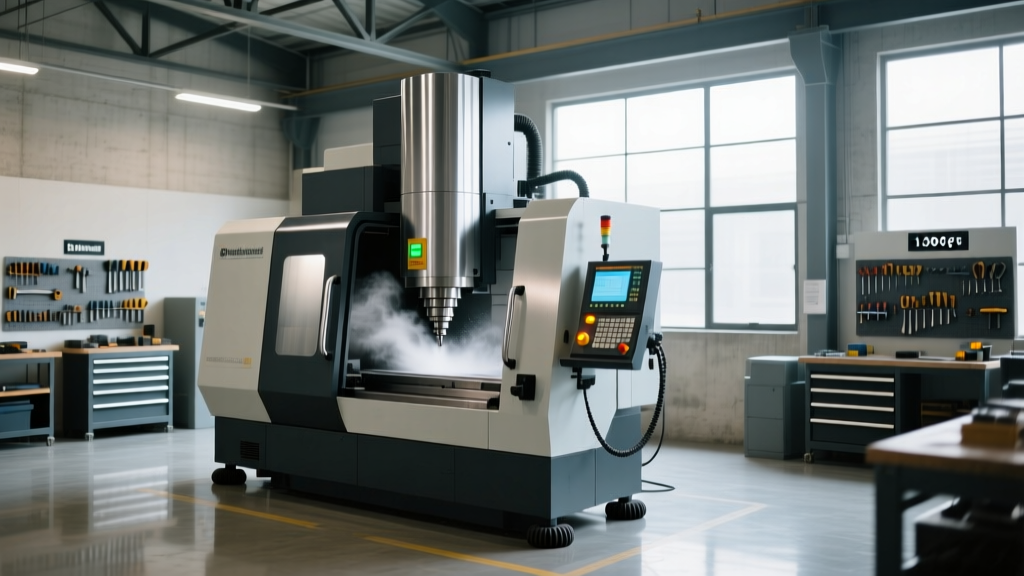
Integrating a production-grade cnc vertical machine center into a small workshop environment (under 2,000 square feet) requires balancing spindle rigidity, axis travel, and physical footprint. Unlike sprawling production facilities, small job shops must account for every square inch, from the machine’s base casting to the swing radius of the operator door and the discharge trajectory of the chip conveyor. This analysis breaks down the spatial, electrical, and financial realities of siting a modern VMC in a constrained environment, drawing on aggregate data from small-to-medium enterprise (SME) manufacturing retrofits.
The Footprint-to-Envelope Ratio: Siting a VMC
The most critical metric for small shops is not just the machine's physical footprint, but the "operational footprint"—the total space required when doors are open, the tool changer is in motion, and the operator is loading a vise. A machine with a compact base might still require 36 inches of rear clearance for maintenance panel access and chip conveyor discharge.
When evaluating a cnc vertical machine center for tight bays, manufacturers must look at the footprint-to-envelope ratio. High-density machines maximize the XYZ travel relative to the floor space they consume. Below is a comparison of three industry-standard VMCs frequently deployed in small-shop environments, reflecting 2026 market configurations and pricing.
| Machine Model | Footprint (W x D) | Work Envelope (XYZ) | Weight | Est. Base Price (2026) |
|---|---|---|---|---|
| Haas VF-2SS | 92" x 86" | 30" x 20" x 20" | 7,800 lbs | $78,000 - $85,000 |
| DMG MORI CMX 600V | 108" x 94" | 23.6" x 22" x 20" | 11,400 lbs | $115,000 - $125,000 |
| Brother Speedio S500X1 | 63" x 95" | 19.6" x 15.7" x 11.8" | 5,950 lbs | $95,000 - $105,000 |
Note: Pricing reflects base models with standard 12,000 RPM spindles and basic chip conveyors. High-pressure coolant and probing packages will add $8,000 to $15,000.
Case Study: Retrofitting a 1,500 Sq. Ft. Job Shop
To illustrate the practical challenges of VMC integration, we examine an aggregate case study based on profiles from the NIST Manufacturing Extension Partnership (MEP), which frequently assists small manufacturers in transitioning from manual to CNC operations. The subject is a 1,500 sq. ft. aerospace job shop replacing two manual Bridgeport mills with a single, high-speed cnc vertical machine center (specifically, a Haas VF-2SS equivalent).
Infrastructure Hurdle: 3-Phase Power and Rotary Converters
Small workshops are often housed in commercial strip malls or older industrial parks equipped only with single-phase 240V power. A standard production VMC requires 3-phase power (typically 230V or 400V) to run the spindle drive, coolant pump, and chip conveyor motors efficiently.
Upgrading the building's electrical service to 3-phase can cost between $15,000 and $40,000, depending on local utility transformer requirements. Instead, the shop utilized a digital rotary phase converter. A 30HP digital converter (such as those from Phase Perfect) costs approximately $4,200 and generates a clean, balanced 3-phase output that protects sensitive CNC servo drives from voltage harmonics. This approach saved the shop $22,000 in upfront infrastructure costs and allowed the machine to be operational within 14 days of delivery.
The Hidden Space Killers: Chip Conveyors and Mist Collectors
When floor-planning a VMC, operators often forget the auxiliary equipment. A standard hinge-belt chip conveyor extends the machine's depth by 24 to 36 inches. In a shop where the back of the machine faces a wall, this is a dealbreaker.
WARNING: Chip Evacuation in Tight SpacesIf rear clearance is less than 48 inches, do not order a standard rear-discharge conveyor. Specify a side-discharge conveyor or a high-capacity flood coolant system with a manual clean-out tray. Side-discharge models require an additional 30 inches of lateral clearance but allow the machine to be pushed within 12 inches of the rear wall for maintenance access.
Furthermore, machining aluminum or steel at 12,000 RPM in an enclosed space generates significant oil mist. Without a roof-mounted mist collector (adding 24 inches to the machine's overall height), the shop's HVAC system will quickly foul, and condensation will form on the shop's ceiling and nearby manual machines. A 1/2 HP centrifugal mist collector requires a dedicated 110V circuit and 4-inch flex ducting routed to the exterior or through a HEPA filtration return.
Financial Breakdown and ROI Timeline
According to industry analyses published by the Society of Manufacturing Engineers (SME), small shops that automate manual milling operations typically see a return on investment within 18 to 24 months, provided spindle utilization exceeds 40%. For our 1,500 sq. ft. case study, the financial breakdown is as follows:
- Machine & Tooling Investment: $92,000 (VMC, phase converter, Kurt vises, Sandvik Coromant tooling, and Renishaw probe)
- Labor Savings: Replaced 1.5 manual machinist shifts. At $65,000/year fully burdened, this yields $97,500 in annual savings.
- Scrap Reduction: Manual milling scrap rate was 6%; VMC scrap rate dropped to 1.2%, saving $8,400 annually in aerospace-grade 6061-T6 and 7075 aluminum.
- Payback Period: 11.4 months.
The true value of the cnc vertical machine center in a small shop is not just speed, but unattended machining. By utilizing the machine's 24+1 tool carousel and integrated probing, the shop was able to run "lights out" batches of aluminum flanges on weekends, effectively increasing their weekly production hours from 50 to 85 without adding floor staff.
Critical Installation Tolerances for Small Bays
Placing a 7,800 lb machine in a small, potentially older building requires strict attention to floor loading and rigging logistics. The Haas VF Series installation guidelines and similar OEM manuals dictate specific foundational requirements that small shop owners frequently overlook.
Floor Loading and Point Pressure
A standard 4-inch thick concrete slab rated at 3,000 PSI can support a VMC, but the issue is point loading. If a 7,800 lb machine rests on four 4-inch square leveling feet, the pressure at each foot exceeds 480 PSI. If the machine is placed near a slab edge or over an unreinforced control joint, the concrete will spall or crack over time due to dynamic vibration during heavy roughing cuts.
Actionable Fix: Always place 12" x 12" x 1" steel load-distribution plates under the leveling feet if the machine is sited on a standard 4-inch slab. For machines exceeding 10,000 lbs, core-drilling to verify slab thickness and pouring isolated 12-inch deep concrete pads is mandatory to prevent geometric twisting of the machine casting over a 5-year period.
Rigging and Forklift Clearances
Small shops often have low-clearance roll-up doors (typically 10 to 12 feet high). A VMC on a skid can easily reach 108 inches in height. Before ordering, verify the "travel height" of the machine on its shipping skid. If the door clearance is tight, the machine must be un-skidded outside and rolled in on heavy-duty skate rollers. Ensure the shop floor is swept and degreased; skate rollers will slip on oil-saturated concrete, creating a severe crush hazard in narrow aisles.
Decision Framework: Is a VMC Right for Your Footprint?
Small Shop VMC Selection Matrix
Choose a Compact 3-Axis VMC (e.g., Brother Speedio, Haas Mini Mill) if:
- Your primary materials are aluminum, brass, or mild steel.
- Your shop ceiling clearance is under 10 feet.
- You rely on single-phase 240V power and want to avoid 30HP phase converters.
- Batch sizes are high (100+ parts), and cycle time reduction is the primary ROI driver.
Choose a Mid-Size Production VMC (e.g., Haas VF-2/3, DMG CMX) if:
- You machine titanium, Inconel, or deep-pocket steel parts requiring high torque and rigidity.
- You have a dedicated 3-phase power drop or space for a large rotary converter.
- You require a 4th-axis rotary table (trunnion or index) which consumes significant Y-axis travel.
- Floor space allows for a 4-foot rear maintenance corridor and side-discharge chip conveyor.
Integrating a cnc vertical machine center into a small workshop is a highly calculated exercise in spatial geometry and electrical engineering. By prioritizing the operational footprint over the base casting dimensions, investing in clean digital phase conversion, and addressing point-loading on concrete slabs, small job shops can unlock enterprise-level production capabilities without requiring a facility expansion.