CNC Robotic Machine Accuracy: Budgeting for Tight Tolerances
Analyze the true cost of achieving tight tolerances with a CNC robotic machine. Compare CapEx, calibration OpEx, and ROI for precision robotic machining.
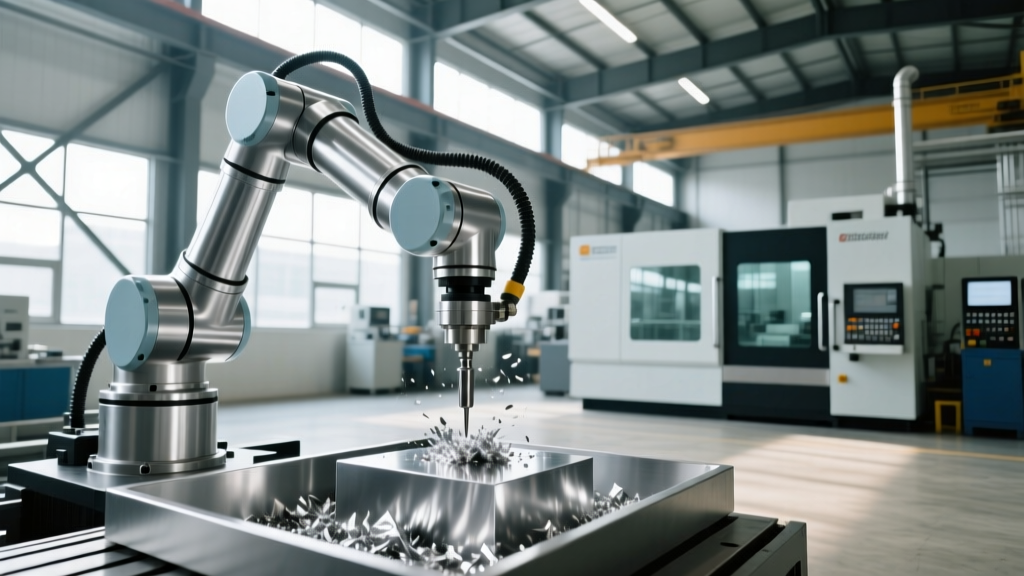
Integrating a 6-axis articulated arm with a high-speed spindle creates a highly flexible cnc robotic machine, capable of trimming composites, milling foam, and drilling aluminum. However, manufacturing buyers frequently encounter a harsh reality when reviewing budget proposals: achieving standard CNC-mill tolerances (±0.01mm) on a robotic arm designed primarily for material handling requires substantial capital and operational investment. A standard robot arm is not a plug-and-play replacement for a 5-axis vertical machining center (VMC).
When planning a 2026 automation budget, shop owners and manufacturing engineers must look beyond the base price of the robotic arm. The true cost of precision lies in kinematic calibration, structural stiffening, thermal compensation, and specialized tooling. This guide breaks down the exact CapEx and OpEx requirements to achieve tight tolerances with robotic machining cells.
The Metrology Gap: ISO 9283 Explained
According to the ISO 9283 standard for manipulating industrial robots, performance is split into two distinct metrics:
- Pose Repeatability (RP): The robot's ability to return to the exact same taught position. Standard industrial robots excel here, often achieving ±0.02mm.
- Pose Accuracy (AP): The robot's ability to reach a specific coordinate in 3D space commanded by the software. Out-of-the-box accuracy is typically poor (±0.50mm to ±1.50mm) due to kinematic chain errors, gear backlash, and link compliance.
Budgeting Insight: You are paying to close the gap between high repeatability and low absolute accuracy.
Capital Expenditure (CapEx): Base Models vs. High-Precision Cells
The baseline cost of a 50kg-payload robot arm (such as the FANUC M-710iC/50 or KUKA KR 60-3) ranges from $45,000 to $65,000. However, this bare arm cannot hold machining tolerances. To build a viable CNC robotic machine, you must budget for a fully integrated precision cell.
| System Tier | Tolerance Capability | Estimated Cell CapEx | Key Hardware Additions |
|---|---|---|---|
| Entry-Level (Routing/Trimming) | ±0.50mm | $85,000 - $110,000 | Base robot, standard ER collet spindle, basic CAM post-processor. |
| Mid-Tier Calibrated | ±0.15mm | $140,000 - $185,000 | Kinematic calibration software, shrink-fit tooling, stiffened EOAT, laser tracker rental. |
| High-Precision Active | ±0.05mm | $220,000 - $300,000+ | Absolute encoders, active force-compliance (PushCorp), real-time thermal compensation, external linear axes. |
Operational Expenditure (OpEx): The Hidden Costs of Calibration
Unlike a cast-iron VMC that maintains its geometric accuracy for decades, a robotic arm's accuracy degrades. Gear wear, minor collisions, and ambient temperature fluctuations alter the robot's kinematic model. Maintaining tight tolerances requires a strict calibration OpEx budget.
Laser Tracker Calibration Intervals
To map the robot's actual kinematic behavior and update the controller's error map, facilities use laser trackers like the Faro Vantage or API Radian. These devices measure the robot's tool center point (TCP) across hundreds of spatial coordinates to identify link-length and joint-offset errors.
- Purchase Cost: $120,000 to $180,000 per unit.
- Rental Cost: $2,500 to $4,000 per week.
- Frequency: High-precision cells require full kinematic recalibration every 3 to 6 months, or immediately following any end-effector collision.
Robotic links expand and contract with ambient shop floor temperatures. A 2-meter robot arm made of cast aluminum or steel can experience TCP shifts of up to 0.10mm with a 5°C change in room temperature. If your facility lacks strict HVAC climate control, budget for real-time thermal compensation sensors or accept a looser tolerance band.
Software and Post-Processing Licenses
Standard robot controllers do not natively interpret complex 5-axis G-code. You must budget for specialized robotic machining software. RoboDK and Siemens Run MyRobot are industry standards for simulating toolpaths, managing singularity avoidance, and generating native robot code. Expect to pay between $5,000 and $8,500 for perpetual machining add-on licenses per cell, plus annual maintenance fees of roughly 15%.
Mitigating Cutting Force Deflection
The most significant barrier to CNC-level accuracy in robotics is structural stiffness. A standard 5-axis VMC weighs 10,000+ lbs and features rigid linear guideways. A 6-axis robot relies on rotary joints and harmonic drives, making it highly susceptible to deflection under cutting loads.
According to research from the National Institute of Standards and Technology (NIST) on robotic machining, cutting forces cause the robot's links to bend, resulting in dimensional errors and severe chatter marks on the workpiece. To maintain ±0.10mm tolerances in aluminum, you must limit radial cutting forces to under 150N.
Budgeting for Active Compliance
If your application requires higher cutting forces or inconsistent part geometries (common in castings or composite trimming), passive stiffness is insufficient. You must budget for active end-of-arm tooling (EOAT):
- Force-Torque Sensors: ATI Industrial 6-axis F/T sensors ($8,000 - $12,000) allow the robot to 'feel' cutting forces and adjust its path in real-time.
- Active Compliance Devices: PushCorp passive and active compliance units ($15,000 - $25,000) mechanically decouple the spindle from the robot arm, maintaining constant tool pressure against the part surface regardless of minor robotic positional errors.
Tooling: Where Microns are Won or Lost
A $250,000 calibrated robotic cell will fail to hold ±0.05mm tolerances if paired with low-grade tooling. Standard ER collet chucks introduce radial runout (often 0.01mm to 0.03mm) that compounds the robot's inherent kinematic inaccuracies. Furthermore, the extended stick-out lengths required for robotic EOAT act as a lever, amplifying vibration.
Actionable Tooling Budget Rules:
- Mandate Shrink-Fit Holders: Budget $150 to $300 per Haimer or Lyndex-Nikken shrink-fit holder. They provide superior radial stiffness and balance (G2.5 at 25,000 RPM) compared to mechanical collets.
- Short-Gage Lengths: Design custom EOAT that positions the spindle as close to the robot's faceplate as physically possible. Every 50mm of added Z-height reduces the robot's payload capacity and stiffness by roughly 15%.
- Tool Breakage Detection: Because robots lack the enclosed, high-pressure coolant environments of VMCs, tool wear accelerates. Integrate non-contact laser tool setting systems (e.g., Renishaw NC4) to automatically update tool length offsets mid-cycle ($12,000 - $18,000).
Decision Framework: Robot vs. 5-Axis VMC
Before approving the CapEx for a CNC robotic machine, run your application through this decision matrix to verify ROI.
"Robots win on volume and reach; VMCs win on precision and heavy metal removal. If your part fits inside a 1-meter cube, requires heavy roughing passes in steel, and demands ±0.01mm tolerances, buy a VMC. If your part is a 3-meter aerospace composite panel requiring light trimming and hole-drilling at ±0.15mm, the robotic cell yields a 40% faster ROI due to reduced fixturing and unlimited work envelope."
Summary Checklist for 2026 Budget Planning
- [ ] Base Robot: Specify high-payload models (minimum 2x the calculated cutting force requirement) to maximize joint stiffness.
- [ ] Calibration CapEx: Allocate $15,000 for initial third-party kinematic calibration services and software licenses.
- [ ] Calibration OpEx: Budget $12,000 annually for laser tracker rentals and recalibration downtime.
- [ ] Tooling: Eliminate ER collets from the budget; allocate funds exclusively for shrink-fit and hydraulic chucks.
- [ ] Environment: Include HVAC upgrades or thermal enclosure costs to maintain a ±2°C ambient temperature around the cell.
By accurately forecasting the metrology, software, and mechanical stiffness requirements, manufacturers can successfully deploy CNC robotic machines that bridge the gap between flexible automation and strict aerospace or automotive tolerance standards.