Rotary CNC Machine Vibration Damping: Pads vs Active Mounts
Compare passive pads, tuned mass dampers, and active mounts for rotary CNC machine vibration damping. Find the best noise reduction setup for your shop.
The Asymmetric Mass Problem in 4th-Axis Machining
Integrating a rotary CNC machine setup—such as a Haas HRT310 or Tsudakoma RN-170 trunnion table—fundamentally alters the dynamic stiffness of your milling center. Unlike standard 3-axis work, a loaded 4th-axis rotary table introduces an asymmetric, constantly shifting center of gravity. As the platen rotates, the mass distribution changes, causing the system's natural resonant frequency to drift. This drift frequently aligns with the spindle's tooth-pass frequency, resulting in severe regenerative chatter, accelerated tool wear, and operator noise exposure routinely exceeding 95 dBA.
OSHA Compliance Alert: According to OSHA noise standards, the Permissible Exposure Limit (PEL) is 90 dBA over an 8-hour time-weighted average, but the Action Level triggers mandatory audiometric testing at just 85 dBA. Unmitigated chatter on a rotary CNC machine easily breaches the 90 dBA threshold at the operator console.To eliminate chatter and reduce acoustic emissions, shops must decouple the rotary table from the machine casting or damp the harmonic energy. Below is a technical comparison of the three primary damping alternatives: passive elastomeric pads, tuned mass dampers (TMD), and active piezoelectric mounts.
Technology Comparison Matrix
| Damping Technology | Cost per Setup | Target Frequency | Setup Complexity | Best Application |
|---|---|---|---|---|
| Sorbothane / Neoprene Pads | $150 - $400 | > 30 Hz (High-Frequency) | Low (Drop-in) | General job shop milling, light aluminum/steel |
| Eddy-Current Tuned Mass Dampers | $2,500 - $6,000 | 10 Hz - 40 Hz (Low-Frequency) | High (Requires FFT tuning) | Aerospace titanium/Inconel, heavy interrupted cuts |
| Active Piezoelectric Mounts | $12,000 - $25,000 | Broadband (0.5 Hz - 200 Hz) | Medium (Auto-calibrating) | Medical micromachining, optical mold finishing |
Alternative 1: Passive Elastomeric Isolation Pads
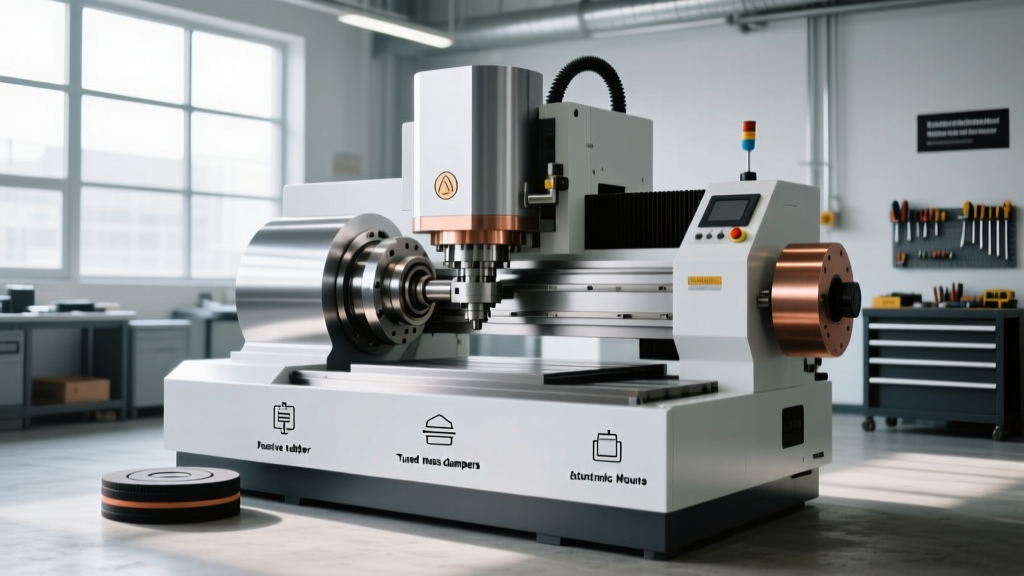
Passive pads are the most common entry-level solution for rotary CNC machine noise reduction. They function by introducing a compliant layer between the rotary table base and the milling machine's T-slot bed. Sorbothane is the industry benchmark here, capable of dissipating up to 94.5% of vibrational energy as heat.
The Durometer Selection Trap
Most shops fail with passive pads because they select the wrong durometer (hardness). The durometer must be matched to the static load of the rotary table and the frequency of the chatter.
- 50 Durometer (Shore A): Ideal for high-frequency spindle whine and lightweight rotary setups (under 200 lbs total). Excellent for finishing passes in aluminum where chatter occurs above 80 Hz.
- 70 Durometer (Shore A): Required for heavy 4th-axis setups, such as a 350 lb tombstone fixture on a 500mm platen. If you use 50A pads under a 700 lb load, the elastomer will 'bottom out' (compress to its solid height), creating a rigid metal-to-metal connection that transmits 100% of the vibration.
Alternative 2: Tuned Mass Dampers (TMD)
When passive pads fail to stop low-frequency 'rumble' (typically 15 Hz to 40 Hz) caused by heavy interrupted cuts on a rotary CNC machine, Tuned Mass Dampers are the required alternative. As detailed in Sandvik Coromant's vibration troubleshooting guide, low-frequency chatter is deeply destructive to carbide end mills and inserts.
A TMD consists of a secondary mass suspended by springs and dampers (often utilizing eddy-current magnetic damping to avoid mechanical wear). The mass is mathematically tuned to vibrate exactly 180 degrees out of phase with the primary resonance of the rotary table.
Real-World Tuning Protocol
- Mount the Accelerometer: Attach a tri-axial ICP accelerometer to the rotary table platen using a magnetic base or cyanoacrylate adhesive.
- Impact Testing: Strike the platen with a calibrated modal hammer while the machine is idle. Record the ring-down using an FFT (Fast Fourier Transform) analyzer.
- Identify the Peak: Locate the dominant low-frequency peak. For a loaded trunnion table, this is frequently around 38 Hz.
- Tune the TMD: Adjust the spring stiffness on the TMD unit until its natural frequency matches the 38 Hz peak. Once engaged, the TMD absorbs the kinetic energy, flattening the FFT peak and eliminating the audible rumble.
Alternative 3: Active Piezoelectric Isolation Systems
For high-precision environments where tolerances are held to sub-micron levels (e.g., machining optical molds or medical implants on a 5-axis rotary CNC machine), passive and tuned systems are insufficient. Active vibration cancellation systems use piezoelectric actuators paired with real-time accelerometers.
These systems sample the vibration profile at up to 10,000 Hz. When the sensor detects an incoming harmonic wave from the spindle or rotary axis servo motor, the piezoelectric actuator physically expands and contracts in sub-millisecond intervals to generate an exact counter-wave. This results in near-zero relative motion between the cutting tool and the workpiece.
Cost vs. Benefit Analysis
Active mounts represent a massive capital expenditure, often costing between $12,000 and $25,000 per axis. However, the ROI is justified in specific scenarios:
- Surface Finish Requirements: Eliminates the 'micro-chatter' marks that require secondary manual polishing on mold cavities.
- Tool Life Extension: Prevents micro-chipping on diamond-coated or CBN inserts used in hardened steels, extending tool life by 40% to 60%.
- Dynamic Shifting: Unlike TMDs, which are tuned to a single frequency, active mounts adapt instantly as the rotary table shifts the workpiece mass during a multi-hour cycle.
Acoustic Enclosures: Treating the Airborne Noise
While damping mounts treat structure-borne vibration (chatter), they do not block airborne noise generated by the cutting action itself or the rotary axis brake mechanisms. To achieve full OSHA compliance, structural damping must be paired with acoustic absorption.
Do not use standard egg-crate polyurethane foam inside your CNC enclosure. Polyurethane degrades rapidly when exposed to water-soluble coolants and way oils, turning into a sticky, ineffective sludge within six months. Instead, specify hydrolysis-resistant melamine foam or micro-perforated aluminum acoustic panels. Melamine foam offers an NRC (Noise Reduction Coefficient) of 0.90 and is inherently fire-resistant and impervious to synthetic cutting fluids.
Final Procurement Directives
Selecting the correct noise and vibration reduction system for your rotary CNC machine requires matching the technology to your specific cutting mechanics and budget.
Decision Framework
- Choose Passive Pads IF: Your budget is under $500, you primarily machine aluminum or mild steel, and your chatter is a high-pitched 'squeal' occurring during light finishing passes.
- Choose Tuned Mass Dampers IF: You are performing heavy roughing in titanium or stainless steel, the chatter is a low-frequency 'growl' that shatters carbide end mills, and you have the technical capability to perform FFT impact testing.
- Choose Active Piezo Mounts IF: You are a Tier-1 aerospace or medical supplier holding sub-5-micron tolerances on complex 5-axis rotary contours, and secondary polishing operations are creating a production bottleneck.
Frequently Asked Questions
Can I use standard hockey pucks as vibration isolators under my rotary table?
No. While vulcanized rubber hockey pucks provide some isolation, they lack the viscous damping properties of engineered elastomers like Sorbothane. Rubber stores and returns vibrational energy (acting like a spring), which can actually amplify resonance at specific RPMs. Sorbothane converts the energy to heat, effectively killing the vibration.
Does adding isolation pads reduce the machining accuracy of the rotary axis?
If correctly specified, no. The primary risk is 'static deflection'—if the pad is too soft, the heavy cutting forces will push the rotary table slightly off-axis. This is why calculating the static load per square inch and selecting a 70 or 80 durometer pad for heavy rotary tables is critical to maintaining geometric accuracy.
How often do elastomeric damping pads need to be replaced?
In a standard 2-shift machine shop environment exposed to water-soluble coolants, Sorbothane or neoprene pads should be inspected every 12 months and replaced every 24 to 36 months. Coolant saturation causes the elastomer to swell, lose its durometer rating, and eventually crack. Keep the base of the rotary table as dry as possible using targeted air blasts to extend pad life.