Field Safety Compliance for Portable Titanium CNC Machine Use
Master safety standards and NFPA 484 compliance for portable titanium CNC machine field work. Mitigate fire risks and ensure OSHA adherence on-site.
The Extreme Hazard of Field-Machining Titanium Alloys
Deploying a portable titanium CNC machine for on-site aerospace repairs, pipeline flange facing, or marine shaft modifications introduces severe safety variables not present in controlled factory environments. Titanium alloys, particularly Ti-6Al-4V (Grade 5), are notoriously difficult to machine due to their low thermal conductivity. In a portable field setup, the heat generated at the cutting edge is not easily dissipated, leading to rapid work hardening, tool wear, and the generation of highly combustible swarf and fines.
⚠️ CRITICAL FIRE HAZARD: Titanium fines and thin chips can ignite spontaneously at temperatures as low as 1,200°F (649°C) when exposed to air or oxygen. Once ignited, titanium burns at approximately 5,000°F (2,760°C) and will violently react with water, nitrogen, and carbon dioxide. Standard ABC fire extinguishers will exacerbate a titanium fire.When operating portable CNC milling or drilling rigs—such as the Mirage Machining Systems MM3000 or Climax BB5000 series—safety officers must enforce strict adherence to combustible metal standards. The uncontrolled nature of field work means that standard shop-floor enclosures and automated chip conveyors are absent, requiring rigorous manual protocols to prevent catastrophic deflagration.
NFPA 484 Compliance Matrix for Mobile Operations
The National Fire Protection Association (NFPA) 484 serves as the definitive standard for the production, processing, and handling of combustible metals. While NFPA 484 is primarily written for fixed facilities, its core tenets regarding combustible dust and swarf management are legally enforceable under OSHA’s General Duty Clause for field operations.
| Compliance Area | NFPA 484 Requirement | Portable Field Execution Protocol |
|---|---|---|
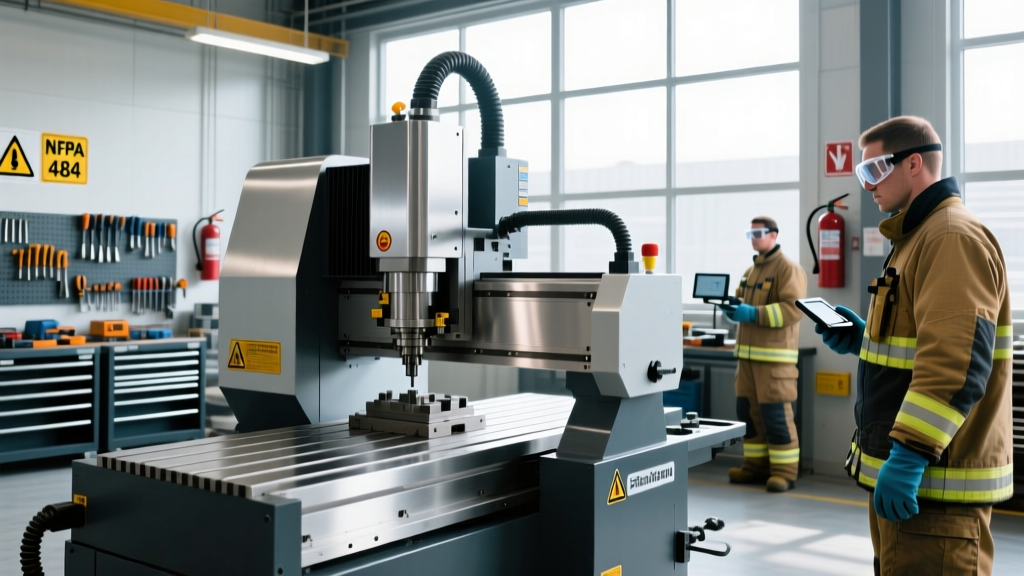
| Fire Suppression | Appropriate Class D extinguishing agents readily available. | Minimum two 30-lb Class D (Met-L-X or G-1) extinguishers positioned within 15 feet of the portable CNC footprint. |
| Swarf Accumulation | Metal dust and chips must not be allowed to accumulate. | Continuous manual vacuuming using HEPA-filtered, explosion-proof vacuums. Never use compressed air to blow chips. |
| Housekeeping | Combustible materials kept away from machining zones. | Establish a 20-foot clear zone around the portable rig. Cover all nearby grating or porous surfaces with fire-retardant welding blankets. |
| Hot Work Permits | Authorization required for spark-producing activities. | Treat all portable titanium CNC operations as Hot Work. Require a dedicated fire watch for the duration of the cut plus 60 minutes post-operation. |
Coolant Chemistry and Hydrogen Gas Mitigation
Selecting the correct metalworking fluid (MWF) for a portable titanium CNC machine is a matter of chemical safety, not just tool life. Titanium reacts exothermically with water at high temperatures. If water-based coolants are used and the cutting zone dries out—a common occurrence in portable setups where flood coolant pumps may struggle to maintain pressure against gravity—the resulting reaction between hot titanium fines and water produces hydrogen gas.
The Hydrogen Deflagration Risk
Hydrogen gas is highly flammable and can ignite from the ambient heat of the cutting zone or a stray spark from the spindle motor. To mitigate this, field safety protocols dictate the following coolant parameters:
- Straight Oils (Neat Oils): Preferred for portable field work on titanium. Heavy-duty straight oils (e.g., Castrol Iloform or equivalent chlorinated/ester-based oils) eliminate the water-hydrogen reaction risk entirely. However, they require strict fire-watch protocols due to the oil's own flash point.
- Water-Soluble Synthetics: If straight oils are prohibited by the site owner due to environmental containment rules, you must use a high-lubricity synthetic coolant mixed at a strict minimum 5:1 (water-to-concentrate) ratio. The high water content acts as a heat sink, but only if continuous flood coverage is guaranteed.
- Minimum Flow Rates: Portable coolant pumps must deliver a minimum of 2.5 GPM (Gallons Per Minute) directly at the tool tip. Low-pressure misting or spray-mist systems are strictly prohibited for titanium field machining.
Equipment Grounding and Stray Voltage Protocols
Portable CNC machines are often bolted directly to the workpiece (e.g., a titanium valve body or aircraft structural member) using magnetic bases or mechanical clamps. In field environments, the workpiece itself may not be adequately grounded to the earth, creating a floating electrical potential.
If the portable CNC's spindle motor or servo drives experience a ground fault, the electrical current will seek the path of least resistance through the cutting tool and into the workpiece. This stray voltage creates micro-arcs at the tool-workpiece interface. In titanium machining, these micro-arcs instantly ignite the surrounding swarf.
Grounding Verification Step: Before powering on the portable CNC control panel, the safety officer must use a digital multimeter to measure the resistance between the machine chassis and the earth ground. The resistance must read less than 1.0 ohm. Additionally, a physical copper grounding strap (minimum 4 AWG) must be bolted directly from the portable machine base to a verified earth ground rod or the facility's structural grounding grid.Air Quality and OSHA PEL Compliance
Beyond fire hazards, machining titanium generates airborne particulates. The Occupational Safety and Health Administration (OSHA) enforces strict Permissible Exposure Limits (PEL) for airborne dust. According to OSHA's combustible dust guidelines and general air quality standards, titanium dioxide dust and metallic titanium fines pose both respiratory and secondary explosion hazards.
In a field setting, you cannot rely on the facility's central HVAC system. Portable Local Exhaust Ventilation (LEV) units equipped with HEPA filters and explosion-proof motors must be positioned within 12 inches of the cutting zone. The capture velocity at the hood must exceed 200 feet per minute (FPM) to effectively pull heavy titanium fines out of the air before they settle on horizontal surfaces, where they become a secondary fire hazard.
Step-by-Step Field Safety Audit Checklist
Safety managers overseeing portable titanium CNC machine deployments must complete this audit prior to the first spindle start:
- Zone Isolation: Verify a 20-foot radius around the machine is cleared of all combustible materials, including cardboard, wooden pallets, and standard hydraulic fluids.
- Fire Watch Assignment: Designate a dedicated fire watch personnel equipped with a Class D extinguisher and a thermal imaging camera to monitor the workpiece temperature post-cut.
- Grounding Test: Confirm < 1.0 ohm resistance between the portable CNC chassis, the workpiece, and true earth ground.
- Coolant Verification: Test coolant concentration with a refractometer. Ensure water-based fluids are not exceeding a 10:1 dilution ratio to maintain adequate thermal mass.
- Chip Evacuation Plan: Confirm the presence of an explosion-proof vacuum system. Verify that operators are explicitly briefed to never use compressed air blow-guns to clear titanium chips.
- Toolpath Review: Ensure the CNC program avoids dwell times. Tool dwell in titanium causes rapid heat buildup and spontaneous ignition. Feed rates must remain constant and aggressive enough to carry heat away in the chip.
Expert Insight on Heat Management
'The biggest mistake field technicians make with portable titanium CNC rigs is treating them like steel machining centers. You cannot stop the spindle to take a measurement without risking a fire. The moment the tool stops moving but remains in contact with the titanium, the friction heat spikes, and the fines ignite. Program your toolpaths to retract completely into the coolant stream before pausing, and never leave a portable rig unattended while the spindle is engaged.'
— Senior Field Repair Engineer, Aerospace Mobile Machining Division
Adhering to these rigorous safety standards transforms the volatile process of field-machining titanium from an uncontrolled hazard into a managed, compliant engineering operation. By prioritizing NFPA 484 compliance, strict coolant chemistry management, and verified electrical grounding, safety officers can ensure that portable titanium CNC machines deliver vital on-site repairs without compromising personnel safety or facility integrity.